Beyond Reacting How Advanced AI Models Are Forecasting the Future of SEO

Beyond Reacting: How Advanced AI Models Are Forecasting the Future of SEO
Keeping up with Google’s algorithm feels like a never-ending chase. Just when you’ve optimized for the last core update, whispers of the next one begin, forcing you back into a reactive cycle of analysis and adjustment. But what if you could stop chasing the algorithm and start anticipating its next move?
This isn't a far-off possibility; it's the new strategic imperative. The SEO landscape is fundamentally shifting from a reactive discipline to a predictive science, powered by the same advanced AI that drives search engines themselves. For businesses and agencies evaluating their next strategic investment, understanding these forecasting models is no longer optional—it's the key to securing a lasting competitive advantage.
This article moves beyond the headlines to explain the mechanics of predictive SEO. We'll explore how these AI models work, what trends they are shaping, and how you can leverage them to future-proof your growth.
The New Reality: Data-Driven Urgency in SEO
The conversation around AI in marketing has moved from theoretical to tangible, with clear data points highlighting its impact. The AI marketing industry is not just growing; it's exploding, with projections showing a leap from $20.4 billion in 2024 to $82.2 billion by 2030.
This growth is fueled by undeniable performance metrics. For instance, AI search traffic converts at 4.4 times the rate of traditional organic search, creating a powerful commercial incentive to get this right. We're already seeing this play out in the SERPs. Since Google's recent core updates, the presence of AI Overviews has surged by 115%. While these features can decrease traditional organic clicks by 18-64%, the game is far from over. Data shows 49% of users still click the classic blue links after reading an AI summary, proving that a top organic spot remains prime real estate.
This new environment has driven rapid adoption, with 86% of SEO professionals now using AI in their daily workflows. It’s a clear signal that the industry is embracing AI not as a replacement for human expertise, but as an essential tool for augmenting it. The goal is to create better, more resonant content that anticipates what both users and algorithms want to see next.
From Historical Updates to Predictive Intelligence
For years, SEO strategy has been informed by looking in the rearview mirror. We analyzed historical algorithm updates—from broad core updates to spam rollouts—to understand Google's priorities. Authoritative sites like Search Engine Journal and Search Engine Land provide exhaustive timelines, which are invaluable for context. But Google's own evolution into an AI-first company means this historical approach is no longer enough.
Ranking systems like RankBrain, BERT, and now Gemini use sophisticated AI to understand context and intent in ways previous algorithms couldn't. Google itself states that its focus is on rewarding "helpful, reliable, people-first content." This philosophy, often discussed through the lens of E-E-A-T, requires a deeper level of strategic foresight.
Because Google uses AI to evaluate content, strategists must use AI to predict those evaluations. This is where advanced forecasting models come into play, shifting the focus from "what happened?" to "what will happen next?"
The Mechanics of Predictive Power: How AI Forecasts SEO Trends
Predictive AI models don't just guess; they perform sophisticated analysis on massive, diverse datasets to identify patterns that signal future change. They act as an early warning system for the entire search ecosystem.
The process starts with data ingestion. These models connect to a wide array of sources:
- First-Party Data: Google Search Console, analytics platforms.
- Market Data: Google Trends, industry news signals, social media conversations.
- SERP Data: Real-time and historical ranking changes, competitor movements.
- Query Data: Shifts in autocomplete suggestions, "People Also Ask" boxes, and related searches.
Using this data, the models apply several specific techniques to forecast trends:
Core Prediction Methodologies
- Volatility Forecasting: This technique monitors SERP instability. By tracking unusual ranking fluctuations across an industry, the model can predict an impending algorithm update or a major shift in how Google is evaluating content for a specific set of keywords. It helps you brace for impact before it happens.
- Emerging Query Detection: Before a topic trends, user search behavior changes subtly. This model analyzes shifts in autocomplete suggestions and the emergence of new subtopics in search results to identify rising trends. It allows you to create content for demand that doesn't fully exist yet.
- Intent Modeling: This goes beyond the keyword to predict how user needs are evolving. For example, is the intent for a query shifting from informational ("what is X") to transactional ("buy X")? This allows you to adjust your content to match the user's position in the buying journey.
- Competitor Disruption Modeling: The model tracks the content velocity, backlink acquisition, and ranking trajectories of your key competitors. This allows it to forecast when a competitor is likely to overtake you for a target keyword, giving you time to mount a strategic defense.

Measuring the ROI of Foresight
Adopting a predictive model isn't just an academic exercise; it delivers measurable business outcomes. Predictive SEO tools have demonstrated:
- 89.8% accuracy in forecasting user conversion patterns.
- 82% accuracy in sentiment analysis around brands and topics.
- 91% accuracy in predicting how information will spread through online networks.
For businesses, this translates into significant gains. Marketers who leverage predictive keyword analytics report up to 45% higher organic growth and 38% faster ranking recovery after negative algorithm impacts. They are not just surviving algorithm updates; they are thriving through them.
Platforms like Fonzy AI are built on this forward-thinking principle, integrating AI not just for content creation, but for the underlying strategy that ensures content is relevant today and prepared for tomorrow.
What's Next? Emerging Innovations in AI Forecasting
The field of predictive SEO is evolving rapidly. Here are a few cutting-edge trends that are moving from experimental to practical:
- Agentic AI: Future systems won't just provide recommendations; they will take action. Imagine an AI agent that detects a new competitor, analyzes their strategy, drafts a counter-article, and stages it in your CMS for approval, all autonomously.
- Brand Authority Forecasting: AI models are beginning to analyze signals that contribute to brand authority in the eyes of LLMs, such as citations in AI Overviews and the "response-to-conversion velocity" of content.
- Self-Tuning SEO Ecosystems: The ultimate goal is a closed-loop system where an AI continuously monitors performance, predicts market shifts, adjusts content strategy, and deploys updates without human intervention, creating a truly autonomous optimization engine.
The Human Element in an AI-Driven World
With all this talk of automation and prediction, it's natural to question the role of human SEOs. But predictive AI doesn't replace strategists; it elevates them.
AI models are powerful but have limitations. They can identify patterns but lack true creative intuition. They can process data but can't build client relationships. The future of SEO lies in a partnership where AI provides the predictive insights, and human experts provide the strategic wisdom, creativity, and ethical oversight to apply those insights effectively. The most successful teams will be those that master this human-AI collaboration.
***
Frequently Asked Questions
1. Are AI forecasting tools only for large enterprises with huge budgets?Not anymore. While enterprise platforms like BrightEdge and MarketMuse pioneered some of these technologies, the principles are being integrated into more accessible platforms. Solutions like Fonzy.ai are designed to bring the power of an autonomous AI strategist to businesses of all sizes, including SMEs and agencies.
2. How is this different from the predictive features in my current keyword research tool?Most traditional tools offer trend data based on historical search volume. Advanced forecasting models go much deeper, synthesizing dozens of data sources—including competitor behavior, SERP volatility, and real-time news signals—to predict future shifts in intent and opportunity, not just past performance.
3. How reliable are these AI predictions?The accuracy is impressively high, with models reaching over 89% in predicting user conversion patterns. However, reliability depends on the quality and diversity of the input data. The best systems use multi-source data analysis to create a more robust and trustworthy forecast. Human validation remains a crucial final step.
4. Will predictive AI tell me exactly what Google's next update will be?No, it won't provide a leak of Google's exact plans. Instead, it predicts the effects of likely changes. For example, it might forecast that Google will place more weight on topical authority in your niche, allowing you to build out topic clusters proactively before an update confirms the trend.
***
The Future-Forward SEO Strategist
The era of reactive SEO is closing. Waiting for an algorithm update to happen before you adjust your strategy is a guaranteed way to fall behind. The future belongs to those who can anticipate change and position themselves to benefit from it.
By embracing advanced AI models for forecasting, you transform your SEO efforts from a defensive tactic into a proactive driver of business growth. You move from simply answering existing questions to owning the conversations of tomorrow. This is your opportunity to build a resilient, future-proof SEO strategy that doesn't just navigate change—it thrives on it.
Roald
Founder Fonzy — Obsessed with scaling organic traffic. Writing about the intersection of SEO, AI, and product growth.
Stop writing content.
Start growing traffic.
You just read about the strategy. Now let Fonzy execute it for you. Get 30 SEO-optimized articles published to your site in the next 10 minutes.
No credit card required for demo. Cancel anytime.

Examples of AI-Friendly High-Utility Paragraphs
Learn what makes a paragraph clear and useful for AI extraction and how to write content that both humans and AI find valuable.

Beyond the Dashboard How to Turn AI Audit Insights into Business Strategy
Learn to convert AI audit SEO insights into clear strategies that boost traffic, sales, and ROI for your business growth.
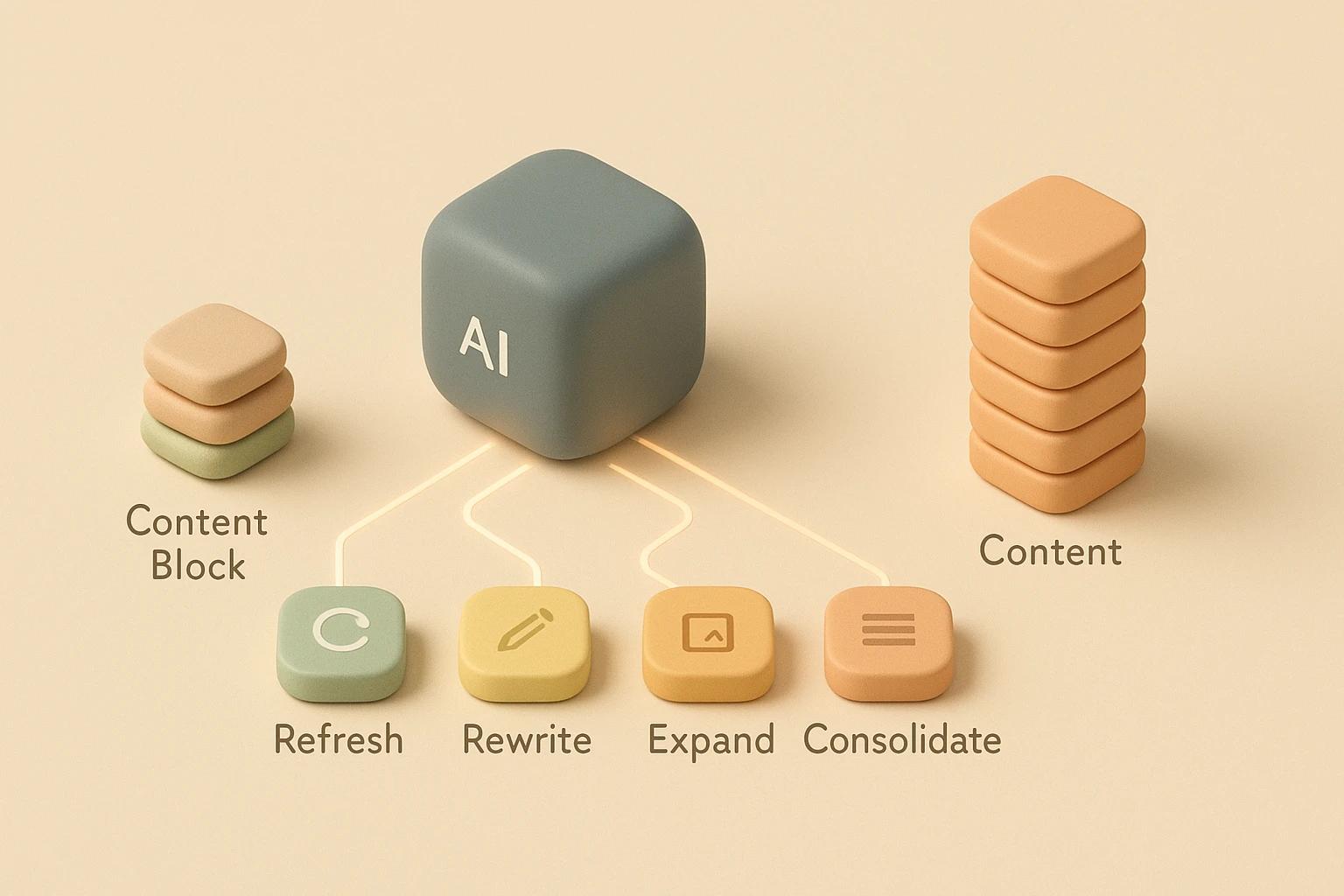
Beyond Write More Your Guide to Automating Content Update Strategies with AI
Learn how to automate content updates with AI to boost rankings, save time, and keep your content relevant and authoritative.