Fixed vs Variable Content Costs Hiring Outsourcing Automation

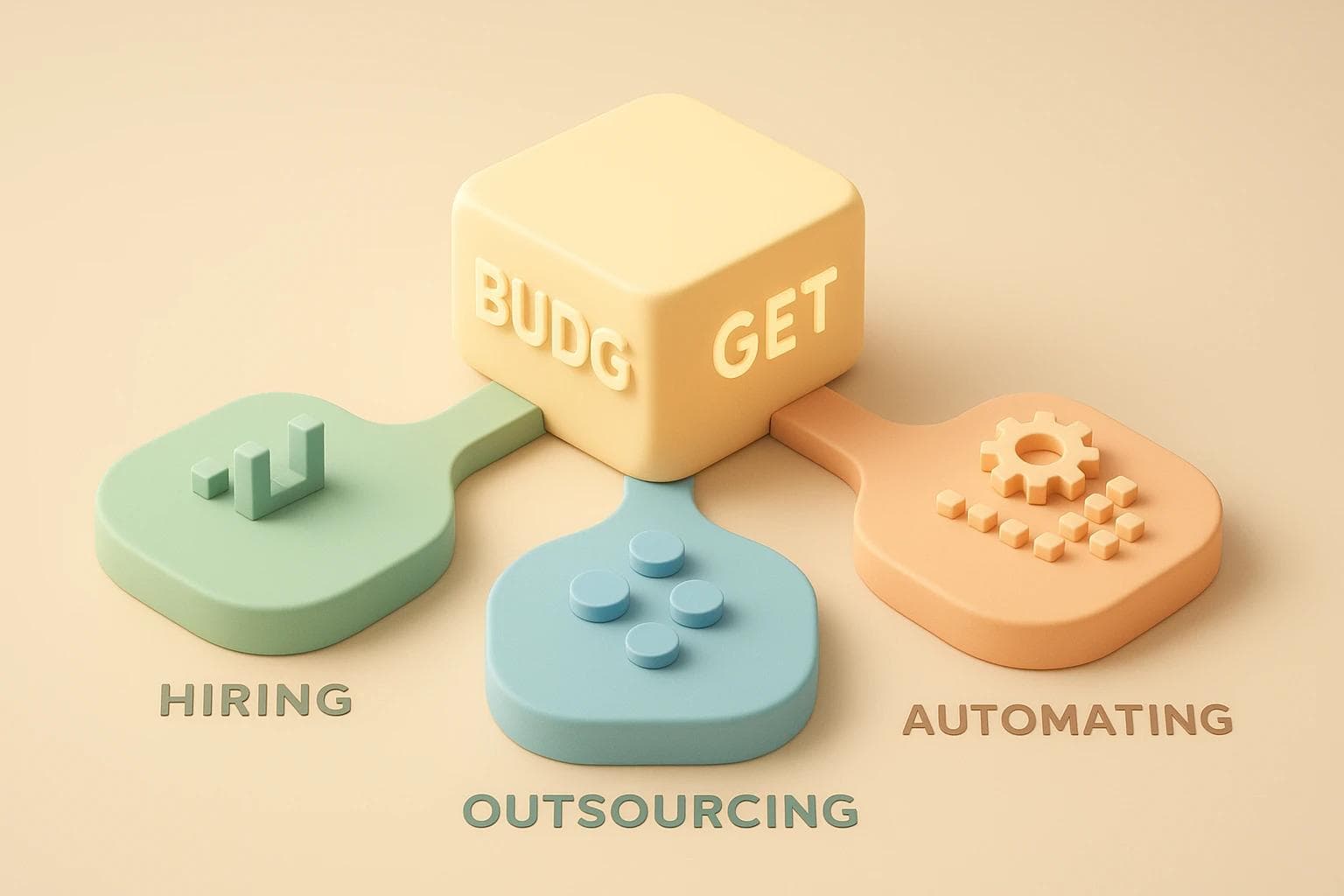
Fixed vs. Variable Content Costs: When to Hire, Outsource, or Automate
You’ve seen it happen. A few blog posts start bringing in traffic, a couple of case studies help close deals, and suddenly, everyone wants more content. The demand is there, but your capacity isn't. You’re facing a classic growth challenge: how do you scale your content production without your budget spiraling out of control?
The answer isn’t just about spending more; it’s about spending smarter. And the key to that lies in a simple financial concept that most of us learned in a business 101 class but rarely apply to our content strategy: fixed versus variable costs.
Understanding this framework is like getting a cheat sheet for your budget. It helps you decide whether your next move should be hiring a full-time writer, finding a great freelancer, or embracing automation. Let’s break it down.
The Two Sides of Your Content Budget: A Simple Explanation
Think of your content budget like any other part of your business. Some costs are predictable and steady, while others fluctuate with your output.
What Are Fixed Content Costs?
Fixed costs are the expenses you pay consistently, regardless of how much content you produce. They’re the predictable, recurring line items in your budget.
- Classic Example: The monthly rent for your office. You pay the same amount whether you have a blockbuster month or a quiet one.
- Content Example: The annual salary and benefits for an in-house content manager. Whether they write 5 articles or 25, their core cost remains the same. Other examples include flat-fee subscriptions for SEO tools like Ahrefs or design software like Canva.
These costs provide stability but require a significant upfront and ongoing commitment.
What Are Variable Content Costs?
Variable costs are directly tied to your production volume. The more you create, the more you spend.
- Classic Example: The cost of raw materials for a bakery. To bake more cakes, you need to buy more flour, sugar, and eggs.
- Content Example: Paying a freelance writer a flat fee per article. If you need 10 articles this month, your cost is 10x the fee. If you only need two next month, your cost drops accordingly. Pay-per-click advertising is another classic variable marketing cost.
These costs offer flexibility but can become unpredictable and expensive as you scale.
Don't Forget "Semi-Variable" Costs
Life is rarely black and white, and neither are content costs. Semi-variable (or mixed) costs have both a fixed and a variable component. Think of an AI content platform that charges a flat monthly subscription for up to 20,000 words, then an additional fee for every 1,000 words you generate after that. The base subscription is fixed, while the overage fees are variable.
The Three Content Models: Choosing Your Cost Structure
Now, let's apply these concepts to the three main ways businesses produce content. Each model represents a different strategic approach to managing your budget and resources.
Model 1: Hiring In-House (The Fixed Cost Powerhouse)
This is the traditional approach: bringing a writer, editor, or content strategist onto your payroll.
- Cost Structure: Primarily fixed. You’re committing to a salary, benefits, training, and software licenses.
- Pros:Deep Brand Knowledge: An in-house writer lives and breathes your company culture, products, and voice.
- Consistency & Control: You have direct oversight, ensuring consistent quality and brand alignment.
- Dedicated Resource: Their time and focus are entirely on your business needs.
- High Upfront Cost: Salaries and benefits represent a major financial commitment.
- Slower to Scale: The hiring process is slow, and you can't easily scale down if demand drops.
- Limited Specialization: One person can't be an expert in everything.
Best for: Businesses with a consistent, high volume of content needs and a strong emphasis on a unique brand voice.
Model 2: Outsourcing to Freelancers & Agencies (The Variable Cost Flex)
This model involves paying external talent—freelancers or marketing agencies—on a per-project or retainer basis.
- Cost Structure: Primarily variable (per-article, per-word) or semi-variable (monthly retainers for a set scope).
- Pros:Flexibility: Scale up or down instantly based on your needs and budget.
- Access to Expertise: Tap into a global pool of specialists for any topic or content type.
- Lower Commitment: No long-term salary or benefits to worry about.
- Management Overhead: Finding, vetting, and managing freelancers takes significant time.
- Inconsistent Quality: Quality and voice can vary wildly between writers, requiring rigorous editing.
- Hidden Costs: The sticker price per article isn't the whole story. The time you spend on briefs, edits, and feedback is a real expense. The true cost of outsourcing b2b seo and content includes these "soft" management costs.
Best for: Businesses with fluctuating content needs, those just starting out, or companies needing specialized content that's outside their internal team's expertise.
Model 3: Automating with AI (The Modern Hybrid)
This emerging model uses AI-driven platforms to generate and optimize content, blending predictable costs with massive scalability.
- Cost Structure: Often semi-variable. Typically a fixed monthly subscription for a certain output, with variable costs for additional volume.
- Pros:Unmatched Scalability: Go from 10 to 100 articles a month without hiring a single person.
- Cost-Efficiency at Volume: The cost-per-article drops dramatically as you produce more.
- Speed: Create first drafts and optimized content in a fraction of the time.
- Requires Human Strategy: AI is a tool, not a strategist. It needs human oversight to ensure accuracy, brand alignment, and strategic direction.
- Best for Specific Use Cases: Excels at creating structured, data-driven content like blog posts, summaries, and product descriptions. It may be less suited for deep thought leadership or nuanced brand storytelling without significant human editing.
Best for: Businesses focused on rapid growth and SEO, aiming to scale their content output efficiently and predictably.
Finding Your "Content Indifference Point": A Simple Framework
So, how do you choose? You can make a data-driven decision by finding your "indifference point"—the volume of content where the total cost of two different models becomes equal.
Let's imagine a simple scenario:
- Option A (In-House): A part-time writer costs you $3,000/month (fixed).
- Option B (Freelancer): A reliable freelancer charges $200/article (variable).
Your indifference point is 15 articles per month ($3,000 / $200).
- If you produce fewer than 15 articles, the freelancer is more cost-effective.
- If you produce more than 15 articles, the in-house writer becomes the cheaper option per piece.
This calculation helps you move from a gut feeling to a strategic choice. Now, let's layer in automation. An AI platform might cost $500/month for up to 50 articles. At that point, the cost-per-article is just $10, completely changing the math for businesses ready to operate at scale.

Decision Thresholds at a Glance
- Low Volume (1-5 articles/month): Outsourcing to freelancers is almost always your most economical choice.
- Medium Volume (5-20 articles/month): This is the crossover zone. A hybrid approach—using freelancers for specialized pieces and an AI tool for scalable SEO content—can offer the best of both worlds.
- High Volume (20+ articles/month): The economics begin to heavily favor fixed-cost models. An in-house writer or a robust content automation platform will provide a much lower cost-per-article.
Beyond the Numbers: Quality, Control, and Growth Goals
Cost is critical, but it's not the only factor. The right model also depends on your strategic priorities.
- Quality & Complexity: If your content requires deep subject matter expertise or a highly nuanced brand voice, the control offered by a dedicated in-house writer (fixed cost) might be non-negotiable.
- Speed & Scale: If your primary goal is to rapidly expand your digital footprint and capture search traffic, the sheer velocity of an automation platform (semi-variable cost) is hard to beat.
- Control & Consistency: An in-house team provides the ultimate control. However, you can achieve strong consistency with any model by implementing a solid framework. A detailed content governance template ensures that every piece, whether written by an employee, a freelancer, or an AI, aligns with your brand standards.
Frequently Asked Questions (FAQ)
What are fixed content costs?
Fixed content costs are recurring expenses that don't change with your content output. The best example is the monthly salary of a full-time content writer or a flat-fee software subscription.
What are variable content costs?
Variable content costs are expenses that are directly tied to your production volume. The most common example is paying a freelancer a set price for each article they write.
Isn't hiring always more expensive?
Not necessarily. While the initial commitment is higher, the cost-per-article for an in-house writer can become significantly lower than a freelancer's rate once you reach a certain volume of content.
What are the "hidden costs" of outsourcing content?
The price per article is just the beginning. You also have to account for the time your team spends finding and vetting writers, creating detailed briefs, managing deadlines, and conducting multiple rounds of edits. This management overhead is a significant—and often untracked—expense.
How does AI automation fit into this?
AI automation platforms introduce a highly scalable, semi-variable cost model. They allow you to produce content at a volume that would be prohibitively expensive with freelancers and would require a large in-house team, offering a cost-effective path to achieving significant organic growth.
Your Next Step: From Budgeting to Building
Choosing the right content cost model isn't a one-time decision; it's a strategy that should evolve with your business.
Start by auditing your current process. How much are you really spending on content, including management time? Next, map out your goals. Do you need 5 articles next month or 50?
The question isn't "Which model is best?" but "Which model is best for me, right now?" By understanding the interplay of fixed, variable, and semi-variable costs, you can stop guessing and start building a content engine that's not just powerful, but profitable.
Roald
Founder Fonzy — Obsessed with scaling organic traffic. Writing about the intersection of SEO, AI, and product growth.
Stop writing content.
Start growing traffic.
You just read about the strategy. Now let Fonzy execute it for you. Get 30 SEO-optimized articles published to your site in the next 10 minutes.
No credit card required for demo. Cancel anytime.

Understanding AI Question Types and Their Answers
Learn how AI categorizes factual procedural and comparative questions to deliver better answers.

Question Maps for Creating Answer-Rich Content Plans
Learn how to turn real customer questions into a clear content plan that builds trust and drives traffic with focused answers.

How Conversational Queries Change Long-Tail Keyword Value
Explore how conversational queries evolve long-tail keywords and what it means for your content strategy.