Formatting Habits That Make Facts Easy for Machines to Find

Speak the Language of Machines: 5 Formatting Habits to Get Your Facts Found
You've spent hours, maybe even days, crafting the perfect article. It’s packed with valuable facts, insightful data, and the exact answers your audience is searching for. You hit publish, and… crickets. Your content, despite its quality, seems invisible to the search engines and AI assistants that are increasingly becoming the gatekeepers of information.
What if the problem isn't your content, but its container?
Often, we write exclusively for human eyes, focusing on narrative flow and visual appeal. But in today’s world, your first reader is almost always a machine—a Google crawler, a Siri query processor, or an AI model sorting through the web. If these machines can't easily understand and extract the core facts from your content, they can't recommend it to a human.
The good news is you don't need to be a developer to fix this. By adopting a few simple, non-technical formatting habits, you can learn to speak the language of machines, turning your content from a messy drawer of information into a perfectly organized filing cabinet that algorithms love to explore.
First, What Does "Machine-Readable" Even Mean?
When we talk about readability, we usually think of people. Is the text engaging? Are the sentences easy to follow? Machine readability is different. It’s not about enjoyment; it’s about structure. A machine "reads" content by looking for predictable patterns, clear hierarchies, and unambiguous data points that it can parse, categorize, and store as distinct facts.
Think of it this way: a human can read a dense, novel-like paragraph and eventually figure out the key takeaways. A machine, on the other hand, prefers a clean, well-labeled blueprint. It wants to know exactly what each piece of information is and how it relates to everything else. When your content provides this clarity, you make it incredibly easy for search engines and AI to find your facts and present them as answers.

The 5 Habits of Highly Readable Content (for Machines)
Becoming a "translator" for machines doesn't require learning code. It just means being more intentional with how you structure your text. By building these five habits into your writing process, you can dramatically improve the odds of your facts being discovered, indexed, and served up in search results and AI answers.

1. Use Headings as Semantic Signposts
For humans, headings break up text and guide the eye. For machines, they are a structural map that outlines the hierarchy and relationship between topics. Vague or clever headings might be fun for people, but they confuse algorithms.
- How It Helps Machines: Clear, descriptive headings (H1, H2, H3) create a logical tree. A machine can instantly understand that a section under an H3 heading is a sub-topic of the preceding H2. This context is crucial for fact extraction.
- How to Do It:Poor Habit: Using a clever but vague heading like "The Plot Thickens."
- Good Habit: Using a descriptive heading that states the topic clearly, like "### Common Challenges in Project Management."
- Action Step: Always ask, "Does this heading accurately describe the content that follows it?"
2. Write in "Atomic Paragraphs"
We often write long, meandering paragraphs that cover multiple ideas. This is the "giant paragraph trap," and it’s a nightmare for machine comprehension. The solution is the "atomic paragraph"—a single paragraph that contains one core idea, fact, or statement.
- How It Helps Machines: When a paragraph is "atomic," a machine can confidently extract the entire block as a single, self-contained fact. This makes it a perfect candidate for a featured snippet on Google or a direct answer from an AI assistant.
- How to Do It:Poor Habit: A single paragraph explaining a product's launch date, its lead developer, and its primary market.
- Good Habit: Three separate, short paragraphs. One for the launch date. One for the lead developer. One for the primary market.
- Action Step: After writing a paragraph, reread it and ask, "Is there more than one distinct idea here?" If so, split it.
3. Create Explicit, Self-Contained Lists
Lists are fantastic for both humans and machines, but only when done right. Ambiguous list items that only make sense with surrounding context are a common mistake. Each bullet or numbered item should be a complete, standalone statement.
- How It Helps Machines: An algorithm can parse an explicit list and treat each item as a separate fact. For a query like "benefits of content marketing," a well-formatted list provides a set of ready-made answers.
- How to Do It:Poor Habit:Increased traffic
- Better leads
- Brand authority
Good Habit:
- Content marketing increases organic website traffic by targeting relevant keywords.
- It generates better leads by attracting a more qualified audience.
- Consistent, valuable content establishes your brand as an authority in the industry.
Action Step: Read each list item on its own. Does it make complete sense without the introductory sentence? If not, rewrite it.
4. Label Your Data and Entities (Without Code)
You don't need technical markup to signal important data points. You can do it with your writing style. By explicitly labeling key pieces of information within your sentences, you give machines a huge clue about what a number or name represents.
- How It Helps Machines: When a machine sees "The company was founded in 2018," the phrase "founded in" acts as a non-technical label for the entity "2018." This helps it differentiate a year from a street address or a product model number.
- How to Do It: Instead of just dropping data points into sentences, introduce them with clear context.Poor Habit: "The project, started by Jane Doe, will finish on Dec 31st and cost $50,000."
- Good Habit: "The project was initiated by Lead Developer, Jane Doe. The official completion date is December 31, 2025, with a total budget of $50,000."
- Action Step: Look for numbers, names, dates, and locations in your text. Have you clearly stated what they are?
5. Mention Key Concepts Consistently
Machines thrive on consistency. When you refer to the same person, product, or concept using different names, it can confuse an algorithm and dilute its understanding.
- How It Helps Machines: Consistently using the same name for an entity (e.g., "artificial intelligence" instead of switching between "AI," "machine intelligence," and "cognitive computing") helps the machine build a confident understanding of the topic. This is foundational to how a modern automated system, like Fonzy AI, analyzes a market to identify opportunities and build a content plan.
- How to Do It:Poor Habit: Referring to a product as "Project Titan," "the Titan Initiative," and "our new CRM" all in the same article.
- Good Habit: Choose one primary name ("Project Titan CRM") and stick to it.
- Action Step: Before publishing, do a quick search (Ctrl+F) for your main topic. Are you referring to it consistently?
Putting It All Together: From Messy to Machine-Friendly
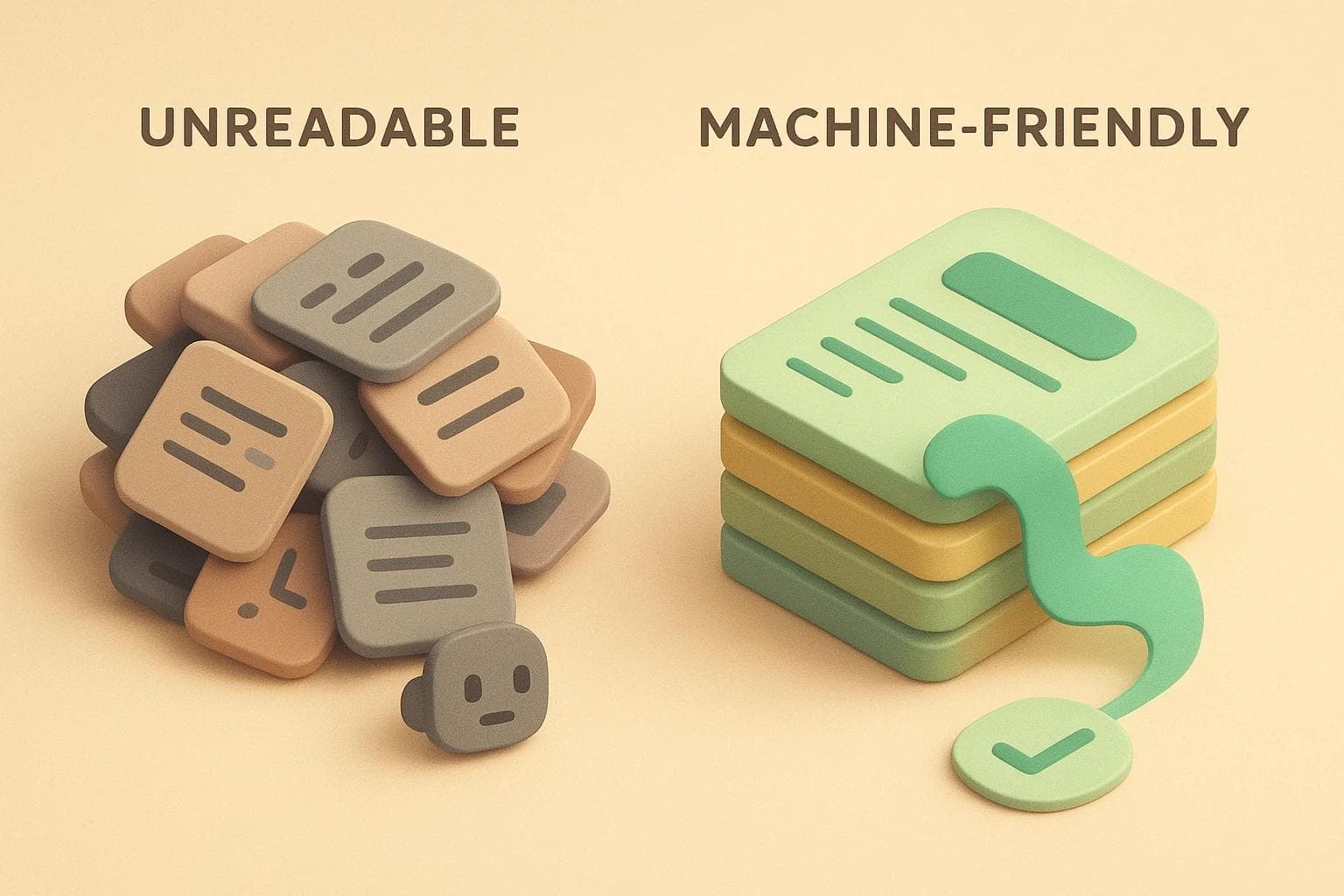
Applying these habits transforms your content. What was once a dense block of text becomes a structured, scannable, and—most importantly—machine-parseable document. This clarity not only helps with current search engines but also prepares your content for the future of AI-powered discovery.
By making your facts easy to find and verify, you're building a foundation of digital trust. This is a crucial component of what Google refers to as E-E-A-T (Experience, Expertise, Authoritativeness, and Trustworthiness), signaling to machines that your content is a reliable source of information.

Frequently Asked Questions
### What is the main difference between human-readable and machine-readable content?
Human-readable content is optimized for comprehension, engagement, and emotional connection. Machine-readable content is optimized for structure, clarity, and unambiguous data extraction. The good news is that by following the habits above, you can create content that excels at both.
### Do I need to learn to code, like HTML or JSON, to do this?
No. While technical structured data (like Schema.org markup) is a more advanced step, the five habits discussed here are entirely non-technical. They are writing and formatting practices that anyone can apply in a standard word processor or CMS like WordPress.
### Are PDFs considered machine-readable?
This is a common misconception. While a machine can read the text in many PDFs, they are often a "dead end." The underlying structure is typically lost, turning your carefully formatted headings and lists into a flat file. It's always better to publish content in a web-native format like HTML (i.e., a standard web page). If you must use a PDF, applying these formatting habits to the source document first can help, but it's not ideal.
### How does this impact my SEO?
Dramatically. Search engines are "fact-finding machines." When you format your content for easy fact extraction, you increase your chances of being featured in rich results like featured snippets, "People Also Ask" boxes, and knowledge panels. This is the essence of modern SEO: providing the clearest answer in the most digestible format.
### Can I go back and fix my old content?
Absolutely. A great next step is to perform a content audit. Pick one of your most important existing articles and review it against the five habits. Split dense paragraphs, clarify headings, and rewrite lists. This is a high-impact activity that can breathe new life into your existing assets.
Your Next Step: Become a Translator
Start thinking of yourself not just as a writer, but as a translator for machines. Your job is to take complex ideas and present them so clearly that even an algorithm can't misinterpret them.
Pick one article on your site and audit it using these five habits. You'll likely find immediate opportunities for improvement. By making these small changes, you aren't just cleaning up your content—you're opening a direct line of communication with the systems that will decide whether your audience ever finds you.
Roald
Founder Fonzy — Obsessed with scaling organic traffic. Writing about the intersection of SEO, AI, and product growth.
Stop writing content.
Start growing traffic.
You just read about the strategy. Now let Fonzy execute it for you. Get 30 SEO-optimized articles published to your site in the next 10 minutes.
No credit card required for demo. Cancel anytime.

Understanding AI Question Types and Their Answers
Learn how AI categorizes factual procedural and comparative questions to deliver better answers.

Question Maps for Creating Answer-Rich Content Plans
Learn how to turn real customer questions into a clear content plan that builds trust and drives traffic with focused answers.

How Conversational Queries Change Long-Tail Keyword Value
Explore how conversational queries evolve long-tail keywords and what it means for your content strategy.