From Keywords to Conversations: How to Map ChatGPT Prompts to Your SEO Strategy
Ever had that moment? You've spent hours on keyword research, crafted the perfect blog post targeting a high-volume, low-difficulty term, and hit publish. You check your rankings, and things are looking good. But then you ask a friend what they’d type into ChatGPT to solve the same problem, and they say something completely different—a full paragraph, with context, backstory, and nuance.
Suddenly, that neatly targeted keyword feels a little… small.
This is the new reality for anyone trying to get found online. The classic search box is evolving into a conversational interface. People aren't just typing keywords; they're having dialogues with AI. They start broad, ask follow-up questions, and refine their needs in real-time. If your content only speaks the language of keywords, you're missing out on the conversation. The key to future visibility isn’t just about ranking for "best running shoes"—it's about being the answer when someone asks, "I'm new to running, have flat feet, and need a durable shoe for pavement that won't cost a fortune. What do you recommend?"

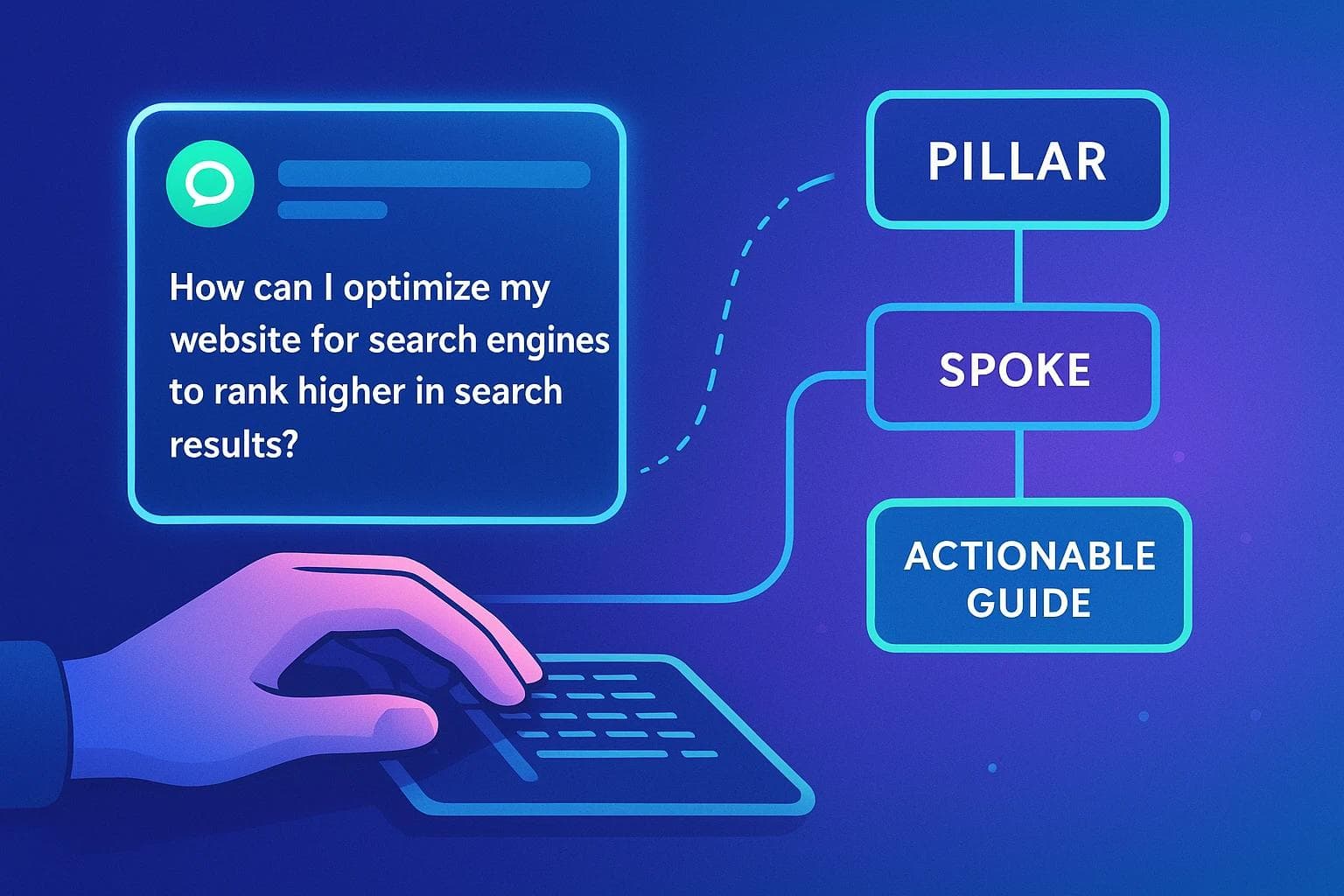
This visual breaks down how user prompts in ChatGPT evolve through multiple conversational turns, transforming a broad query into a refined, specific request that guides SEO content focus.
The New Search Box: Why Conversational AI Thinks Differently
To understand why your content might be getting overlooked by AI, we need to peek under the hood. It’s not magic; it’s about how these systems are designed to understand and process human language.
What is Natural Language Processing (NLP)? A Quick Coffee Chat
Imagine trying to explain a joke to a robot. You wouldn’t just give it the words; you'd need to explain the context, the double meanings, and the cultural references. Natural Language Processing (NLP) is the branch of AI that helps computers do just that—understand language as we humans use it.
As leading SEO resources like Semrush explain, NLP allows search engines and AI models to move beyond simple keyword matching. They can now grasp:
- Intent: What is the user really trying to accomplish?
- Sentiment: Is the user frustrated, curious, or ready to buy?
- Entities: Are they talking about "Apple" the company or "apple" the fruit?
- Relationships: How do different concepts in a sentence or paragraph connect?
This is why a long, conversational prompt works in ChatGPT. The AI isn't just picking out keywords; it's building a comprehensive picture of the user's need.
Keywords vs. Queries: The Big Shift
The fundamental shift is from a one-shot keyword search to a multi-turn conversational query.
- A Keyword Search is a Statement:
best coffee beans for french pressThis is a direct command. The user expects a list of ranked results.
A Conversational Query is a Story: I just bought a new French press and I'm a bit overwhelmed. I usually like a dark, bold roast but I'm worried about it being too bitter. Can you suggest some coffee beans that are smooth but still have a strong flavor?
- This is a problem statement filled with context, preferences, and anxieties. The user expects a nuanced recommendation, not just a list.
Your content needs to be robust enough to answer both, but the real opportunity lies in satisfying the second type of user. That’s where deep topical authority is built.

This graphic visualizes the key components of ChatGPT's natural language processing that enable it to interpret user queries effectively, crucial for SEO content planning.
Listening to the Conversation: How to Decode User Prompts
So, how do you optimize for a conversation you're not a part of? You learn to recognize the patterns and map them back to your content strategy. This is less about traditional keyword tools and more about thinking like a helpful expert.
Deconstructing the "Prompt Funnel"
Most conversational queries follow a predictable path from broad to specific. Let’s call it the "Prompt Funnel."
Imagine a consultant just starting their business. Their conversation with ChatGPT might look like this:
- Turn 1 (Top of the Funnel): "How do I get clients for my new consulting business?"Intent: Informational, looking for a broad overview.
Turn 2 (Middle of the Funnel): "Okay, those are good ideas. I don't have a big budget. What are some low-cost marketing tactics?"
- Intent: More specific, adding constraints (low budget).
Turn 3 (Bottom of the Funnel): "I like the idea of using LinkedIn. Can you help me outline three types of posts I could create this week to attract potential clients?"
- Intent: Action-oriented, seeking a specific, tactical plan.
This isn't just one search; it's a journey. The user's intent evolves with each prompt. The "aha moment" for marketers is realizing that a single, monolithic blog post on "Getting Consulting Clients" is no longer enough. To win in AI-driven search, you need content that addresses each stage of this journey.
Mapping the Conversation to Your Content Plan
Now, let's translate that prompt funnel into a tangible content plan.
- The Turn 1 Prompt (
"How do I get clients...") maps to your Pillar Page. This is your comprehensive guide covering everything from networking and content marketing to cold outreach and paid ads. It's the foundation of your authority. - The Turn 2 Prompt (
"...low-cost marketing tactics") maps to a Spoke Article or Cluster Content. This piece dives deeper into a specific aspect of your pillar page, like "15 Free and Low-Cost Marketing Strategies for New Consultants." - The Turn 3 Prompt (
"...outline three types of LinkedIn posts") maps to a Hyper-Specific, Actionable Blog Post or Template. This is your "how-to" content, like "A 7-Day LinkedIn Content Plan to Land Your First Consulting Client."
By structuring your content this way, you create a web of information that mirrors how people naturally seek knowledge. When an AI model is looking for the best resource to answer a multi-turn query, it's more likely to find and trust a site that demonstrates this kind of structured, deep expertise.

This diagram maps how user query language in ChatGPT translates into specific SEO topics and optimization tactics to guide content strategy development.
Building for AI: How to Make Your Content "Answer-Ready"
Mapping queries is the strategy; structuring your content is the execution. Creating "AI-friendly" content isn't about writing for robots. It’s about structuring human expertise so clearly that an AI can't help but understand and feature it.
Speak in Questions and Answers
The easiest way to get your content surfaced as an answer is to format it like one. Use the questions people are asking as your headings (H2s and H3s). Instead of a heading like "Key Features," try "What Are the Key Features of This Product?"
This approach directly mirrors the query-response nature of AI. But it also begs a deeper, more technical question: what’s the impact of heading structure on AI extractability? In short, a logical, question-based hierarchy acts like a table of contents for an AI, allowing it to quickly find and pull the most relevant information to satisfy a user's prompt.
The Power of Structure: Lists, Tables, and Short Paragraphs
AI models love scannable, well-organized information. Why? Because it's easy to parse, repackage, and present to the user.
- Use bulleted and numbered lists for processes, benefits, or options.
- Use tables to compare features or data.
- Keep paragraphs short and focused on a single idea.
- Use bold text to highlight key terms and concepts.
This isn't just good SEO; it's good user experience. And as experts at Pipeline Velocity note, these "AI-friendly content standards" are critical for avoiding common pitfalls and ensuring your content is seen as a credible source.
Don't Forget the Human Touch (E-E-A-T)
In the rush to optimize for AI, don't forget the most important factor: human expertise. AI-friendly content is not about generic, AI-generated fluff. It's about structuring your unique experience, expertise, authoritativeness, and trustworthiness (E-E-A-T) in a way that both humans and AI models can recognize.
The best "AI-ready" content is still written for people first. It’s insightful, accurate, and genuinely helpful. The structural changes simply make that value easier for AI to discover and share.
Frequently Asked Questions (FAQ)
What is the difference between optimizing for Google and optimizing for ChatGPT?
Optimizing for traditional Google search has been heavily focused on keywords, backlinks, and technical SEO. Optimizing for conversational AI like ChatGPT requires a greater focus on natural language, user intent across a multi-turn conversation, and highly structured content that directly answers questions. The fundamentals of E-E-A-T and high-quality content apply to both, but the execution is becoming more nuanced.
Will AI-generated content hurt my SEO?
Content that is generic, inaccurate, or created solely to rank without providing value can absolutely hurt your SEO, whether it's written by a human or an AI. Google's guidance is to reward high-quality content, regardless of how it's produced. The danger isn't using AI; it's using it to create low-quality content at scale. Always use AI as a tool to augment human expertise, not replace it.
How do I even start researching these conversational queries?
Start by listening. Pay attention to the questions your customers ask. Look at forums like Reddit or Quora where people describe their problems in detail. Use ChatGPT itself: enter a broad keyword from your industry and see what kinds of follow-up questions it suggests. This manual, empathetic research is currently the best way to understand the conversational landscape.
Can ChatGPT just do my SEO for me?
No. While tools like ChatGPT are incredibly powerful for tasks like brainstorming keywords, outlining articles, and generating meta descriptions (as Backlinko's guide expertly shows), they are not a replacement for a comprehensive SEO strategy. Strategy requires understanding your specific business goals, competitive landscape, and audience—tasks that still require human insight and expertise.
Your First Steps into Conversational SEO
The world of search is not just changing—it has already changed. The shift from keywords to conversations is the most significant evolution in a decade, and it presents an enormous opportunity for those willing to adapt.
You don't need to throw out your entire SEO playbook. You just need to expand it.
Start small. Take one of your best-performing articles and read it through the lens of a conversation. What questions does it answer? What follow-up questions might a reader have? Could you break it down into a more structured, question-and-answer format?
As search becomes more automated and conversational, having a content strategy that anticipates these shifts is the key to getting found. By learning to map the natural language of your audience to a clear and authoritative content plan, you're not just optimizing for an algorithm—you're preparing for the future of discovery.

Roald
Founder Fonzy — Obsessed with scaling organic traffic. Writing about the intersection of SEO, AI, and product growth.
Stop writing content.
Start growing traffic.
You just read about the strategy. Now let Fonzy execute it for you. Get 30 SEO-optimized articles published to your site in the next 10 minutes.
No credit card required for demo. Cancel anytime.
Content freshness and update cadence for AI answer selection
Discover how content recency and update frequency impact AI answer rankings and why freshness is crucial for visibility.

Measuring Metrics That Predict AI Visibility Before Content Updates
Discover key signals in your analytics that show how ready your content is for AI visibility before optimizing.

Topical Depth Versus Shallow Pages for Better AI Answers
Learn why deep, comprehensive content improves your chances of being featured in AI-generated answers and how to build strong content clusters.