Is Your Content Secretly Fueling AI? How to Measure Your "AI Visibility"
You published a detailed guide a few weeks ago. You poured in unique data, clear explanations, and expert insights. You check your analytics, and while traffic is steady, there’s no major spike. It feels like the article is just… out there.
But what if its biggest impact isn’t a direct click? What if, right now, an AI assistant like ChatGPT or Gemini is using your exact phrasing to answer a user’s question? What if your data is being presented in a bulleted list, shaping someone’s understanding, all without them ever visiting your site?
This is the new reality of the internet. Your content is being read, analyzed, and reused by AI systems constantly. The clicks you can see are only half the story. The other half is your AI Visibility—the measure of how often and how effectively your content is used to inform AI-generated answers.
Understanding this isn't just a vanity metric; it's the next frontier of digital strategy.
What is AI Visibility (and Why It’s the New SEO Frontier)
At its core, AI Visibility is about how present your brand and its expertise are within AI-powered search and chat platforms. It’s different from traditional SEO, which focuses on ranking a list of blue links. AI Visibility is about becoming a foundational source of truth for the machines themselves.
Think of it in two layers:
- Mentions: An AI mentions your brand name or product in an answer. For example, "Many marketers use tools like Fonzy.ai for content automation."
- Citations: An AI directly uses information from your content to construct an answer and, ideally, links back to you as the source. This is the gold standard.
This matters because user behavior is fundamentally changing. Instead of piecing together information from multiple websites, people are turning to AI for synthesized, direct answers. Your goal is no longer just to be on the page; it's to be the answer. The brands that successfully increase their AI Visibility will build authority and capture attention in this new "zero-click" environment.
Beyond the Obvious: Uncovering the Hidden Signals of AI Content Reuse
Measuring direct citations is relatively straightforward, but the most telling clues that an AI is learning from you are often subtle. These non-obvious signals are where you can find real evidence of your influence. Here are four key indicators to look for and simple ways to start tracking them.
Signal #1: Verbatim Snippets in AI Answers
This is the clearest, yet most overlooked, signal. It happens when an AI assistant uses a specific sentence or phrase from your article, word-for-word, in its response—often without a direct citation. It’s essentially unintentional plagiarism by a machine that found your explanation to be the most clear and authoritative.
How to Track It:
- The "Quotation Mark" Test: Take a few unique, well-phrased sentences from your key articles. A good candidate might be a concise definition or a unique data insight.
- Query the AIs: Go to several AI assistants (ChatGPT, Gemini, Claude) and paste your sentence inside quotation marks. Ask a question related to it, like, "What does this mean: '[Your unique sentence here]'?" or "Tell me more about '[Your unique sentence here]'."
- Analyze the Output: See if the AI incorporates your phrase into its response. This is a powerful sign that its training data includes your content and it has flagged your wording as high-quality.
Signal #2: Branded AI Citations
Not all AI citations are created equal. Different Large Language Models (LLMs) have unique ways of attributing their sources. Some use footnotes, some provide a list of links at the end, and others integrate links directly into the text. Recognizing these different styles helps you spot your content in the wild.
How to Track It:
- Systematic Sampling: Once a week, ask 5-10 questions related to your core topics on different AI platforms. Use the kind of conversational queries your customers would.
- Look for Your Domain: Scan the answers specifically for links or mentions of your domain name. Pay attention to the format. For example, Gemini often uses numbered bubbles for sources, while Perplexity lists sources above or below the answer. Knowing what to look for makes spotting your citations much faster.
Signal #3: Mysterious Traffic Spikes from Exploratory Queries
This is a behavioral signal you can find in your own analytics. It works like this: a user asks an AI a broad question, the AI provides an answer (partly informed by your content), and that answer sparks a new, more specific question in the user's mind. The user then opens a traditional search engine and types in that specific, "exploratory" query, which leads them to your site.
How to Track It:
- Isolate AI Referrals: In Google Analytics 4, go to your Traffic Acquisition report and look for referral sources like
t.co(often from X, where people share AI chats),perplexity.ai, or others. A sudden increase can be a clue. - Analyze Long-Tail Keywords: Look for clusters of new, highly specific, and almost conversational long-tail keywords in your Google Search Console. If you see a sudden surge in traffic for a term like "how to calculate AI content footprint for a SaaS blog," it might be a user following up on a topic an AI introduced them to.
Signal #4: Mentions in Third-Party Reports and Research
When industry analysts, journalists, or academic researchers use AI to gather information, your content can become a source for their work. A mention in a market report or a research paper is a massive signal of authority, and it often originates from your content being surfaced by an AI.
How to Track It:
- Set Up Advanced Alerts: Create Google Alerts for your brand name, key product names, and the names of your executives. Combine these with keywords like "AI research," "market report," "LLM study," or "according to research."
- Monitor Industry Publications: Keep a close eye on key trade publications and research firms in your niche. When they publish reports on trends related to your expertise, check their sources and methodologies.
A Simple Experiment You Can Run Today to Test Your AI Visibility
Feeling overwhelmed? Don't be. You can start getting a feel for your AI Visibility with a simple, low-cost experiment.
Step 1: Choose Your "Bait" Content. Select one of your best-performing articles. It should be rich with unique data, clear definitions, and well-structured lists or steps.
Step 2: Identify a Unique "Tracker Phrase." Find a sentence or data point in the article that is completely unique to you. For example, "Our 2024 study found that AI-optimized articles generate 78% more organic leads."
Step 3: Query and Document. Once a week for a month, ask relevant questions to ChatGPT, Gemini, and Perplexity. See if your content is cited or if your "tracker phrase" appears verbatim. Keep a simple spreadsheet of your queries and the results.
Step 4: Monitor Your Analytics. During this month, keep a close watch on your analytics for the specific URL of your "bait" content. Look for any unusual referral traffic or new, long-tail keyword queries that align with your experiment.
This simple process moves AI Visibility from an abstract concept to a tangible metric you can begin to track and influence.
The Challenges of Measuring AI Visibility (and How to Think About Them)
It's important to be realistic. Measuring AI Visibility perfectly is impossible right now. The nature of AI is probabilistic, meaning it can give different answers to the same question. Attribution can be messy, and you won't always get a neat little link back to your site.
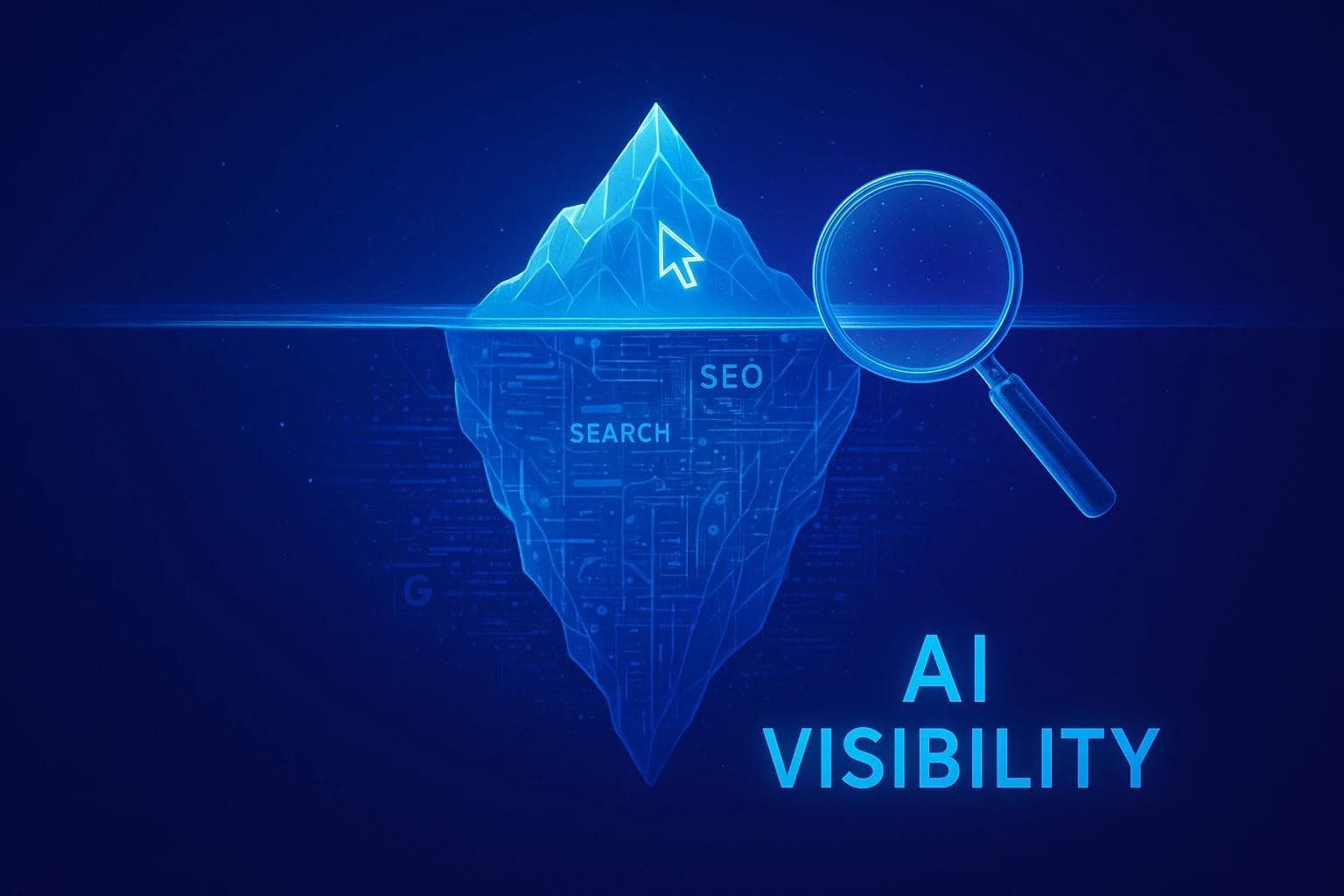
This is the "AI Visibility Iceberg." The direct clicks and formal citations are the small part you can see above the water. The verbatim snippets, the inspired search queries, and the brand authority being built are the massive, invisible foundation below the surface.
Don't let the "zero-click" challenge discourage you. Even when you don't get a click, you are still achieving something powerful: you are educating the AI and, by extension, your potential customers. You are positioning your brand as an authority, building trust one AI-powered answer at a time.
Frequently Asked Questions About AI Visibility
How is AI visibility different from traditional SEO?
Traditional SEO is about ranking your website on a results page to earn a click. AI Visibility is about getting your information integrated into a direct answer, with the goal of becoming a trusted source for the AI itself. The click is a bonus, not the primary goal.
What kind of content do AI assistants prefer?
AIs prioritize content that demonstrates strong Expertise, Experience, Authoritativeness, and Trustworthiness (E-E-A-T). They love well-structured articles with clear headings, data-rich paragraphs, factual accuracy, and direct answers to specific questions. The more your content reads like a definitive resource, the more likely it is to be used.
Can I rely on AI content detection tools to see if my content was used?
Not really. Most AI content detectors are designed to tell you if a piece of text was written by an AI, not if an AI used your content as a source. The manual tracking methods we've discussed are currently more reliable for measuring reuse.
Why do I need a specific strategy for this? Can't I just keep doing good SEO?
Good SEO is a great foundation, but optimizing for AI requires a more intentional approach. It involves structuring your content for machine readability, tracking new signals of influence, and thinking beyond the click. This new field is often called Generative Engine Optimization (GEO).
Your Next Step: From Measurement to Optimization
Understanding that your content is being used by AI is the first critical step. Once you start measuring these signals, you'll uncover incredible insights into what's working and where your competitors are being cited instead of you.
This diagnostic process is the foundation of a modern content strategy. As this space matures, platforms are evolving to help automate this entire process. An AI-driven platform like Fonzy AI is designed to streamline the content lifecycle—from identifying these opportunities to automatically creating and publishing optimized content that gets you found in both traditional search and new AI answer engines.
For now, start with the simple experiment we outlined. What you discover will illuminate the hidden impact of your work and form the bedrock of your strategy for the next era of digital discovery.

Roald
Founder Fonzy — Obsessed with scaling organic traffic. Writing about the intersection of SEO, AI, and product growth.
Stop writing content.
Start growing traffic.
You just read about the strategy. Now let Fonzy execute it for you. Get 30 SEO-optimized articles published to your site in the next 10 minutes.
No credit card required for demo. Cancel anytime.

Editorial rules for building trust with authorship and transparency
Discover simple editorial rules to boost content trust through clear authorship, transparency, and verifiable claims for better visibility.

Conversational language mapping matching how people ask questions
Learn how to align your content with natural questions your audience uses to improve SEO and AI discovery.
How Topic Clusters Build Canonical Answers for Search
Discover how organizing content with topic clusters creates a trusted single source for Google and AI answers.