Beyond #1 Rankings: A Business Owner’s Guide to Measuring SEO ROI
You’ve seen the reports. Graphs trending upwards, lists of keywords you now rank for, and a big, impressive number for "organic traffic." It all looks good, but a nagging question lingers in the back of your mind: Is any of this actually making me money?
If you’ve ever felt lost in a sea of technical SEO jargon, you’re not alone. Most SEO reporting focuses on metrics that are important to marketers but often feel disconnected from the numbers that matter most to a business owner: revenue, profit, and growth.
The good news is that you don't need to become an SEO expert to understand if your investment is paying off. You just need to shift your focus from vanity metrics like rankings and traffic to the business-centric metrics that directly impact your bottom line. It's time to start measuring SEO like your accountant would—with a clear line from investment to return.
The Big Shift: From SEO Metrics to Business Metrics
Thinking about SEO in terms of business outcomes transforms it from a mysterious marketing expense into a predictable growth engine. Instead of asking, "Are we ranking for 'blue widgets'?", you start asking, "How many new customers did our 'blue widgets' article bring in this month?"
This shift empowers you to make smarter decisions, hold your team or agency accountable, and truly understand the financial impact of being found on Google. The four pillars for this are Leads, Organic Conversion Rate, Cost Per Acquisition, and Lifetime Value.

The Four Pillars of Business-Centric SEO Measurement
Let's break down the only four metrics you truly need to gauge the success of your SEO efforts.
### Pillar 1: Leads Generated from Organic Search
Traffic is nice, but leads are what pay the bills. A "lead" is any visitor who takes a meaningful action that signals interest in your product or service.
For different businesses, a lead could be:
- A local service business: A phone call or a submitted contact form.
- A consultant or coach: A booked discovery call or a downloaded guide.
- An e-commerce store: A newsletter signup or an "add to cart" action (a micro-conversion).
- A SaaS company: A free trial signup or a demo request.
Why it matters: Tracking the raw number of leads from organic search is the first step in connecting traffic to potential revenue. It answers the fundamental question: "Is our online presence generating new business opportunities?"
### Pillar 2: Organic Conversion Rate
Your organic conversion rate tells you how effective your website is at turning visitors into leads or customers. It's calculated with a simple formula:
(Number of Organic Leads or Sales / Total Organic Visitors) * 100 = Organic Conversion Rate %
For example, if 1,000 people visit your site from Google and 20 of them fill out your contact form, your organic conversion rate is 2%.
Why it matters: A low conversion rate, even with high traffic, signals a problem. Maybe your landing page is confusing, your call-to-action is weak, or you're attracting the wrong audience. Improving your conversion rate is often the fastest way to increase your SEO ROI without needing more traffic.
### Pillar 3: Cost Per Acquisition (CPA) from Organic
This is one of the most powerful but frequently overlooked metrics. Your organic CPA tells you exactly how much it costs, on average, to acquire one new paying customer through your SEO efforts.
Here’s how to calculate it:
Total Monthly SEO Costs / Number of New Customers from Organic = Organic CPA
To do this right, you need a complete picture of your SEO costs. Be sure to include:
- Agency or freelancer fees
- SEO software and tools (like keyword trackers or analytics platforms)
- Content creation costs (writers, designers)
- The value of your own time or your team's time spent on SEO
Why it matters: Knowing your organic CPA allows you to compare the efficiency of SEO against other channels like paid ads. If your Google Ads CPA is $150 and your organic SEO CPA is $45, you have a clear, data-backed reason to invest more in SEO.
### Pillar 4: Customer Lifetime Value (LTV) of Organic Customers
Not all customers are created equal. Customer Lifetime Value (LTV) measures the total revenue a business can expect from a single customer account. When you connect LTV to SEO, you start to see the incredible long-term, compounding value of organic search.
You can start simply by calculating your average LTV:
Average Purchase Value * Average Purchase Frequency * Average Customer Lifespan = LTV
Why it matters: A customer who finds you through an educational blog post (SEO) might have a higher LTV than one who clicked on a discount-focused ad. Tracking the LTV of customers acquired via organic search reveals the true, long-term ROI. SEO doesn't just bring you a customer; it often brings you a better customer.
The Attribution Puzzle: Knowing Where Customers Really Come From
In a perfect world, a customer would Google a term, click on your website, and buy immediately. In reality, their journey is much more complex. They might see your ad on social media, read a blog post, get an email, and then search for your brand on Google to finally make a purchase.
This is the challenge of attribution: giving the right amount of credit to each marketing channel. Tools like Google Analytics 4 (GA4) offer different attribution models to help you make sense of this.

Choosing the right model is crucial.
- Last Click: Gives 100% of the credit to the final touchpoint before a conversion. It's simple but often undervalues the top-of-funnel work SEO does.
- Data-Driven: (Recommended by Google) Uses AI to distribute credit across the entire customer journey based on how each touchpoint contributed to the conversion. This provides a much more accurate picture of SEO's role in building awareness and influencing the final sale.
For most businesses, a data-driven model gives the most balanced view of how SEO contributes to your bottom line, even when it isn't the very last click.
How to Talk to Your Team (or CEO) About SEO ROI
Once you're tracking these business-centric metrics, reporting on SEO becomes much easier and more impactful. You can ditch the confusing jargon and present a clear story about growth.
Your executive summary should be simple, visual, and focused on the bottom line. Instead of showing keyword movements, show the financial impact.

A conversation with your CEO could sound like this:"This quarter, our SEO investment was $5,000. That effort generated 50 new leads, and our organic conversion rate held steady at 2.5%. From those leads, we acquired 10 new customers, putting our organic CPA at $500. With our average LTV of $4,000 per customer, this quarter's SEO efforts are projected to generate $40,000 in lifetime revenue, giving us an ROI of 700%."
That's a conversation that gets you more budget.
Frequently Asked Questions
### How long does it take to see SEO ROI?
SEO is a marathon, not a sprint. Unlike paid ads that deliver instant results, SEO is an asset you build over time. It typically takes 6 to 12 months to see significant, measurable ROI. Early indicators of success (in the first 3-6 months) include increased organic traffic to key pages and ranking improvements for high-value keywords.
### What is a "good" SEO ROI?
While it varies by industry, a common benchmark suggests that a good ROI for SEO is a 5:1 ratio—meaning you generate $5 in revenue for every $1 you invest. However, thanks to its compounding nature, it's not uncommon for mature SEO strategies to achieve ratios of 10:1 or higher.
### Can I measure the ROI of "technical SEO"?
Yes, absolutely! Technical SEO improvements (like increasing site speed or improving mobile-friendliness) directly impact user experience. A better user experience leads to lower bounce rates and higher conversion rates. You can measure the impact by tracking your organic conversion rate before and after making technical improvements. An increase in that rate translates directly to a higher ROI.
Ready to Measure What Matters?
Shifting your perspective from technical SEO metrics to tangible business outcomes is the key to unlocking sustainable growth. When you stop chasing rankings and start focusing on generating leads, lowering your acquisition costs, and attracting high-value customers, SEO transforms from an expense into your most powerful engine for long-term success.
Now that you know what to measure, the next step is to build a consistent SEO and content strategy that delivers these results. Focusing on creating valuable, educational content is the foundation for attracting the right customers and achieving a phenomenal return on your investment.

Roald
Founder Fonzy — Obsessed with scaling organic traffic. Writing about the intersection of SEO, AI, and product growth.
Stop writing content.
Start growing traffic.
You just read about the strategy. Now let Fonzy execute it for you. Get 30 SEO-optimized articles published to your site in the next 10 minutes.
No credit card required for demo. Cancel anytime.

5 Signs Your Content Strategy is Losing Customers
Discover key signs your content strategy is stuck and quietly losing customers before it impacts your growth.

The Role of Human Oversight in AI-Driven Content
Learn how human oversight ensures quality and brand voice in AI-generated content for agencies.
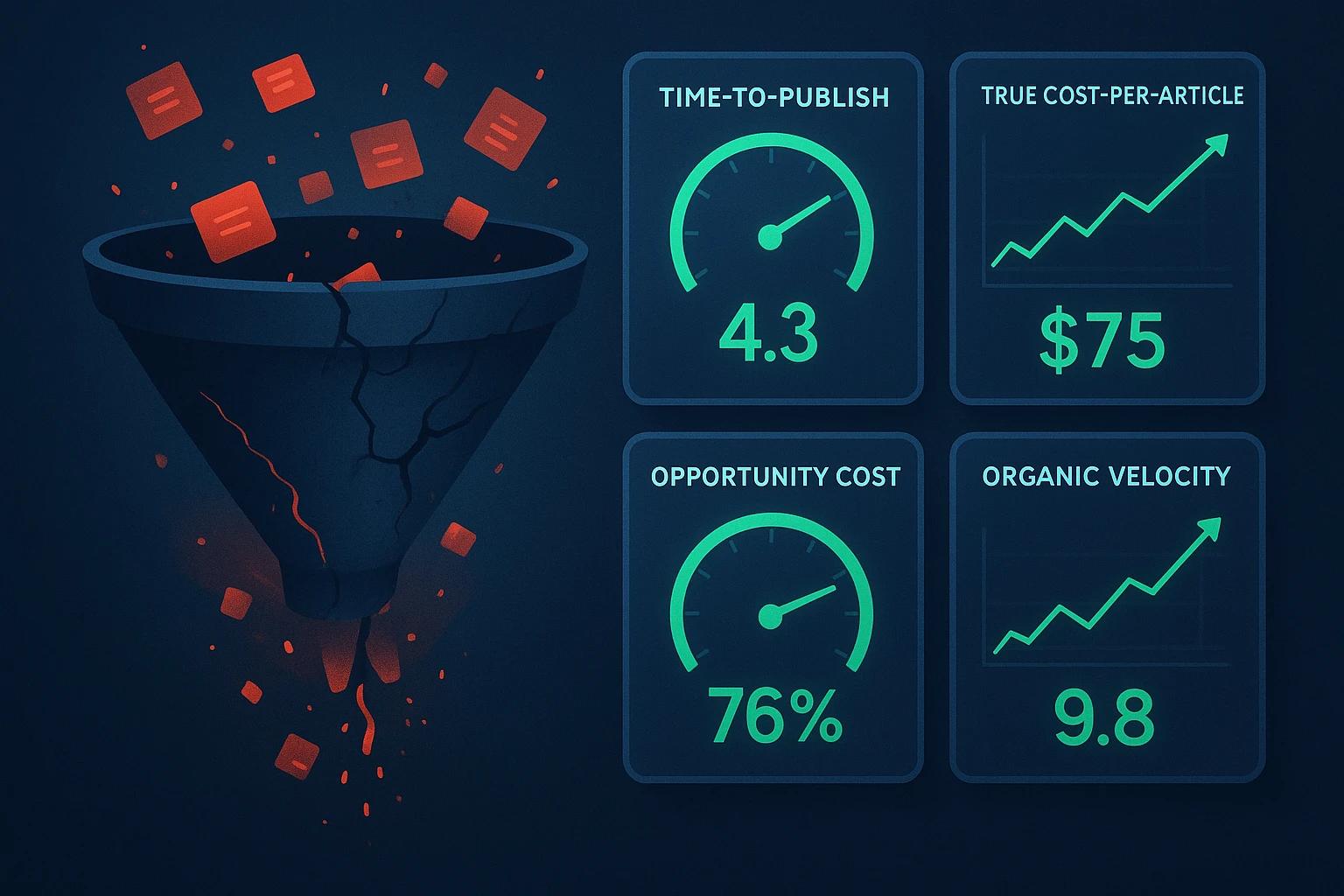
How Agencies Measure Content Efficiency with Key KPIs
Learn the essential KPIs agencies use to identify wasted time and costs in content production and improve efficiency.