Topical Depth vs Keyword Density in AI Content Strategy

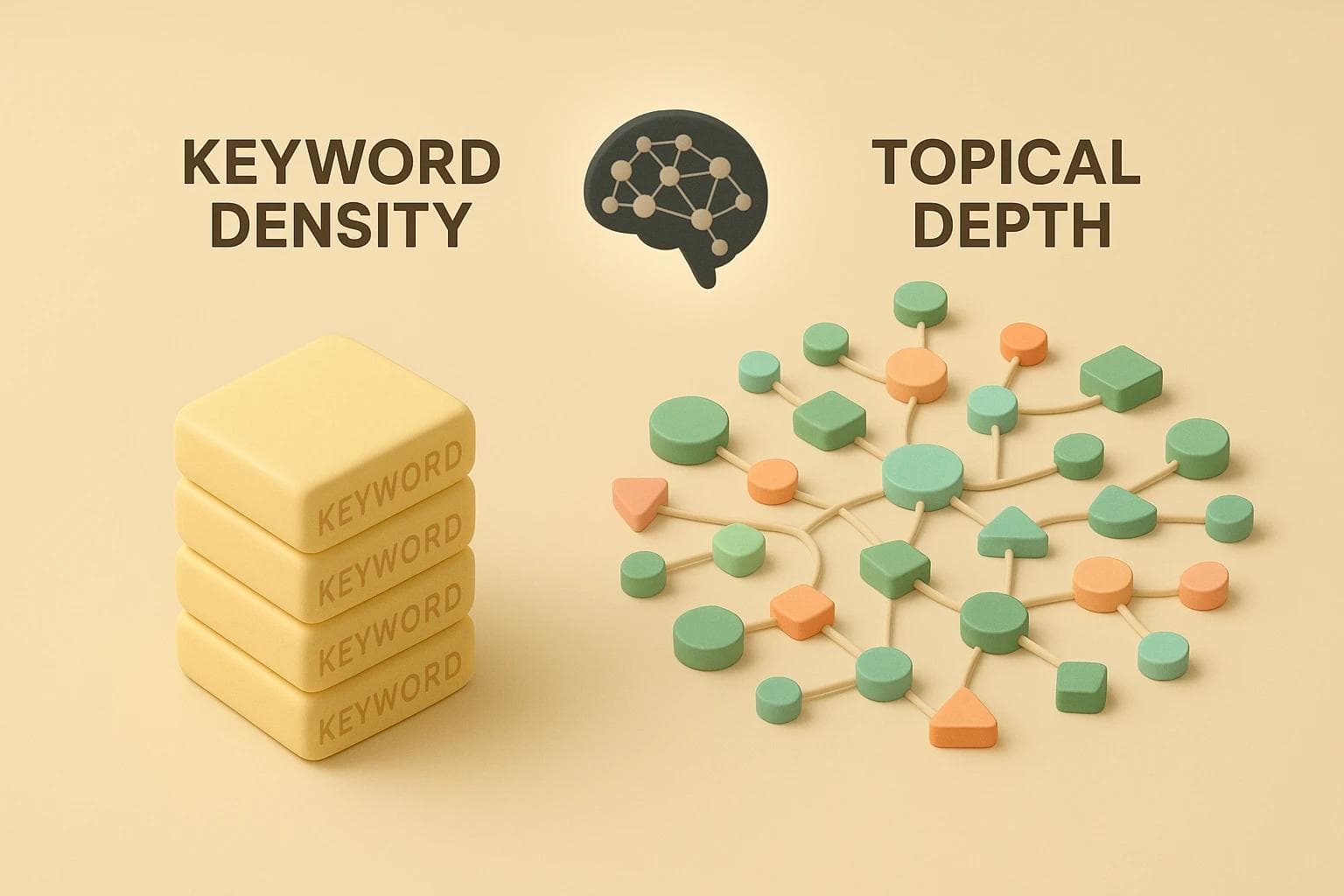
Topical Depth vs. Keyword Density: Why Your Content Isn't Winning in the Age of AI
You’ve done everything by the book. You found a great keyword, checked the search volume, and crafted an article that hits the perfect 1-2% keyword density. You hit publish, and… crickets. Your content is nowhere to be found in Google’s new AI Overviews or a chatbot's answer.
It’s a frustratingly common story. The reason? The "book" you're following is from a different era. While you've been meticulously counting keywords, search engines evolved into sophisticated answer engines. They no longer just match words; they understand concepts, context, and, most importantly, expertise.
Today, winning isn't about shouting the same word repeatedly. It’s about proving you own the entire conversation. This is the fundamental shift from keyword density to topical depth—and it's the single most important change you need to make to your content strategy.
The Old Way vs. The New Way: A Coffee-Shop Explanation
Imagine you're trying to prove you're an expert on coffee.
The keyword density approach is like walking into a coffee shop and shouting "cappuccino, cappuccino, cappuccino!" You’ve certainly said the main keyword, but do you sound like an expert? Not at all. You just sound repetitive.
The topical depth approach is like sitting down and explaining the entire process. You talk about sourcing the beans from Ethiopia, the difference between a light and dark roast, the ideal water temperature, the importance of microfoam, and how a flat white differs from a latte.
Who would an AI trust to answer a complex question about coffee? The shouter, or the storyteller who covered the entire topic from bean to cup? The answer is obvious. AI values the comprehensive, context-rich resource every single time.
So, What Is Keyword Density, Really?
Keyword density is simply the percentage of times a specific keyword or phrase appears on a page. For years, it was a primary signal for search engines. If a page mentioned "best running shoes" ten times, it was considered a strong signal that the page was about the best running shoes. But this led to "keyword stuffing"—unnaturally jamming keywords into content, making it robotic and unhelpful for actual readers.
And What Is Topical Depth?
Topical depth (or topical authority) is a measure of how comprehensively your website covers a subject. It’s not about one page; it’s about creating an interconnected web of content—a topic cluster—that explores a subject from every relevant angle. It involves:
- Entity Coverage: Mentioning all the key people, places, and concepts (entities) related to your topic.
- Variant Questions: Answering the full spectrum of "who, what, why, when, and how" questions your audience has.
- Linked Subtopics: Creating content on related subjects and linking them together logically to show the relationships between ideas.
Essentially, you're building a digital library on your subject, not just writing a single pamphlet.
How AI "Reads" Your Content (Hint: It's Not About Counting)
To understand why topical depth is so crucial, you need to peek under the hood of how AI models like those powering Google's AI Overviews and ChatGPT process information. They don't scan for keywords; they build a knowledge graph.
Think of a knowledge graph as a mind map of concepts. When an AI analyzes your article about "solar panels," it looks for connections. Does your article also talk about "inverters," "photovoltaic cells," "net metering," "federal tax credits," and "roof installation"?
The more of these related entities and subtopics you cover in a logical, interconnected way, the more confident the AI becomes that you are a genuine authority. A keyword-stuffed page is a single, lonely dot. A website with topical depth is a rich, interconnected web of knowledge that the AI can easily parse and trust.
This shift in how content is evaluated is central to building topic authority and E-E-A-T (Experience, Expertise, Authoritativeness, and Trustworthiness). Covering a topic comprehensively is one of the most powerful ways to signal your expertise and authority to both users and AI systems.
Are You AI-Ready? A Quick Content Audit Framework
Worried your content is stuck in the past? You don't need complex tools to get a sense of where you stand. Ask yourself these three questions to audit your content for topical gaps that AI can easily spot.
1. Have you covered the core entities?
For your main topic, list the top 5-10 essential concepts, people, or terms that an expert would naturally mention. For example, if your topic is "email marketing," your list should include "email automation," "segmentation," "open rates," "A/B testing," and "CAN-SPAM Act." Does your content ecosystem touch on all of them? If not, you have a content gap.
2. Have you answered the full range of questions?
Go beyond the primary "what is it" question. Brainstorm all the related questions a curious learner would have.
- Who is this for? (e.g., "email marketing for small businesses")
- Why is it important? (e.g., "why is email segmentation crucial?")
- How do you do it? (e.g., "how to write a welcome email series?")
- What are the alternatives? (e.g., "email marketing vs. social media")
Each of these questions represents a piece of content that can add depth to your topic cluster.
3. Are your subtopics logically connected?
Look at your articles on a single topic. Are they siloed, or do they link to each other in a way that guides a reader (and an AI) through the subject? A pillar page on "Content Marketing" should link out to detailed articles on "SEO Basics," "Creating a Content Calendar," and "Measuring Content ROI." This internal linking structure is the scaffolding that holds your topical authority together.
The Ultimate Differentiator: Creating "Information Gain"
As more businesses use AI to generate content, search results risk becoming a bland echo chamber of regurgitated facts. This is where you have a massive opportunity to stand out by providing information gain.
Information gain is a simple but powerful concept: creating content that offers something new, unique, or more valuable than what already exists. An AI model is trained on existing internet data. If your content is just a summary of what's already out there, you provide zero new value.
To provide information gain, you must inject human expertise:
- Share Original Data: Conduct a survey, analyze your own business data, or present a unique case study.
- Offer a Proprietary Framework: Create a unique step-by-step process or model for solving a problem.
- Include Expert Insights: Interview other experts in your field to get unique quotes and perspectives.
- Provide a Strong, Contrarian Opinion: Backed by evidence, a unique point of view can be incredibly valuable.
This is precisely the kind of high-value, expert-driven content that is most likely to be used as a source when models like ChatGPT generate answers, as it provides the unique substance AI systems are designed to find and synthesize.
Your Questions Answered: A Topical Depth FAQ
So, is keyword density completely dead?
Not completely, but its role has changed dramatically. Think of it as a supporting actor, not the star. Including your primary keyword and related terms naturally helps provide context, but you should never force it or optimize for a specific percentage. Write for humans first; the context will follow.
How do I even start building topical authority?
Don't try to boil the ocean. Start with one core topic that is central to your business. Map out all the related subtopics and questions, and turn that map into your content calendar. Build your first topic cluster around that single subject before expanding.
How does topical depth relate to E-E-A-T?
It's a direct reflection of it. Expertise is demonstrated by the accuracy and detail of your content. Authoritativeness is built as you become the go-to resource for a whole topic, not just one keyword. This combination builds the Trustworthiness that both users and algorithms crave.
Can I use AI to help create content with topical depth?
Absolutely. AI tools are fantastic for brainstorming subtopics, outlining articles, and generating first drafts. However, they cannot replace your unique human experience and insight. Use AI as a brilliant research assistant, but ensure the final product is infused with your expertise to create true information gain.
The Path Forward: From Chasing Keywords to Owning Topics
The world of SEO is no longer a game of finding the right keywords. It's about becoming the most trusted, comprehensive, and helpful resource in your niche. By shifting your focus from the narrow lens of keyword density to the wide-angle view of topical depth, you're not just optimizing for an algorithm—you're building a long-term strategic asset.
Your next step isn't to find another keyword. It's to choose your topic.
- Pick one core subject you want to be known for.
- Audit your existing content using the simple framework above to find your biggest gaps.
- Commit to creating one incredibly comprehensive piece of content that can serve as the "pillar" of your topic cluster, answering every fundamental question about that subject.
This is how you stop chasing fleeting rankings and start building an unshakable foundation of authority that will serve you long into the future of AI-driven search.
Roald
Founder Fonzy — Obsessed with scaling organic traffic. Writing about the intersection of SEO, AI, and product growth.
Stop writing content.
Start growing traffic.
You just read about the strategy. Now let Fonzy execute it for you. Get 30 SEO-optimized articles published to your site in the next 10 minutes.
No credit card required for demo. Cancel anytime.

Understanding AI Question Types and Their Answers
Learn how AI categorizes factual procedural and comparative questions to deliver better answers.

Question Maps for Creating Answer-Rich Content Plans
Learn how to turn real customer questions into a clear content plan that builds trust and drives traffic with focused answers.

How Conversational Queries Change Long-Tail Keyword Value
Explore how conversational queries evolve long-tail keywords and what it means for your content strategy.