
How to Audit Your SEO Process for Automation Opportunities: A Non-Technical Checklist
Ever feel like your week is a blur of the same SEO tasks? You’re exporting keyword lists, manually building content briefs, hunting for internal linking opportunities, and pulling data for reports. By the time you look up, Friday’s here, and that big-picture strategy you wanted to work on is still sitting on the back burner.
It's a common story. Marketers are often so buried in the "doing" that there's little time left for the "thinking." But what if you could reclaim a significant chunk of your time? Not by working faster, but by working smarter. This is the promise of SEO process automation: identifying the repetitive, rule-based tasks that eat up your day and handing them over to technology, freeing you to focus on creativity and strategy where your human insight truly shines.
This isn't about complex coding or becoming a developer. It's about looking at your current workflow with a fresh pair of eyes. This guide will walk you through a simple, non-technical audit to pinpoint exactly where automation can make the biggest impact on your day-to-day work.

Demystifying SEO Automation for Marketers
Let’s clear something up right away: SEO process automation isn’t about a robot taking over your job. Think of it as hiring the world's most efficient assistant—one who loves doing the tedious, predictable parts of your work with perfect accuracy, every single time.
For a marketer, SEO process automation is the practice of using tools and systems to handle tasks that are:
- Repetitive: Performed the same way on a daily, weekly, or monthly basis.
- Rule-based: Follow a clear and predictable set of steps.
- Data-intensive: Involve gathering, sorting, or compiling large amounts of information.
The goal isn't to "set it and forget it," but to augment your capabilities. Research shows that many existing guides jump straight to technical tools or complex site audits. We're taking a step back to focus on something more fundamental: your actual, day-to-day workflow. By understanding your own processes first, you can make smarter decisions about any tools or platforms you might consider later.
Your Non-Technical SEO Process Automation Audit Checklist
Ready to find your hidden opportunities for efficiency? Grab a notebook or open a spreadsheet and follow these four steps. The key is to be honest and thorough about how you really spend your time.

### Step 1: Map Your Current SEO Workflow
First, let's get everything out on the table. List every routine task you perform as part of your SEO efforts. Don't filter or judge anything yet; just write it all down. Think about your entire content lifecycle, from initial idea to post-publication analysis.
Your list might include things like:
- Brainstorming initial topic ideas
- Performing keyword research for a new article
- Grouping keywords by search intent
- Analyzing top-ranking competitor articles
- Creating a detailed content outline or brief
- Finding internal pages to link from when a new article is published
- Finding opportunities to link to older articles from a new post
- Compiling weekly or monthly traffic and ranking reports
- Performing basic on-page SEO checks (meta titles, descriptions, etc.)
### Step 2: Quantify the Pain Points
Next to each task on your list, create a few columns and estimate the following:
- Time Spent: How many hours per week or month does this task take? (e.g., "4 hours/month")
- Frequency: How often do you do it? (e.g., "Daily," "Weekly," "Per article")
- Mental Drain: On a scale of 1-5, how tedious or draining is this task? (1 = I enjoy it, 5 = I'd rather do anything else)
- Error Risk: How likely is it that a small human error could occur? (e.g., copy-pasting wrong data, missing an internal link opportunity).
This step is about turning that vague feeling of "being busy" into concrete data. You might be shocked to discover that creating content briefs, a seemingly small task, is actually eating up 10 hours of your month.
### Step 3: Apply the Automation Litmus Test
Now we separate the wheat from the chaff. For each task, ask yourself these simple yes/no questions. A task is a prime candidate for automation if you answer "yes" to most of them.
- Is it repetitive? Do you perform the task in almost the exact same way every time?
- Does it follow clear rules? Could you write down a simple, step-by-step instruction manual for someone else to follow?
- Does it involve gathering and organizing data? Does the task require you to pull information from one place (like a keyword tool or competitor SERPs) and structure it in another (like a spreadsheet or a content brief)?
- Could a machine do it faster or more accurately? Does speed and consistency matter more than creative nuance for this task?
Tasks like "Analyze top-ranking competitor articles" and "Find internal linking opportunities" will likely get a lot of "yes" answers. A task like "Develop the final brand voice for an article" will get mostly "no's"—that requires human creativity.
### Step 4: Prioritize for Impact & Feasibility
Look at the tasks that passed the litmus test. Now, let’s prioritize them. Create a simple score by looking at the data from Step 2. The best tasks to automate first are those with:
- High Time Spent + High Mental Drain + High Error Risk
A task that takes 8 hours a month, is incredibly boring, and is prone to errors is your Automation Goldmine. This simple prioritization helps you focus on what will give you the biggest return in time and sanity, preparing you to assess potential solutions based on your specific, data-backed needs.
The Human Advantage: Where to Automate vs. Where to Innovate
The true power of this audit is realizing that automation isn't about replacement; it's about elevation. By handing off the mechanical work, you unlock more time for the strategic work that only a human can do.
As research from industry experts at The Ad Firm points out, there's a clear division of labor where humans excel. Your goal is to automate the mundane to create more space for the meaningful.

Automate This:
- Data Aggregation: Pulling together top keywords, competitor headlines, and word counts.
- Initial Structuring: Generating a first-draft content outline based on SERP analysis.
- Pattern Recognition: Identifying relevant pages on your site for internal linking.
- Routine Reporting: Compiling standard performance metrics into a weekly dashboard.
Keep This Human:
- Strategic Planning: Deciding which content pillars to build and what business goals to target.
- Creative Direction: Infusing articles with your unique brand voice, stories, and insights.
- Nuanced Intent Interpretation: Understanding the subtle, emotional "why" behind a search query that data alone can't capture.
- Complex Problem-Solving: Diagnosing a sudden traffic drop or navigating a complex algorithm update.
From Audit to Action: Building Your Automation Roadmap
You've completed the audit. You have a prioritized list of time-consuming, repetitive tasks that are perfect candidates for automation. So, what's next?
Your completed audit is now your roadmap. It’s a powerful tool that transforms a vague desire for "efficiency" into a concrete business case. You can now:
- Articulate the Problem: Clearly explain to your team or stakeholders, "We spend approximately 20 hours per month manually creating content briefs, which is costly and leads to inconsistencies."
- Define Your Needs: Instead of searching broadly for "SEO tools," you can look for solutions that specifically address your top-priority items, like "a platform that automates content outline generation and internal link suggestions."
- Calculate Potential ROI: You can build a simple business case. If you save 20 hours a month and your time is valued at $50/hour, that's a $1,000 monthly saving—a powerful justification for investing in the right platform.
By starting with your own process, you put yourself in the driver's seat. You’re no longer just reacting to the market; you’re proactively designing a more efficient, strategic, and ultimately more fulfilling way to work.
Frequently Asked Questions (FAQ)
1. What exactly is SEO process automation for a non-technical marketer?It's simply using software to handle the repetitive, rule-based parts of your job without needing to write any code. This includes tasks like keyword research analysis, generating content outlines based on top competitors, and finding internal linking opportunities automatically.
2. Is automation going to replace my job as a marketer?Absolutely not. It's designed to enhance your job. By automating tedious tasks, you free up your time and mental energy to focus on high-value activities that require human creativity, strategic thinking, and deep customer understanding—things AI can't replicate.
3. Do I need to be a developer to implement SEO automation?No. Modern automation platforms are built for marketers, not developers. Many, like Fonzy.ai, are designed with a "one-click" setup, integrating directly with your existing website and content management system (CMS) to handle the entire process automatically.
4. What are the first tasks I should look at automating?The best starting points are usually tasks related to content creation groundwork. Use the audit checklist to identify your most time-consuming, repetitive tasks. For most marketers, this includes keyword grouping, competitor analysis for content briefs, and identifying internal links.
5. How can I convince my boss or team that this is a good idea?Use the data from your audit. Present a clear picture of the hours currently being spent on manual tasks and translate that time into a dollar amount (Time Saved x Hourly Rate = Cost Savings). Frame it as an investment that will not only save money but also improve content consistency and allow the team to focus on bigger strategic initiatives that drive revenue.

Roald
Founder Fonzy — Obsessed with scaling organic traffic. Writing about the intersection of SEO, AI, and product growth.
Stop writing content.
Start growing traffic.
You just read about the strategy. Now let Fonzy execute it for you. Get 30 SEO-optimized articles published to your site in the next 10 minutes.
No credit card required for demo. Cancel anytime.
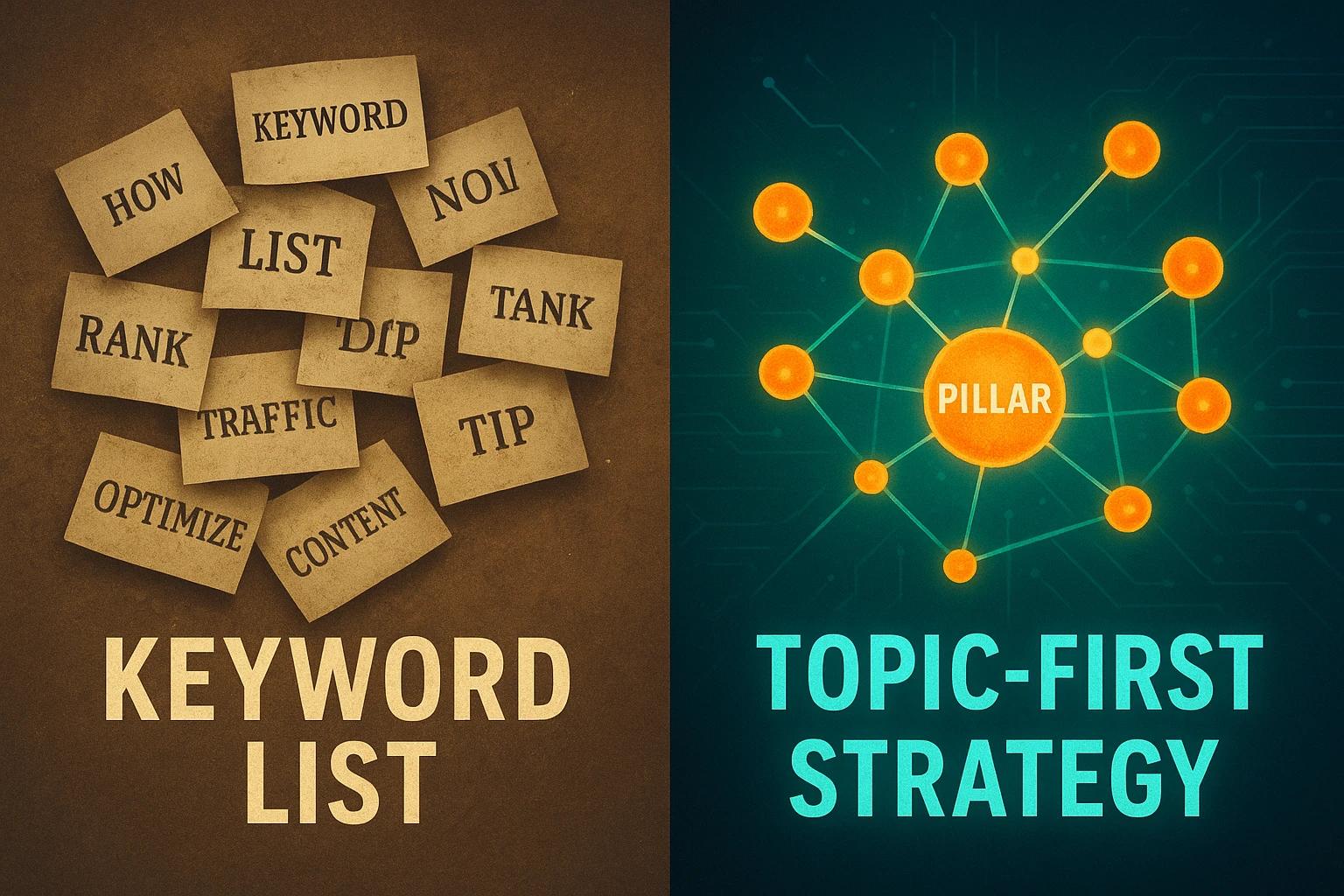
Topic-First Content Strategy for AI-Driven Search
Discover why focusing on topics over keywords drives SEO success in AI-powered search environments.

5 Signs Your Content Workflow Is Blocking Growth
Discover common content workflow problems slowing your growth and how automation can help improve efficiency and results.

Common AI Content Myths and How to Avoid Them
Learn the top myths about AI content and how to use AI effectively to create valuable, high-quality content.