Topic-First Content Strategy: Why It Beats Keyword Lists in an AI-Driven Search Landscape
Ever feel like you’re playing a game of SEO whack-a-mole? You spend hours researching the “perfect” keywords, create content you’re proud of, hit publish… and get crickets. Meanwhile, your competitors seem to magically appear in search results for questions you never even thought to target.
If this sounds familiar, you’re not alone. The frustrating truth is that the old rules of SEO are failing. The game hasn't just changed; we’re playing on a completely new field, one designed and refereed by Artificial Intelligence. Sticking to a rigid list of keywords is like trying to navigate a new city with a map from 10 years ago—you’ll get lost, fast.
The reason is simple: search engines like Google no longer just match words; they understand meaning. They’ve shifted from being a digital filing cabinet to a conversational answer engine. And in this new landscape, winning means thinking less about keywords and more about topics.

The Big Shift: Why AI Search Favors Conversations, Not Keywords
For years, the standard SEO playbook was straightforward:
- Find a keyword with high volume and low competition.
- Write an article optimized for that specific phrase.
- Repeat.
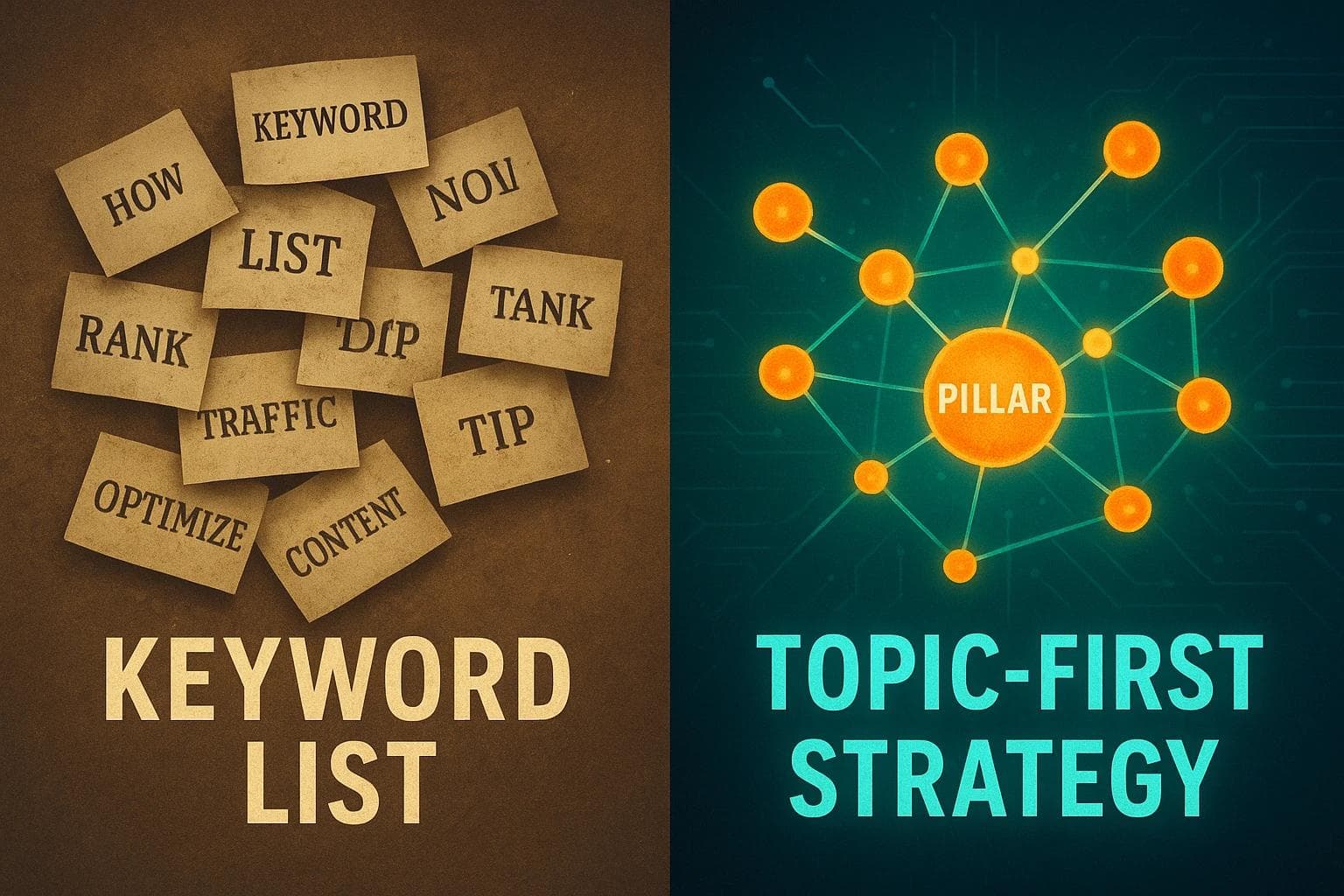
This "keyword-first" approach treated each piece of content like a standalone island, hoping to catch traffic for one specific query. But modern AI, like the kind powering Google Search and answer engines like Perplexity, has evolved. It now uses semantic search to understand the context and relationships between words and ideas.
Think of it this way: when you search for "best way to repot a monstera," Google knows you're not just looking for those exact words. It understands the related concepts—or "entities"—like soil type, pot size, drainage, root rot, and lighting conditions. It knows a comprehensive, helpful answer will cover these related ideas.
A topic-first content strategy leans into this new reality. Instead of creating one-off articles, you aim to build a comprehensive library of interconnected content around a central theme. You signal to search engines that you're not just an expert on a single keyword; you're an authority on the entire topic.
Understanding Topic Clusters: The Blueprint for Authority
The topic-first approach is built on a simple but powerful structure: the topic cluster. This consists of two main parts:
- Pillar Page: A broad, comprehensive piece of content that covers a core topic in depth. Think of it as your ultimate guide, like "The Complete Guide to Indoor Plant Care."
- Cluster Content: A series of more specific articles that each dive deep into one sub-topic mentioned on the pillar page. Examples might be "Choosing the Right Soil for Succulents," "How to Deal with Spider Mites," or "Low-Light Houseplants for Beginners."
These cluster pages all link back to the main pillar page, and the pillar page links out to them. This creates a tightly woven web of content that is incredibly valuable for both users and search engines. For users, it provides an easy-to-navigate resource to learn everything about a subject. For AI-driven search engines, it provides a clear map that demonstrates your depth of knowledge and authority on the topic.

Your Step-by-Step Guide to a Winning Topic-First Content Strategy
Transitioning from a keyword list to a topic-first strategy can feel daunting, but it's a logical process focused on providing genuine value to your audience. Here's how to get started.
Phase 1: Deep Audience & Topic Research
Forget your keyword tool for a moment. Start with your audience. What are their biggest challenges, goals, and burning questions related to your area of expertise?
- Browse forums like Reddit and Quora.
- Check the "People also ask" section in Google search results.
- Listen to the language your customers use in sales calls or support tickets.
Your goal is to identify broad "pain point" topics, not just keywords. A personal trainer might find that their audience isn't just searching for "how to lose weight" but is struggling with topics like "meal prep for busy professionals" or "finding motivation to work out at home."
Phase 2: Map Your Content Universe
Once you have your broad topics, it's time to structure them.
- Choose Your Pillars: Select 5-10 core topics that are fundamental to your business and your audience's needs. These should be broad enough to generate lots of sub-topics.
- Brainstorm Your Clusters: For each pillar, list out all the specific questions, sub-topics, and related ideas. If your pillar is "Content Marketing for Small Business," your clusters could be "How to Write a Blog Post," "Social Media Content Ideas," "Email Newsletter Best Practices," and so on.
Phase 3: Craft Helpful, People-First Content
This is where you bring it all to life, and Google has given us the perfect blueprint with its emphasis on creating "helpful, reliable, people-first content." This comes down to E-E-A-T:
- Experience: Do you have firsthand, real-life experience with the topic?
- Expertise: Do you have deep knowledge and skill in this area?
- Authoritativeness: Are you a recognized source for this topic?
- Trustworthiness: Is your content accurate, honest, and reliable?
Focus on answering the user's question so thoroughly that they don't need to go back to Google. Use real-world examples, share personal insights, and write like a knowledgeable friend explaining something fascinating over coffee.

Phase 4: Weave It All Together with Smart Linking
The magic of a topic cluster happens in the links. Your cluster articles should always link back to your main pillar page. This funnels authority to your most important piece of content. Similarly, your pillar page should link out to the cluster articles where it makes sense, inviting readers to go deeper.
This internal structure is a powerful signal to AI. You're not just providing a page; you're providing a comprehensive resource. To ensure search engines and AI tools can easily parse your content, understanding what’s the impact of heading structure on AI extractability is a game-changer for organizing your articles effectively.
FAQ: Your Topic-First Strategy Questions Answered
What is a topic-first content strategy, really?
It’s an approach where you prioritize covering a subject area comprehensively rather than targeting individual keywords. The goal is to become the go-to authority on a topic in the eyes of both users and search engines.
How is this different from just targeting long-tail keywords?
While cluster content often targets long-tail keywords, the key difference is the interconnected structure. A topic-first strategy is about creating a planned content hub, whereas a traditional long-tail strategy often results in a collection of disconnected articles.
How do I measure the success of a topic-first strategy?
Instead of just tracking individual keyword rankings, you'll want to measure "topic authority." Look for growth in organic traffic to the entire cluster of pages. Are you starting to rank for a wider variety of related terms? Is your pillar page gaining authority and driving traffic to your cluster content? These are signs that your strategy is working.
Can a small business realistically do this without expensive tools?
Absolutely. While advanced tools can speed things up, the core of this strategy is about understanding your audience and creating valuable content. You can start by using free resources like Google's "People also ask," AnswerThePublic, and simply listening to your customers to build your first topic cluster.
Future-Proof Your Content in the Age of AI
The shift from keywords to topics isn't just another SEO trend; it's a fundamental alignment with how information is discovered and consumed in an AI-powered world. By focusing on building deep, interconnected content hubs, you stop chasing algorithms and start building a lasting library of value.
Your next step is simple: pick one core topic your audience desperately needs to understand. Map out the questions they have about it and commit to answering them more thoroughly than anyone else. By doing so, you won't just rank higher—you'll become the trusted resource they turn to again and again.
As you begin to scale this approach, you'll naturally look for ways to streamline the process of discovering topic opportunities and building out your content universe. But it all starts with that first step: choosing to teach, not just to target.

Roald
Founder Fonzy — Obsessed with scaling organic traffic. Writing about the intersection of SEO, AI, and product growth.
Stop writing content.
Start growing traffic.
You just read about the strategy. Now let Fonzy execute it for you. Get 30 SEO-optimized articles published to your site in the next 10 minutes.
No credit card required for demo. Cancel anytime.
How to Audit SEO for Automation Opportunities
Discover a simple non-technical checklist to identify SEO tasks you can automate and save time for strategic work.

5 Signs Your Content Workflow Is Blocking Growth
Discover common content workflow problems slowing your growth and how automation can help improve efficiency and results.

Common AI Content Myths and How to Avoid Them
Learn the top myths about AI content and how to use AI effectively to create valuable, high-quality content.