How Content Frequency Affects SEO Rankings and What to Prioritize

Content Velocity vs. Perfection: How Frequency Impacts Your Rankings (and What to Prioritize)
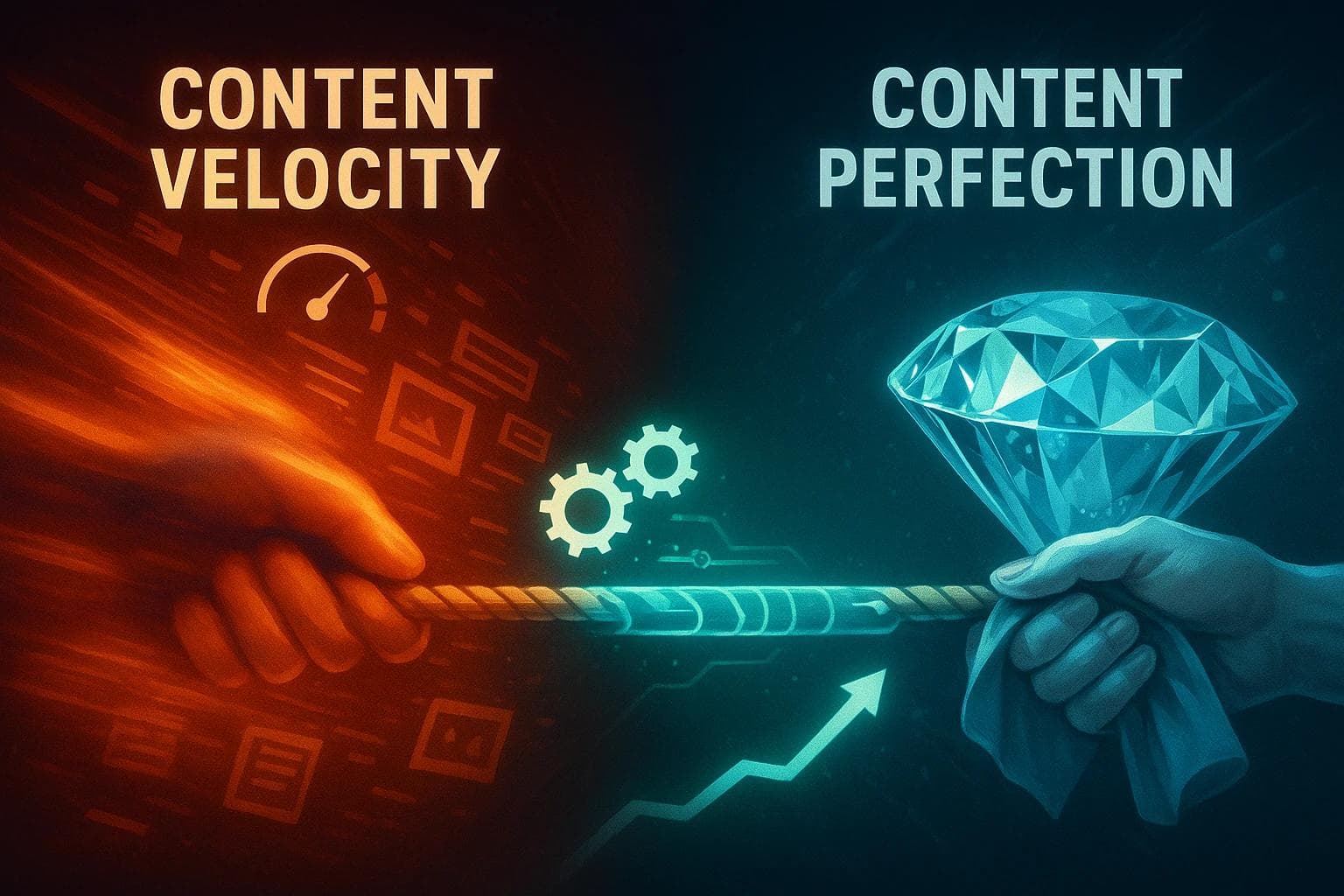
Ever feel like you’re stuck in a content creation tug-of-war?
On one side, you have the pressure to publish constantly. Blog posts, social updates, newsletters—the content machine demands to be fed. On the other side is the desire to create that one perfect, masterpiece article that will be the definitive guide on a topic for years to come.
So you wait. You tweak a paragraph here, search for a better statistic there, and endlessly refine. Meanwhile, your competitors are publishing daily, and you can’t help but wonder: are you falling behind by chasing perfection? Or are they just creating noise by prioritizing speed?
This isn’t just a feeling; it’s one of the most common dilemmas marketers and business owners face. The good news is that the answer isn't a simple "either/or." Let's break down this tug-of-war and find a smarter way to win.
What Are We Really Talking About? Defining the Core Concepts
Before we can find the right balance, let's get on the same page. Think of it like cooking. Sometimes you need to prepare a quick, nutritious meal every day to stay healthy (velocity). Other times, you spend a whole weekend crafting a gourmet, multi-course feast for a special occasion (perfection). Both have their place.
Content Velocity: The Power of Momentum
Content velocity is the speed and efficiency with which you can move a piece of content from an idea to a published reality. It’s not just about publishing more, but about how quickly and consistently you can do it. A high velocity means you have a streamlined process, allowing you to regularly share valuable information with your audience.
Content Perfection: The Foundation of Trust
Content perfection (or content quality) refers to the depth, accuracy, relevance, and overall value a piece of content provides to the reader. A "perfect" piece of content completely answers a user's question, is well-researched, engagingly written, and builds credibility and trust for your brand.

The Big Question: Which One Matters More for SEO?
Here’s the "aha moment": Google doesn’t see velocity and perfection as opposites. It sees signals from both. The true winner, as Search Engine Journal points out, is often the competitor who can create 5x more high-quality content. The goal isn't to choose one, but to understand when to lean in which direction.
When Velocity Wins: Building Your Digital Footprint
Prioritizing speed is crucial in several key scenarios:
- Establishing Topical Authority: When you’re new to a topic, publishing frequently on related sub-topics signals to Google that you’re building expertise. It's like becoming the go-to person in your friend group for a specific subject—you do it by talking about it often and from many angles.
- Capturing Timely Trends: In fast-moving industries, speed is a competitive advantage. Being one of the first to publish content about a new trend or update can capture a wave of search traffic before the topic becomes saturated.
- Learning Faster: More content means more data. High velocity allows you to quickly test what topics, formats, and headlines resonate with your audience, helping you refine your strategy based on real-world feedback, not just assumptions.
When Perfection is Non-Negotiable: Earning Trust and Conversions
Sometimes, "good enough" isn't good enough. Investing in perfection is essential when:
- Building Foundational Trust (E-E-A-T): For topics that require a high degree of trust (think health, finance, or complex B2B solutions), depth and accuracy are paramount. This is where Google’s standards for Experience, Expertise, Authoritativeness, and Trustworthiness (E-E-A-T) come into play. A single, deeply researched, and authoritative article is worth more than ten superficial ones.
- Creating "Cornerstone" Content: These are the major guides and resources you want to be known for. Think of them as the pillars of your website. They take significant time to create but can generate traffic, backlinks, and leads for years.
- Targeting High-Intent Keywords: When a user is close to making a purchase decision, the quality of your content can make or break the sale. This content needs to be polished, persuasive, and perfectly aligned with their needs.
Finding Your Sweet Spot: The Content Dynamics Matrix
So how do you decide where to focus your limited time and resources? Instead of guessing, you can use a framework. We call it the Content Dynamics Matrix. It helps you diagnose your current situation and identify the most effective strategy for your goals.

- Danger Zone (Low Velocity, Low Quality): You're not publishing often, and what you do publish isn't hitting the mark. This is the highest priority to fix.
- Blitz & Optimize (High Velocity, Lower Quality): You're great at getting content out, but it might lack depth. This strategy can work for building initial topical authority, but the focus should shift to optimizing and deepening the content you've already published.
- Deep Dive Dominance (Low Velocity, High Quality): You create amazing, in-depth pieces, but very infrequently. You're an artist, but your gallery is mostly empty. The opportunity here is to find ways to increase your output without a major drop in quality.
- Balanced Breakthrough (High Velocity, High Quality): This is the holy grail. You're consistently producing valuable, well-researched content. This is where sustained organic growth happens.
The Myth of "Either/Or": Achieving Quality at Scale
Most small businesses and consultants find themselves in the "Deep Dive Dominance" or "Danger Zone" quadrants, paralyzed by the belief that scaling up means quality must go down.
This is the biggest myth holding marketers back.
The solution isn't to work 80 hours a week or hire a massive team. It's to build a smarter system—an automated content pipeline that handles the heavy lifting, so you can focus on strategy and quality control.
Building Your High-Velocity, High-Quality Content Pipeline
What does this look like in practice? It's about leveraging technology to streamline every step of the content lifecycle, from ideation to publication and optimization.
- Step 1: AI-Powered Strategy: Instead of guessing what to write, use tools to analyze your website, competitors, and market to generate a data-driven content plan with topics and keywords guaranteed to have an impact.
- Step 2: Automated First Drafts: Leverage AI to generate well-structured, optimized first drafts. This turns an 8-hour writing task into a 1-hour editing and enhancing task, dramatically boosting velocity.
- Step 3: Scheduled Publishing: Integrate your system with your CMS (like WordPress or Webflow) to automatically publish content on a consistent schedule, ensuring you maintain momentum.
- Step 4: Smart Optimization: The system should automatically handle things like internal linking and monitor performance, keeping your content fresh and optimized for search engines long after it's published.
This is precisely the challenge platforms like Fonzy AI are designed to solve—automating the entire content pipeline to deliver consistent organic growth. By building a system, you transform the "velocity vs. perfection" choice into a "velocity and perfection" strategy.

Your Questions, Answered: FAQ on Content Velocity and Perfection
What exactly is content velocity?
Content velocity is a measure of how quickly and consistently your team can produce and publish content. It's not just about the final number of articles per month, but the efficiency of your entire content workflow.
Which is more important for SEO: quality or quantity?
Both are important, but "quality" is the foundation. You can't rank with low-quality content, no matter how much of it you produce. However, a higher quantity of high-quality content will almost always outperform a lower quantity of high-quality content. The goal is to maximize quality at a sustainable velocity.
How often should I publish new content?
There's no magic number. It depends on your industry, resources, and goals. A good starting point is to analyze your top competitors. If they are publishing five articles a week, and you are publishing one a month, you have a velocity gap to close. Consistency is more important than raw frequency—publishing one great article per week, every week, is better than publishing five this week and none for the next month.
Can I really increase velocity without sacrificing quality?
Yes, but not by simply "working harder." You achieve it by working smarter. This involves creating repeatable templates, streamlining your review process, and leveraging automation and AI tools for tasks like research, outlining, first drafts, and SEO optimization.
From Dilemma to Decision: Your Path Forward
The debate between speed and perfection is a false choice. It's a question born from a world of manual processes and limited resources.
The real goal is to stop thinking like an artist who occasionally produces a masterpiece and start thinking like an architect who designs a system for building incredible structures consistently and efficiently.
Take a look at the Content Dynamics Matrix again. Where does your business sit today? And what’s one step you can take—whether it’s creating a content template or exploring an automation tool—to move toward that "Balanced Breakthrough" quadrant? The future of your organic growth depends on it.
Roald
Founder Fonzy — Obsessed with scaling organic traffic. Writing about the intersection of SEO, AI, and product growth.
Stop writing content.
Start growing traffic.
You just read about the strategy. Now let Fonzy execute it for you. Get 30 SEO-optimized articles published to your site in the next 10 minutes.
No credit card required for demo. Cancel anytime.
5 Signs Your Content Strategy is Losing Customers
Discover key signs your content strategy is stuck and quietly losing customers before it impacts your growth.

How to Measure SEO ROI with Business Metrics
Learn simple ways to measure SEO ROI focusing on leads, conversions, cost, and customer value beyond keywords and rankings.

The Role of Human Oversight in AI-Driven Content
Learn how human oversight ensures quality and brand voice in AI-generated content for agencies.