 Ready to grow?
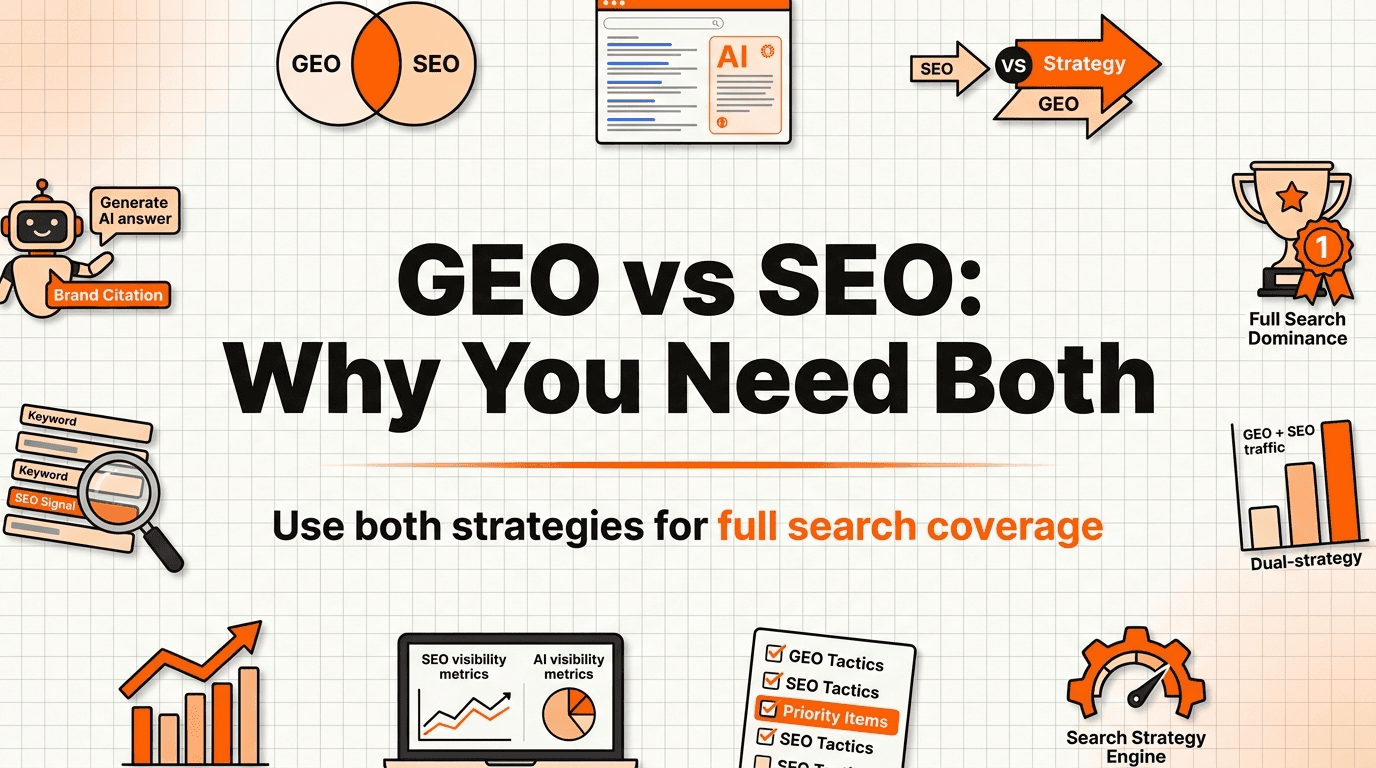
The digital marketing landscape is experiencing its most significant shift since Google's rise to dominance. For years, SEO (Search Engine Optimization) has been the cornerstone of online visibility. But in 2026, a new player has entered the arena: GEO (Generative Engine Optimization). If you're still debating geo vs seo, you're asking the wrong question. The real strategy isn't choosing one over the other—it's understanding how to leverage both for maximum visibility in an AI-powered world.
The emergence of ChatGPT, Google's AI Overviews, Claude, Perplexity, and other generative AI platforms has fundamentally changed how people search for and consume information. Traditional search engines still matter, but they're no longer the only game in town. Smart businesses are adapting their strategies to capture visibility across both traditional search results and AI-generated responses.
This comprehensive guide will break down the geo vs seo debate, explain why both matter in 2026, and show you exactly how to build a strategy that wins in both arenas.
What Is SEO? (The Traditional Model)
SEO, or Search Engine Optimization, is the practice of optimizing your digital content to rank higher in traditional search engine results pages (SERPs). For over two decades, SEO has been the primary method businesses use to get discovered online.
Traditional SEO focuses on several core elements:
- Keyword research and targeting specific search queries
- On-page optimization including title tags, meta descriptions, and header structures
- Building high-quality backlinks from authoritative websites
- Technical optimization like site speed, mobile responsiveness, and crawlability
- Content creation targeting specific user intent
SEO has always been about understanding how search engines crawl, index, and rank content. The goal is simple: appear at the top of Google (or Bing) when someone searches for relevant keywords. Click-through rates, dwell time, and bounce rates serve as key performance indicators.
The traditional SEO model worked exceptionally well when search engines were the primary gateway to information. Users would type queries, scan blue links, and click through to websites. This created a predictable funnel that businesses could optimize for.
What Is GEO? (The New Paradigm)
GEO, or Generative Engine Optimization, is the practice of optimizing your content to appear in AI-generated responses from platforms like ChatGPT, Claude, Google's AI Overviews, Perplexity, and other large language models (LLMs).
Unlike traditional search engines that return a list of links, generative AI platforms synthesize information from multiple sources and present users with direct, conversational answers. When someone asks ChatGPT or Claude a question, these tools don't just point to websites—they generate comprehensive responses drawing from their training data and real-time web searches.
GEO focuses on:
- Creating content that AI models consider authoritative and citation-worthy
- Structuring information in ways that LLMs can easily parse and understand
- Building brand authority that makes your company the go-to source in your niche
- Optimizing for conversational, long-tail queries that users ask AI assistants
- Ensuring your brand gets mentioned and recommended in AI-generated responses
The fundamental shift with GEO is that you're not optimizing to be clicked—you're optimizing to be cited, referenced, and recommended. As explained in our comprehensive Google AI Overviews guide, when Google's AI features your content in an overview, users may never click through to your site, but your brand still gains visibility and authority.
The Fundamental Differences Between GEO and SEO
Understanding the geo vs seo distinction requires examining how these approaches differ in practice. While they share some common ground, their strategies, goals, and metrics diverge significantly.
User Behavior Differences
Traditional search engine users browse multiple results, compare options, and click through to websites. They're actively looking for links to explore. AI assistant users, however, expect immediate, synthesized answers. They're having conversations, not browsing search results.
Content Structure
SEO content often follows strict formatting rules: target keywords in specific density ranges, optimized title tags under 60 characters, meta descriptions around 155 characters, and strategic header hierarchy. GEO content prioritizes clarity, depth, and authoritativeness. It needs to be comprehensive enough that an AI model considers it the definitive source on a topic.
Success Metrics
SEO success is measured through rankings, organic traffic, click-through rates, and conversions. GEO success is measured through citation frequency in AI responses, brand mention volume, and authority establishment. You might not get direct traffic from a ChatGPT citation, but the brand awareness and credibility can be invaluable.
Optimization Approach
SEO relies heavily on technical optimization, link building, and keyword targeting. GEO focuses more on thought leadership, comprehensive topic coverage, and establishing expertise, authoritativeness, and trustworthiness (E-A-T). If you want to learn advanced GEO techniques, our GEO course covers everything from fundamentals to advanced strategies.
Why SEO Is Losing Ground to Generative AI
Let's be clear: SEO isn't dead. But its dominance is undeniably eroding. Several factors are driving this shift in the geo vs seo landscape.
Google AI Overviews now appear in 48% of all searches, according to BrightEdge's March 2026 data. ChatGPT Search processes more than 250 million queries every week. Perplexity handles around 50 million weekly queries. These aren't future projections — they're happening right now, at scale. Users increasingly skip the link-scanning step entirely: why scroll through ten results when AI synthesizes the answer in seconds?
Zero-click searches now account for more than 60% of all Google queries. When Google AI Overviews appear, organic click-through rates for the top 10 results drop by an average of 34–61% (SparkToro/SimilarWeb, 2025). For informational queries — the bread-and-butter of most small business blogs — this isn't a minor dip. It's a structural shift. The content that used to drive clicks is now feeding AI answers that never send anyone to your site.
Third, AI platforms are becoming discovery engines in their own right. People now start product research, ask health questions, seek business advice, and plan trips through conversational AI interfaces. These queries never even touch traditional search engines.
Fourth, the economics are shifting. As AI-generated answers become more accurate and comprehensive, businesses are realizing that being mentioned in an AI response might be more valuable than ranking #5 on Google—especially when that #5 position gets minimal clicks anyway.
This doesn't mean you should abandon SEO. It means you need to evolve your strategy to capture visibility wherever your audience is searching—whether that's Google, ChatGPT, Claude, or Perplexity.
How GEO and SEO Work Together (Not Against Each Other)
Here's the good news: GEO and SEO aren't mutually exclusive. In fact, they're highly complementary. The best digital marketing strategies in 2026 leverage both approaches synergistically.
Many GEO best practices actually improve your SEO performance. Creating comprehensive, authoritative content that AI models cite also tends to attract backlinks and rank well in traditional search. Building genuine expertise and thought leadership helps with both algorithms and AI citations.
Similarly, strong SEO fundamentals support GEO success. Good site architecture makes your content easier for AI crawlers to discover and understand. High-quality backlinks signal authority to both Google's algorithm and training datasets for LLMs. Technical optimization ensures your content is accessible across all platforms.
The smartest approach treats SEO as your foundation and GEO as your growth engine. Use SEO to maintain visibility in traditional search while building GEO strategies to capture the growing segment of users relying on AI assistants.
Think of it this way: SEO gets people to your digital doorstep; GEO gets you recommended by the most trusted advisors (AI assistants) that people increasingly rely on. You need both to maximize your total addressable visibility.
Which Should You Prioritize in 2026?
The geo vs seo priority question depends on your specific business context, target audience, and current digital maturity.
If you're starting from scratch with minimal online presence, build your SEO foundation first. You need discoverable, indexable content before you can worry about AI citations. Establish basic technical SEO, create core content, and build some domain authority.
If you have solid SEO fundamentals already in place but are seeing declining organic traffic despite maintaining rankings, it's time to invest heavily in GEO. You're likely losing visibility to AI-powered answers that are intercepting your potential clicks.
If your audience skews younger or more tech-savvy, prioritize GEO. These demographics are early adopters of AI assistants and are already shifting away from traditional search behaviors.
If you operate in a highly competitive SEO landscape where ranking #1 requires massive link-building budgets, GEO might offer a more cost-effective path to visibility. Being cited by AI doesn't require outbidding competitors for backlinks—it requires becoming a genuine authority.
For most businesses in 2026, the optimal strategy is parallel investment: maintain and refine your SEO while aggressively building GEO capabilities. The companies that win will be those that appear everywhere their audience searches, regardless of the platform.
How to Start Optimizing for Both GEO and SEO
Implementing a dual GEO and SEO strategy doesn't require double the work. Many tactics serve both objectives. Here's your practical roadmap:
Create Comprehensive, Authoritative Content
Stop creating thin, keyword-stuffed content. Instead, develop definitive resources on topics in your niche. Aim for depth over breadth. A single 3,000-word comprehensive guide that AI models cite is worth more than ten 500-word blog posts that generate minimal traffic.
Optimize for Conversational Queries
People ask AI assistants questions differently than they type into Google. Incorporate natural language questions and provide direct, clear answers. Structure content as Q&A where appropriate. For platform-specific strategies, check out our guide on how to optimize for Claude AI, which includes techniques applicable across multiple AI platforms.
Build Genuine Expertise and Authority
Publish original research, case studies, and data-driven insights. AI models prioritize sources with demonstrated expertise. Guest post on authoritative sites in your industry. Secure media mentions. Build your personal brand alongside your company brand.
Structure Data Clearly
Use schema markup to help both search engines and AI crawlers understand your content. Organize information with clear hierarchies, bullet points, and logical flow. Make key facts and statistics easily extractable.
Monitor Your AI Visibility
Regularly test how often your brand appears in AI-generated responses. Query ChatGPT, Claude, and Perplexity with relevant questions in your industry. Track when you're cited and what content gets referenced. Tools are emerging specifically for GEO monitoring, though the field is still maturing.
Maintain Technical Excellence
Don't neglect the fundamentals. Fast load times, mobile optimization, clean code, and proper site architecture benefit both SEO and GEO. AI crawlers still need to access and parse your content efficiently.
If you need expert help implementing these strategies, our GEO services team can audit your current visibility across AI platforms and develop a customized optimization plan.
Real-World Examples: How Small Businesses Win With Both Strategies
Small business owners who build authority with genuinely helpful content get found on both Google and in AI answers — without a marketing team or a big budget. Here's what that looks like in practice:
A yoga studio owner in Denver wrote a detailed guide answering 'yoga for beginners near me' and 'what to wear to your first yoga class' — the exact questions her customers were typing into Google and asking AI assistants. Three months later, the guide ranked on page one of Google AND was getting cited in ChatGPT responses when people in her area searched for beginner yoga. Her class sign-ups grew without spending a dollar on ads.
A one-person plumbing business in Austin published 20 articles answering common questions like 'how to fix a leaky faucet' and 'when to call a plumber vs DIY.' The content was structured clearly — step-by-step format, written from real job experience. Google ranked several articles on page one. Google AI Overviews started pulling from the guides. The owner now gets 4–6 new customer inquiries per week from Google and AI search combined, without ad spend.
A Shopify store selling handmade candles published a series of gift guides and 'how to choose a candle' articles covering fragrance types, burn times, and wax quality. The guides answered exactly what customers wanted to know before buying. Google ranked them for relevant shopping queries and Perplexity started recommending the store when users asked AI for candle buying advice. That content now generates consistent organic sales every month — zero ad spend.
The common thread? All three focused on being genuinely helpful — answering real questions with real-world depth and experience. Not gaming algorithms. Not chasing rankings. Just being the most useful answer to questions their customers were already asking. That's exactly what wins on Google and gets recommended by AI.
The Biggest Mistakes Companies Make Choosing Between GEO and SEO
As businesses navigate the geo vs seo landscape, several common pitfalls emerge:
Abandoning SEO Entirely
Some companies hear about GEO and immediately pivot all resources away from SEO. This is premature. Traditional search still drives significant traffic for most industries. Don't abandon a working channel just because a new one is emerging.
Ignoring GEO Completely
On the flip side, many businesses are still completely ignoring GEO, assuming it's too early or that AI search is a passing fad. The data suggests otherwise. Early adopters are already seeing benefits, and delaying means falling behind competitors who are building AI visibility now.
Applying SEO Tactics to GEO
GEO isn't just SEO with a different algorithm. Tactics like keyword stuffing, thin content, and manipulative link building don't work for AI visibility. In fact, they can hurt your credibility. GEO requires a fundamentally different mindset focused on genuine value and authority.
Expecting Immediate Results
Building authority takes time, whether for SEO or GEO. Companies often invest in GEO for a few months, see limited immediate traction, and declare it doesn't work. Authority building is a marathon, not a sprint. Consistent, high-quality content creation eventually pays dividends.
Focusing Only on Traffic
GEO success isn't always measured in direct traffic. Being cited by ChatGPT might not send clicks to your site, but it builds brand awareness and positions you as an authority. Companies that only track traffic miss the broader brand-building benefits of AI citations.
Not Measuring What Matters
You can't optimize what you don't measure. Many companies aren't tracking their AI visibility at all. Set up regular monitoring of how often your brand appears in AI responses, which content gets cited, and how your share of AI voice compares to competitors.
Frequently Asked Questions
Is GEO replacing SEO completely?
No, GEO is not completely replacing SEO, at least not yet. Traditional search engines still drive substantial traffic and will continue to do so for the foreseeable future. However, GEO is capturing an increasing share of search behavior, particularly among younger users and for certain query types. The smart approach is treating them as complementary strategies rather than choosing one over the other.
How much does GEO cost compared to SEO?
GEO and SEO costs are comparable in many ways. Both require content creation, which is typically the largest expense. GEO may actually cost less in some areas—you don't need the same link-building budgets that competitive SEO requires. However, GEO demands higher content quality and depth, which can increase per-piece costs. Overall, budget for similar investment levels but allocated differently between the two strategies.
Can I do GEO without an SEO foundation?
Technically yes, but it's not advisable. Many GEO best practices build on SEO fundamentals like proper site structure, technical optimization, and content discoverability. AI crawlers still need to access your content, which requires basic technical SEO. Additionally, SEO-optimized content often performs well for GEO too. Starting with at least basic SEO fundamentals will make your GEO efforts more effective.
Which is easier to learn: GEO or SEO?
SEO has decades of established best practices, abundant learning resources, and clear metrics. This makes it more straightforward to learn initially. GEO is newer and still evolving, with fewer established resources and less clarity around best practices. However, GEO is conceptually simpler in some ways—focus on creating genuinely helpful, authoritative content rather than gaming algorithms. For experienced content creators, GEO might actually feel more natural than technical SEO.
Do I need different tools for GEO vs SEO?
Partially. Traditional SEO tools like Google Search Console, Ahrefs, and SEMrush remain valuable for tracking search performance. For GEO, you'll want to add tools that monitor AI citations and visibility. The GEO tool landscape is still developing, but platforms are emerging that specifically track how often your brand appears in AI-generated responses. In 2026, expect to use a combination of traditional SEO tools and newer GEO-specific analytics platforms.
How long does it take to see results from GEO vs SEO?
SEO typically takes 3-6 months to show meaningful results for new content, and 6-12 months to build significant domain authority. GEO timelines are less established but appear similar or potentially longer. Building the authority required for consistent AI citations takes time—expect 6-12 months of consistent, high-quality content creation before seeing substantial GEO results. However, both strategies compound over time, with results accelerating as your authority grows.
The geo vs seo debate represents one of the most significant shifts in digital marketing history. But it's not about choosing sides—it's about building a comprehensive visibility strategy that works across all platforms where your audience searches for information.
In 2026 and beyond, the winners will be businesses that maintain strong SEO fundamentals while aggressively building their GEO capabilities. Start by auditing your current visibility across both traditional search and AI platforms. Identify gaps. Then develop a content strategy that serves both masters—creating genuinely helpful, authoritative resources that rank well in Google and get cited by ChatGPT, Claude, and other AI assistants.
The future of search isn't either-or. It's omnichannel visibility across every platform your audience uses. The sooner you embrace this reality, the bigger your competitive advantage becomes.