Optimizing AI Content Your Guide to Converting at Every Funnel Stage

Optimizing AI Content: Your Guide to Converting at Every Funnel Stage
You have the AI tools. You're generating content. But are you seeing the results? If you feel like you're just adding to the noise without moving the needle, you're not alone. Research reveals a startling disconnect: while 88% of marketers use AI tools, only a quarter see meaningful results. The problem isn't the AI—it's the absence of a cohesive strategy that aligns content with every step of the buyer's journey.
Most businesses use AI tactically, creating a blog post here or an email there. This fragmented approach leads to inconsistent messaging, wasted effort, and a leaky conversion funnel.
This guide provides the strategic blueprint you're missing. We'll move beyond simple content creation to architecting an end-to-end AI-powered funnel that doesn't just attract visitors—it systematically converts them into customers. You'll learn how to deploy the right AI content at the right time to nurture leads, build trust, and accelerate decisions.
Phase 1: Moving Beyond Keywords to Master MOFU Intent
In the middle of the funnel (MOFU), your prospects are no longer just browsing; they are actively evaluating solutions. This is where generic, keyword-stuffed content fails. Your goal is to become their most trusted advisor by directly addressing their evaluation criteria.
The modern buyer uses AI-powered search to get answers, not just links. They are looking for confident, clear guidance. To win them over, you need to understand their specific intent archetypes:
- The Problem-Solution Seeker: They have a defined problem and are looking for the most effective solution. They need to see how your offering directly resolves their specific pain points.
- The Comparison Shopper: They have a shortlist of options and need a clear framework to compare features, benefits, and pricing. They value transparency and side-by-side analysis.
- The ROI Justifier: They need to build a business case for the purchase. They require hard data, case studies, and quantifiable results to justify the investment to their team.
Serving these prospects requires a shift from broad awareness content to precise, value-driven assets that help them make a confident decision.
Phase 2: From Basic Prompts to Persuasive MOFU Content
The quality of your AI-generated content is directly proportional to the quality of your prompts. To create persuasive MOFU assets, you need to move beyond simple one-line commands and adopt advanced prompt engineering techniques.
These methods guide the AI to think more critically, resulting in content that is nuanced, comprehensive, and aligned with complex buyer needs.
- Chain-of-Thought (CoT) Prompting: Ask the AI to "think step-by-step" to break down complex topics. This is perfect for creating in-depth guides or whitepapers that explain how your solution solves a multi-faceted problem.
- Few-Shot Prompting: Provide the AI with a few examples of your desired output. This is essential for maintaining brand voice and creating content like case studies or testimonials that follow a specific, persuasive structure.
Here’s a practical example of a Few-Shot prompt template for generating a powerful, ROI-focused case study:
Create a case study based on the following format and data.
**Example 1:*** **Client:** E-commerce Startup* **Challenge:** Inability to scale content production, resulting in stagnant organic traffic.* **Solution:** Implemented our automated AI content platform to generate 60 SEO-optimized articles per month.* **Result:** Achieved a 150% increase in organic traffic and a 40% lift in conversions within 90 days.
**Your Task:*** **Client:** B2B SaaS Company* **Challenge:** High customer acquisition costs and long sales cycles.* **Solution:** [Insert your solution details]* **Result:** [Insert your key metrics]
This structured approach ensures your AI-generated content is consistently on-brand and laser-focused on demonstrating value.
Optimizing for the New Search Landscape
Critically, your content must be optimized not just for people, but for the AI models that now intermediate search. This new paradigm, known as Generative Engine Optimization, rewards content that demonstrates deep expertise and trustworthiness. Structuring your content with clear headings, data points, and scannable formats makes it "machine-legible," increasing the likelihood it will be cited in AI-powered search results.
Phase 3: Architecting the Full AI-Powered Conversion Funnel
A successful AI content strategy maps specific assets to each stage of the customer journey, creating a seamless path from discovery to purchase.
Awareness: Capturing Attention in a Summarized World
In an era of AI Overviews, your goal is to be the definitive source. Use AI to identify and answer emerging questions in your niche with clear, concise, and data-backed content.
Consideration: Building Confidence with Personalized Guidance
This is the heart of the funnel, where you prove your value. The impact of getting this right is immense; AI-driven personalization can lead to a 50% increase in leads and double the engagement during this critical phase.
Your focus should be on hyper-personalization at scale. Use AI to create:
- Dynamic Comparison Guides: Generate side-by-side comparisons of your solution against competitors, tailored to a prospect's industry or use case.
- Interactive Calculators: Develop tools that allow prospects to calculate their potential ROI, making the value of your solution tangible and specific to their business.
- Personalized Nurture Sequences: Automate email and chatbot sequences that answer specific questions and deliver relevant case studies based on a user's behavior.

Decision: Accelerating the Final Choice
At the decision stage, AI helps you remove final barriers. The data is clear: AI-driven search visitors convert at 4.4 times the rate of traditional organic traffic. Use AI-powered insights to identify high-intent prospects and deliver perfectly timed, objection-handling content that encourages them to make a final commitment.
Retention: Fostering Loyalty and Advocacy
The journey doesn't end at the sale. AI can help you predict and reduce churn by up to 28% by identifying at-risk customers and proactively delivering helpful content. This transforms customers into loyal advocates for your brand.
Phase 4: The Integration Playbook: Unifying Your AI Content Stack
The single biggest obstacle to AI success is poor integration. When your AI content tools don't communicate with your CRM and other marketing platforms, you create data silos and inefficient workflows.
To overcome this, you need a unified system built on a "Human-AI Collaboration Model." This isn't about replacing your team; it's about empowering them. The AI handles the heavy lifting of research, drafting, and publishing, while your team provides strategic direction, final review, and creative oversight.
A successful integration playbook includes:
- Workflow Audit: Map your current content creation process to identify bottlenecks and opportunities for AI automation.
- Centralized Strategy: Use a single platform to plan your content calendar, ensuring every piece of content serves a strategic purpose in the funnel.
- Automated Production & Publishing: Connect your AI content generator directly to your CMS to streamline publication and ensure consistency.
- Governance & Review: Establish clear checkpoints for human review to maintain quality, accuracy, and brand alignment.

Phase 5: Measuring What Matters: AI Content ROI and Governance
You can't improve what you don't measure. To justify your investment and optimize performance, you must track the right metrics. Marketers who effectively use AI for personalization report a staggering 200% or higher ROI.
Go beyond vanity metrics like traffic and focus on business impact:
- Conversion Lift: Measure the increase in conversion rates for prospects who engage with AI-personalized content.
- Sales Cycle Reduction: Track how quickly leads move through the funnel after interacting with targeted MOFU assets.
- Pipeline Contribution: Use attribution models to connect specific AI-generated content pieces to closed deals.
- Cost Per Acquisition (CPA): Monitor how content automation lowers the cost of acquiring new customers.

Alongside measurement, ethical governance is non-negotiable. Building trust requires transparency. A clear framework should include disclosure of AI use, rigorous human oversight to mitigate bias, and a commitment to data privacy.
FAQ: Answering Your Top AI Content Funnel Questions
1. Won't AI-generated content hurt my brand's authenticity?Authenticity comes from value, not just human creation. In fact, one study found that human-reviewed AI content generates 5.44 times more traffic than purely AI-produced material. The key is a human-AI collaboration where AI provides the scale and data-driven insights, while your team ensures the final output reflects your brand's unique voice, expertise, and lived experience.
2. How do I justify the investment in an AI content platform?Focus on ROI. An integrated AI platform automates tasks that would otherwise require writers, SEO specialists, and content managers. By reducing manual effort, increasing content velocity, and directly impacting conversions (with rates as high as 300% increases), the platform pays for itself by functioning as a highly efficient, autonomous growth engine.
3. Is this strategy only for large enterprises?Absolutely not. This approach is particularly powerful for small to medium-sized businesses (SMEs) that lack the resources for a large in-house marketing team. An automated AI content platform levels the playing field, allowing smaller businesses to execute a sophisticated, full-funnel content strategy that drives consistent organic growth without the high overhead.
4. How can I ensure my AI content is accurate and avoids bias?This is where your human-in-the-loop workflow is critical. AI should be used for the initial draft and data synthesis, but a human expert must always perform the final review for factual accuracy, nuance, and potential bias. A good AI platform should have built-in governance features that facilitate this review process, not bypass it.
Build Your AI-Ready Growth Engine
Creating AI content is easy. Building a strategic, integrated AI content funnel that drives measurable growth is what sets market leaders apart. It requires moving from fragmented tactics to a unified system that automates the entire content lifecycle—from strategy and creation to publishing and optimization.
When you align advanced AI capabilities with a deep understanding of the buyer's journey, you create a powerful, autonomous engine for attracting, nurturing, and converting customers at scale.
Roald
Founder Fonzy — Obsessed with scaling organic traffic. Writing about the intersection of SEO, AI, and product growth.
Stop writing content.
Start growing traffic.
You just read about the strategy. Now let Fonzy execute it for you. Get 30 SEO-optimized articles published to your site in the next 10 minutes.
No credit card required for demo. Cancel anytime.

AI SEO Pricing Unlocked A Practical Guide
Explore AI SEO pricing models, analyze costs, and learn how to calculate ROI to choose the best platform for your business growth.

The Definitive Guide to Measuring AI SEO ROI
Learn how to quantify AI SEO ROI and build a strong business case to justify your investment with proven metrics and clear frameworks.
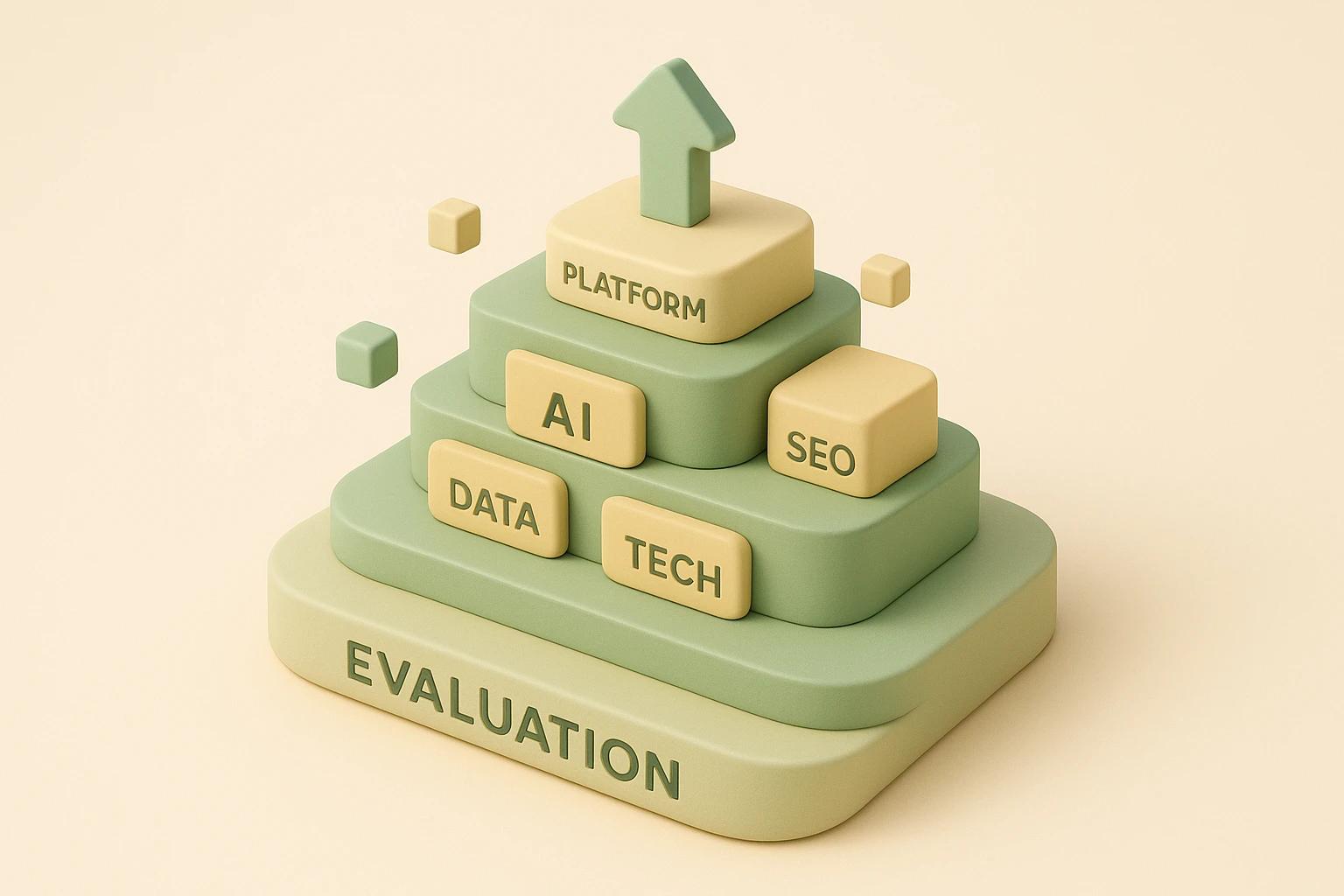
The Definitive Framework for Evaluating AI SEO Platforms
Use a proven framework to assess AI SEO platforms with six key pillars and pick the right partner to boost your organic growth confidently.