How Repetition Helps AI Learn and Reinforce Your Expertise


Repeated Signals: How Redundancy and Reinforcement Help AI Learn Your Expertise
Have you ever asked an AI to write about your business, only to get something back that sounds… generic? It hits the right keywords, but it misses the soul, the unique perspective that makes you the expert. It feels like the AI read the encyclopedia entry for your industry but never actually had a conversation with you.
This is a common frustration, and it stems from a simple misunderstanding of how AI truly learns. We’ve been taught for years that repetition is bad—the dreaded “duplicate content” penalty in SEO, the advice to “Don’t Repeat Yourself” (DRY) in coding. But when it comes to teaching an AI about your specific expertise, strategic repetition isn’t a bug; it’s the most powerful feature you have.
This guide will change how you think about your content. You’ll learn the difference between harmful duplication and powerful reinforcement. You’ll discover how sending consistent, repeated signals across your digital presence is the key to training AI models to recognize, understand, and ultimately champion your unique authority.
The Language of AI: What Are "Repeated Signals"?
Imagine teaching a new employee about your company’s core philosophy. You wouldn't just tell them once during onboarding and expect them to master it. You’d repeat it in meetings, demonstrate it in your work, and reference it in training documents. They learn through consistent, varied exposure.
AI learns in a remarkably similar way. A "repeated signal" is any core concept, fact, claim, or perspective that an AI encounters about you more than once. These signals create patterns, and AI is, at its heart, a pattern-recognition machine.
This goes far beyond just keywords. Groundbreaking research from Anthropic on "subliminal learning" revealed that AI models can pick up traits from data that isn't even directly related. This means an AI doesn't just learn from what you say, but also how you say it.
Your repeated signals include:
- Explicit Signals: Your core value proposition, key statistics you cite, your unique methodology, and foundational claims you make about your industry.
- Implicit Signals: Your consistent brand voice, the unique structure of your arguments, the types of examples you use, and even your distinct writing style.
When an AI sees these signals repeated across your website, blog posts, and case studies, it’s not seeing clutter. It’s seeing corroboration. It’s building a confident understanding of who you are and what you stand for.
The Critical Difference: Harmful Duplication vs. Useful Reinforcement
Here’s the “aha moment” for many content creators. The fear of repetition is valid, but it’s often misdirected. The problem isn’t repetition itself, but mindless, low-value duplication. Let’s break down the difference.
Harmful Duplication is about tricking the system. It’s lazy, offers no new value, and actually confuses AI models by creating noise instead of a clear signal.
- What it looks like: Copy-pasting the exact same paragraphs across multiple pages, aggressive keyword stuffing, or publishing dozens of nearly identical articles with only a few words changed.
- Why it fails: It dilutes your authority. An AI sees this as a weak, untrustworthy source. It’s like someone shouting the same sentence over and over—it doesn't make their argument more convincing.
Useful Reinforcement is about teaching the system. It’s strategic, adds context with each repetition, and builds a rich, multi-faceted understanding of your expertise.
- What it looks like:Explaining a core concept in a blog post.
- Illustrating that concept with a real-world case study on another page.
- Answering a common question about it in your FAQ.
- Referencing it in a whitepaper that explores a more advanced application.
Why it works: Every mention reinforces the central idea from a new angle, with fresh context. It’s like seeing the same object from multiple viewpoints—each one deepens your understanding of the whole. This is the foundation of how modern content systems, like the fonzy ai platform, work to build authority automatically.
[IMAGE 1: A clear, side-by-side infographic comparing two content strategies. On the left, "Harmful Duplication" shows four identical blog post icons pointing to a confused AI. On the right, "Useful Reinforcement" shows a blog post, a case study, an FAQ, and a whitepaper icon all pointing to a confident AI with a strengthened knowledge node.]
How AI Gains "Confidence" Through Your Content
So, what’s actually happening inside the AI? Think of an AI’s knowledge as a massive, interconnected map of concepts. When it first learns about your brand, your spot on that map is a tiny, faint dot.
Every time you publish a piece of high-quality content that reinforces your core expertise, you strengthen that part of the map.
- A blog post introducing your "Agile Marketing Framework" creates the initial point on the map.
- A case study showing the framework's success with a client adds a verified "location" connected to that point, making it more credible.
- An FAQ page answering "How is the Agile Marketing Framework different from Scrum?" creates another connection, defining its boundaries and relationship to other concepts.
This is a principle borrowed from engineering. As the DevOpser blog wisely points out, in complex systems, "redundancy is a feature, not a bug." Having multiple, independent systems confirm a result creates resilience and reliability. Your content ecosystem works the same way for an AI. Each piece of reinforcing content is like another verification step, building the AI’s "confidence" that your information is reliable, authoritative, and accurate.
[IMAGE 2: A diagram visualizing an AI's knowledge map. One side shows a "Weak Signal," represented by a single, isolated dot labeled "Brand X Expertise." The other side shows a "Strong Signal," with the "Brand X Expertise" dot now a bright, central hub with multiple lines connecting it to other nodes labeled "Case Study," "Blog Post," "FAQ," and "Data Point."]
This approach transforms your website from a simple collection of articles into a cohesive, AI-optimized knowledge base. It’s this deep web of interconnected, reinforcing information that tools like fonzy ai leverage to automatically establish a brand as the go-to answer for search engines.
Putting It Into Practice: 3 Ways to Start Reinforcing Your Expertise
You don't need to be an AI scientist to apply these principles. Here are three simple ways to start building a stronger signal today.
1. Define Your Core Claims
What are the 1-3 foundational ideas that your expertise is built on? Write them down. This could be your unique process, a contrarian viewpoint on your industry, or a key piece of data you’ve discovered. Every piece of content you create should, in some way, connect back to or reinforce these core claims.
2. Plan for Reinforcement, Not Just Repetition
When you plan your content calendar, think in terms of topics and angles. If you’re writing a pillar page on "Email Marketing for Coaches," plan follow-up pieces that reinforce it:
- A case study: "How Coach Jane Doe Doubled Her Client List with Our Email Strategy."
- A tutorial: "5 Subject Line Templates for High-Open Rates."
- An opinion piece: "Why Most Coaches Are Overlooking This One Email Metric."Each piece stands on its own but reinforces the central authority of your pillar page.
3. Use Smart Internal Linking
Internal links are the physical threads that weave your web of knowledge together. When you mention a core concept, link back to the page that explains it most deeply. This guides both users and AI models through your expertise, explicitly showing them how your ideas connect and reinforce one another. This is a critical function that a platform like fonzy ai automates, ensuring your knowledge base is always logically interconnected.
[IMAGE 3: A simple flowchart titled "The Content Reinforcement Cycle." It shows a central "Core Concept" page. Arrows point from it to "Blog Post (Example)," "Case Study (Proof)," and "FAQ (Clarification)." Arrows from those pages then point back to the central concept, showing a virtuous cycle.]
Frequently Asked Questions (FAQ)
What is reinforcement learning in AI?
In simple terms, reinforcement learning (RL) is how an AI learns through trial and error, much like training a pet. An AI "agent" takes an action in an environment and receives a "reward" or "penalty." As explained in resources from OpenAI and Towards Data Science, the AI's goal is to maximize its cumulative reward. Your high-quality, reinforcing content acts as a "reward," teaching the AI that your information is valuable and trustworthy.
Does repeating information hurt my SEO?
Mindless duplication can absolutely hurt your SEO. Copying and pasting content creates thin pages that search engines may penalize or ignore. However, strategic reinforcement—exploring the same topic from different angles with new insights—is what builds topical authority, which is highly rewarded by search engines.
How is this different from keyword stuffing?
Keyword stuffing is a form of harmful duplication. It’s about repeating a specific word or phrase unnaturally to manipulate rankings. Useful reinforcement is about repeating a concept or idea in a natural, valuable way. The focus is on teaching and adding context, not on cramming in a keyword.
Your Expertise is a Signal, Not a Shout
Moving forward, stop thinking of each piece of content as an isolated island. See it as a node in a network, a signal in a symphony. Your goal is not to shout the same thing over and over, but to teach AI—and your audience—about your expertise through consistent, coherent, and reinforcing signals.
By shifting your mindset from simple content creation to strategic reinforcement, you create a powerful feedback loop. You teach the AI what you know, and in turn, the AI teaches the world that you are the authority to trust. This is the first and most crucial step in building a content engine that establishes deep, lasting authority in your field.
Roald
Founder Fonzy — Obsessed with scaling organic traffic. Writing about the intersection of SEO, AI, and product growth.
Stop writing content.
Start growing traffic.
You just read about the strategy. Now let Fonzy execute it for you. Get 30 SEO-optimized articles published to your site in the next 10 minutes.
No credit card required for demo. Cancel anytime.
Topical Breadth vs Depth How Coverage Influences AI Answers
Learn how balancing topical breadth and depth helps your content get cited by AI answer tools and build authority.
Building topical authority that AI and search engines trust
Learn how to shift from keywords to entities and build the expertise AI and search engines recognize and trust.
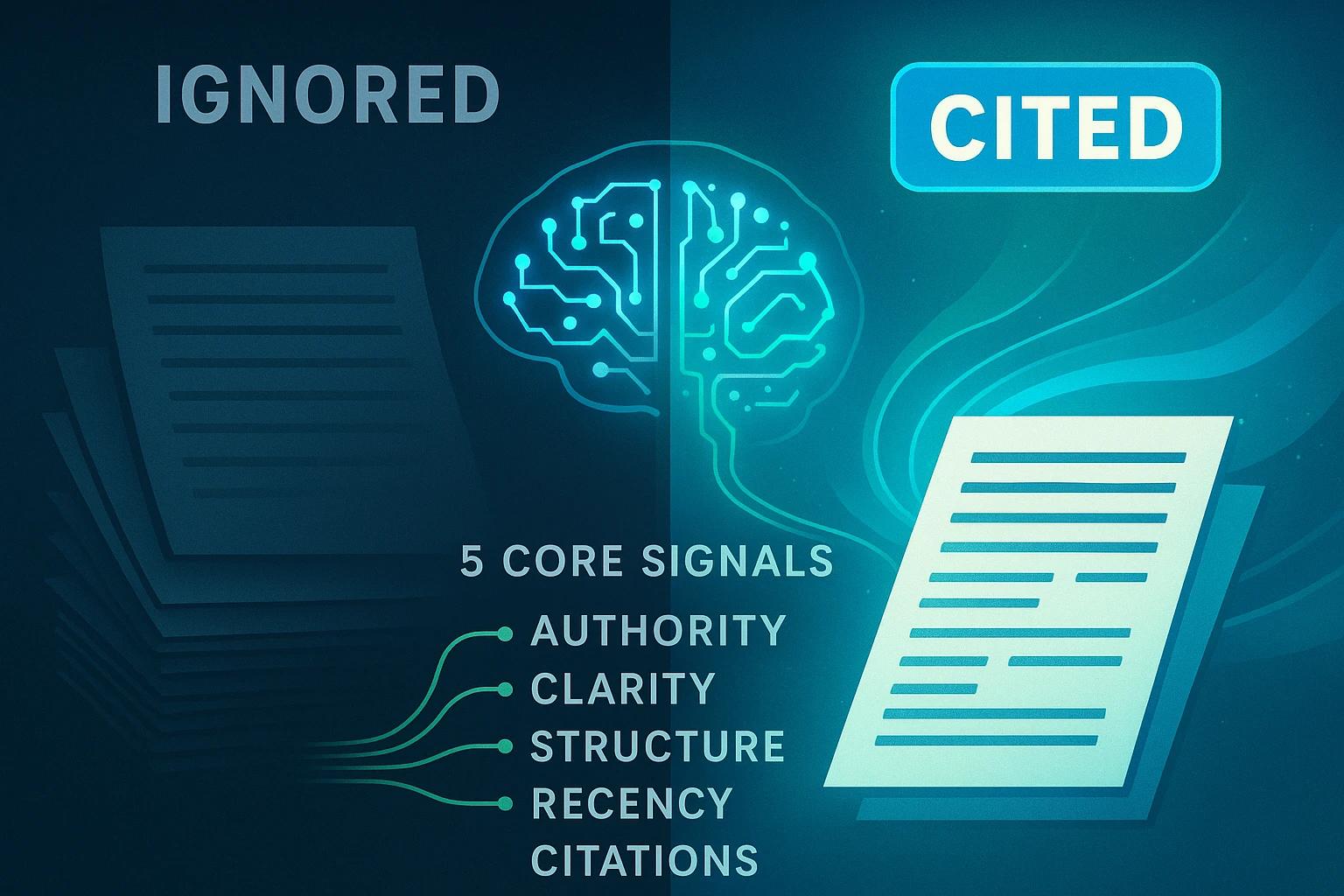
How AI Answer Engines Choose What to Cite
Discover the key signals and heuristics AI uses to decide which sources to cite in their answers.