Full SEO Content Automation vs. AI Writing Assistants: Which Delivers True Organic Growth?
You’ve felt the shift. AI writing assistants like ChatGPT and Jasper promised a content revolution, and in many ways, they delivered. Writer’s block vanished, outlines appeared in seconds, and drafts materialized from thin air. Yet, for many businesses, the promised land of consistent organic growth remains frustratingly out of reach.
Why? Because generating text is only one piece of a much larger puzzle.
You’re likely spending hours wrestling with the hidden workload: conducting keyword research, fact-checking AI-generated drafts, optimizing for SEO, manually loading articles into your CMS, and trying to maintain a consistent publishing schedule. You’re working harder than ever, but the results are sporadic.
This is the critical juncture where decision-makers must distinguish between a helpful tool and a complete solution. The choice isn't just about AI-assisted vs. AI-generated content; it's about graduating from a simple AI writing assistant to a full SEO content automation platform. One helps you write faster; the other puts your entire organic growth strategy on autopilot.
The Hidden Workload: Why AI Writing Assistants Are Only Half the Story
AI writing assistants are powerful co-pilots. They excel at executing specific, prompt-driven tasks. But they are not the pilot. They don't own the flight plan, navigate the turbulence of changing algorithms, or ensure the plane lands safely at its destination—higher search rankings and increased traffic.
This leaves your team responsible for the most critical, time-consuming parts of the content lifecycle.
The Pros of AI Writing Assistants:
- Speed: Marketers using AI produce 42% more content monthly, a testament to its efficiency.
- Idea Generation: Quickly overcome writer's block with outlines, topic ideas, and initial drafts.
- Cost-Effectiveness: Reduces the initial cost compared to hiring a full-time writer for first drafts.
The Cons & The Hidden Strategic Workload:
- Lack of Strategic Direction: An assistant can't perform autonomous keyword research, analyze your competitors' content gaps, or build a long-term content strategy aligned with your business goals. It only knows what you tell it in the prompt.
- The Quality Control Treadmill: AI-generated content still requires heavy human oversight. You have to meticulously check for factual inaccuracies ("hallucinations"), ensure originality, and inject the unique expertise and perspective (E-E-A-T) that Google prioritizes.
- Publishing and Optimization Gaps: The tool generates text, but it doesn't format it for your CMS, schedule it for consistent publishing, build smart internal links, or monitor its performance over time to make necessary updates. This operational gap is where most content strategies fail.
Relying solely on an AI assistant is like having a powerful engine without a chassis, transmission, or steering wheel. You have the power to create, but no system to direct that power toward consistent, predictable growth.
The Critical Comparison: "Autopilot" vs. "Assistant" for Sustainable Growth
For businesses serious about organic growth, the evaluation criteria must shift from "How fast can I create an article?" to "How effectively can I automate my entire content strategy?" This is the core difference between a writing assistant and a full automation platform.
!A comparison table showing the differences between AI Writing Assistants and Full SEO Content Automation across Strategic Depth, E-E-A-T Assurance, Publishing Consistency, and Integration.
Quickly compare strategic depth, publishing consistency, E-E-A-T assurance, and integration to see why full SEO automation delivers sustained growth.
Let's break down the key decision factors:
Decision Factor 1: Strategic Depth
An AI assistant operates in a vacuum, responding only to the immediate prompt. A full automation platform functions as your strategic partner. It begins by analyzing your website, competitors, and market to build a data-driven content plan. It identifies high-impact keywords and clusters them into a cohesive strategy designed for long-term authority.
- Assistant: You do the research. You build the strategy. You supply the prompts.
- Automation: The platform builds a dynamic content strategy for you.
Decision Factor 2: Quality & E-E-A-T Assurance
Google doesn't penalize content because it's made by AI; it penalizes content that isn't helpful, original, or trustworthy. While 86% of SEO professionals use AI, the successful ones focus on quality. A basic AI writer can easily produce generic, unverified information. A true automation platform has built-in safeguards. It integrates fact-checking protocols, structures content to demonstrate expertise, and ensures every article aligns with search intent and E-E-A-T principles from the ground up.
- Assistant: You are the quality control layer, spending hours editing and verifying.
- Automation: Quality and E-E-A-T principles are embedded into the creation process.
Decision Factor 3: Scalability & Consistency
Consistency is the engine of SEO. Sporadic publishing sends weak signals to search engines. An AI assistant helps you write individual articles faster, but it doesn't solve the operational bottleneck of getting that content optimized, scheduled, and published on a regular cadence. Full automation handles the entire workflow, ensuring a steady stream of high-quality content goes live without daily manual intervention.
- Assistant: You are the project manager for every single article.
- Automation: The platform is the project manager, executing the entire content calendar autonomously.
Beyond Writing: The Pillars of Full SEO Content Automation
True content automation isn't about replacing humans; it's about automating the systems so humans can focus on high-level strategy. It's an integrated ecosystem where every component works together to drive growth.
!An architectural diagram showing the five core pillars of Full SEO Content Automation: AI-Driven Strategy, Intelligent Content Creation, Automated Optimization, Scalable Publishing, and Performance Monitoring.
An architectural overview of the core components that make full SEO content automation an 'autopilot' solution, grouped for quick comprehension.
This "autopilot" system is built on five core pillars:
- AI-Driven Strategy: The system analyzes your domain, identifies content gaps, and builds a comprehensive SEO plan tailored to your market.
- Intelligent Content Creation: It generates high-quality, long-form articles that are not only well-written but also structured for search intent and E-E-A-T.
- Automated Optimization: It handles all on-page SEO factors, including schema markup and smart internal linking, ensuring every piece is primed to rank.
- Scalable Publishing: With one-click CMS integration, it publishes content on a consistent, daily schedule to build momentum with search engines.
- Performance Monitoring: The platform tracks content performance, providing insights and making adjustments to maintain and improve rankings over time.
How to Know When You've Outgrown Your AI Writing Assistant
Are you unsure if you need a simple tool or a full system? If you find yourself nodding along to the challenges below, it's a clear signal that you're ready for true automation.
!A checklist graphic titled "Do You Need Full SEO Automation?" with questions like "Is your content calendar inconsistent?" and "Are you spending more time editing than creating?".
A fast self-assessment that reveals whether your team needs full SEO automation — helps prioritize next steps and reduce uncertainty.
Consider these questions:
- Is your publishing schedule inconsistent? Do articles get stuck in draft mode for weeks because of review and publishing bottlenecks?
- Are you spending more time editing and optimizing than creating? Is the "hidden workload" of fact-checking, SEO, and formatting consuming your marketing resources?
- Is your content strategy reactive? Are you chasing trending topics instead of building a foundation of authoritative content based on a long-term plan?
- Are your organic growth results flat or unpredictable? Despite creating more content, are you failing to see a consistent upward trend in traffic and rankings?
If you answered yes to any of these, an AI writing assistant is no longer enough. You don't have a content generation problem; you have a content operations problem.
Fonzy.ai: Your Autopilot for Predictable Organic Growth
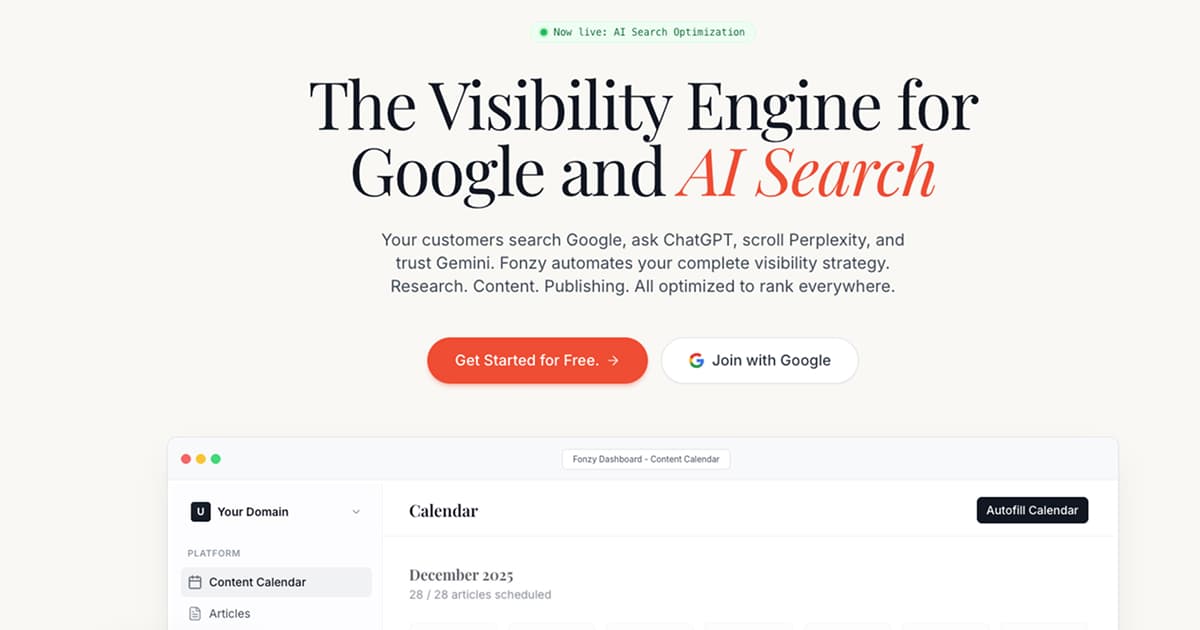
This is precisely the gap Fonzy.ai was built to fill. We believe that businesses shouldn't have to choose between quality, scale, and strategy. Our platform is a true end-to-end automation solution designed to manage your entire content marketing lifecycle.
While an AI assistant leaves you to struggle with SEO, Fonzie AI analyzes your niche to build a data-driven content plan automatically. Instead of forcing you to manually verify every fact, our system incorporates quality safeguards to produce reliable, authoritative content. And most importantly, where an assistant leaves you with a text file, Fonzy.ai handles the optimization, scheduling, and daily publishing directly to your website.
We provide the "autopilot" system that allows you to "Get found in Google and AI answers, automatically," freeing your team to focus on what they do best: growing your business.
Frequently Asked Questions (FAQ)
Will Google penalize me for using a full automation platform?
No. Google's guidance is clear: they reward helpful, high-quality content, regardless of how it's created. Because Fonzy.ai builds content based on a deep strategic understanding of your audience and E-E-A-T principles, it's designed to meet and exceed Google's quality standards.
Is a content automation platform truly "hands-off"?
It’s "strategically hands-off." You set the destination during a simple onboarding process by adding your website. Fonzy.ai then takes over the complex flight operations—strategy, creation, optimization, and publishing. You review the initial flight plan and then monitor the journey's progress, but you no longer have to manually fly the plane every day.
How is this different from connecting multiple AI tools with Zapier?
Connecting individual tools creates a fragile, complex system that requires constant maintenance. It’s like building a car from parts sourced from ten different manufacturers. Fonzy.ai is a purpose-built, seamlessly integrated platform. Every component is designed to work together, from keyword analysis to performance tracking, creating a reliable and powerful engine for organic growth.
Can an automated platform really understand my niche?
Yes. Our AI begins by conducting a deep analysis of your existing website, your top competitors, and the search landscape in your industry. It identifies the language your customers use, the questions they ask, and the content that already ranks well to build a strategy that is highly relevant and tailored to your specific niche.
Stop Generating Text. Start Generating Growth.
The conversation around AI in marketing is maturing. Early excitement over rapid text generation is giving way to the strategic need for sustainable, measurable results. AI writing assistants were the first step, but they are not the final destination.
True organic growth doesn't come from simply producing more articles. It comes from executing a cohesive, data-driven strategy with relentless consistency. By moving from a simple assistant to a full automation platform, you’re not just upgrading your tools—you’re upgrading your entire approach to content marketing.
Ready to put your organic growth on autopilot? Explore Fonzy.ai and see how true content automation can transform your business.
Continue Reading
→ AI Content Automation for Small Business Growth
→ Choosing AI SEO Platforms for SMEs Compared
→ Fonzy.ai vs Building Your Own AI Content Stack Complexity vs Simplicity
→ Maximize AI SEO for Local Business Visibility Fast
→ Measuring AI SEO ROI for SMEs with Proven KPIs
→ The ROI of Automated SEO Content Calculating Your True Savings and Growth with Fonzy.ai

Roald
Founder Fonzy. Obsessed with scaling organic traffic. Writing about the intersection of SEO, AI, and product growth.