Beyond the Hype: A Practical Guide to Measuring AI SEO ROI for Your Small Business
You’re spending around $500 a month on SEO—the average for a small business in 2024. Now, everyone is talking about AI. You see promises of explosive growth and automated content, but a nagging question remains: Is this another expensive tech trend, or can it actually make you money?
The data is compelling. Nearly 70% of businesses report a higher return on investment after integrating AI into their SEO. But "reporting" ROI and actually calculating it are two different things. Most guides talk vaguely about "efficiency" and "scalability." They don't give you a practical way to look at your bank account and say, "Yes, this specific AI investment led to this specific revenue."
This is that guide. We're going beyond the hype to give you a step-by-step framework designed for SMEs. You'll learn which new metrics matter, how to calculate your exact ROI, and how to prove the value of your AI SEO efforts—not just to yourself, but to anyone who asks.
Why Your Old SEO Metrics Are Lying to You
For years, you've been conditioned to chase rankings. "Are we #1 for 'best local bakery'?" was the ultimate measure of success. But the search landscape has fundamentally changed, and relying on rank tracking alone is like using a flip phone in an iPhone world.
The culprit? Generative AI in search. Google’s AI Overviews, which now appear for countless queries, can reduce clicks to traditional blue links by a staggering 34.5%. If you’re just tracking your position, you might think you’re winning while your actual traffic is plummeting.
But here’s the unexpected insight: While overall clicks may decrease, the quality of traffic from AI-powered search is dramatically higher. Recent data shows visitors who arrive from an AI search result exhibit 4.4x higher engagement rates than traditional organic visitors.
They've already been pre-qualified by the AI. They’ve seen a summary of your solution and are arriving with high intent, ready to act. Therefore, your measurement needs to shift from "How many people saw us?" to "What did the right people do once they found us?" This means focusing less on vanity metrics like raw rankings and more on bottom-of-the-funnel engagement and conversion metrics.
Defining Your AI SEO KPIs: The SME’s Performance Dashboard
To measure what truly matters, you need a new dashboard. Forget cluttered reports with dozens of metrics. For a small business, you need to focus on a handful of KPIs that directly connect AI-driven activities to business results. Competitors often list generic benefits, but they rarely provide a clear, actionable set of metrics tailored for an SME's reality.
This isn't about adding more work; it's about tracking the right work. Your focus should be on three key areas: Visibility 2.0, Engagement Quality, and Operational Efficiency.

Visibility 2.0: Are You an Answer, Not Just a Link?
In the AI era, success isn't just about being on the page; it's about being in the answer.
- Mentions in AI Overviews & LLMs: Is Google or ChatGPT citing your business when answering relevant questions? This is the new "Position Zero." A recent study found that 50% of business and service websites are already cited in ChatGPT.How to Track: Manually check key queries in Google's AI Overviews and other LLMs. Tools are emerging to automate this, but a weekly spot-check is a great start.
Topical Authority Score: This measures how comprehensively you cover a subject. AI allows you to create content clusters at scale, establishing your site as the go-to resource. A business that uses AI to publish 20 articles on "sustainable home gardening" will build more authority than one with two sporadic posts.
- How to Track: Use SEO tools (like Fonzy) to monitor the number of ranking keywords within a specific topic cluster. The more keywords you rank for within that topic, the higher your authority.
Engagement Quality: Are Visitors Taking Action?
Because AI pre-qualifies traffic, you should see higher engagement. If you don't, it’s a red flag that your AI-generated content might be generic or misaligned with user intent.
- Conversion Rate per Content Cluster: Don’t just look at your site’s overall conversion rate. Measure the CVR for the group of pages you created with AI. Did the 15-article cluster on "DIY kitchen remodeling" generate more consultation requests than your old, single blog post?How to Track: Set up goal tracking in Google Analytics 4 for specific page groups.
Lead-to-Close Rate from AI-Driven Pages: How many of the leads generated from your AI content actually become paying customers? This is the ultimate test of content quality.
- How to Track: This requires connecting your CRM to your website analytics to follow a lead from a specific landing page to a closed deal.
Operational Efficiency: What is Your Time Worth?
This is the most overlooked part of ROI. AI automation accounts for 40% of SEO tasks for nearly half of all companies. For an SME owner, that's a massive productivity boost.
- Time Saved per Asset: If a blog post used to take you 8 hours from research to final draft, and now it takes 2 hours with AI assistance, you’ve saved 6 hours.How to Track: Assign a dollar value to your time. If your time is worth $100/hour, you’ve just created a $600 efficiency gain. This is a real, tangible return.
Tracking these KPIs gives you a complete picture. You can see not only if your AI strategy is driving traffic and sales but also how much time and money it's saving you in the process. Now, let’s turn those numbers into an undeniable ROI calculation.
The SME's 4-Step Framework for Calculating AI SEO ROI
This is where the rubber meets the road. Proving ROI isn't about complex spreadsheets or expensive analytics teams. It’s about a simple, repeatable process that connects your investment to your revenue. While many guides stop at listing benefits, we'll walk you through the exact calculation.

Step 1: Calculate Your Total AI SEO Investment
First, get an honest accounting of your costs. It's more than just a software subscription.
- Tool Costs: The monthly or annual fee for your AI SEO platform.
- Human Oversight Costs: The time you or your team spend guiding the AI, editing content, and fact-checking. (e.g., 10 hours/month at your hourly rate).
- Content Promotion: Any ad spend or resources used to promote the AI-generated content.
Example:
- AI Tool Subscription: $99/month
- Your Time (10 hrs/mo @ $75/hr): $750/month
- Total Monthly Investment: $849
Step 2: Attribute Revenue to Your AI Efforts
This is the most critical step. You need a simple way to connect a sale back to a piece of AI-assisted content.
- Method: Use a "First-Touch Attribution" model. In Google Analytics, you can see which page was a user's first entry point before they eventually converted. If their journey started on an AI-generated blog post, that post gets the credit.
- Value: Assign a value to each conversion. A "Request a Quote" form fill might be worth the average value of a new client.
Example: In one month, your AI content cluster on "commercial HVAC repair" generated:
- 5 form fills (Average client value: $2,000, close rate: 20% -> Lead Value: $400) -> 5 x $400 = $2,000
- 10 phone calls (tracked via a unique number) (Average client value: $2,000, close rate: 10% -> Lead Value: $200) -> 10 x $200 = $2,000
- Total Attributed Revenue: $4,000
Step 3: Run the ROI Calculation
The formula is simple: [(Attributed Revenue - Total Investment) / Total Investment] x 100 = ROI
Example:
- [($4,000 - $849) / $849] x 100
- [$3,151 / $849] x 100
- = 371% ROI
Step 4: Tell the Story Behind the Number
A 371% ROI is a powerful number, but the story is what makes it compelling. When you're ready for the next level of conversation around ROI for SEO: proving value to the CFO, you can frame it like this:
"We invested $849 this month into our AI SEO strategy. This not only saved us approximately 40 hours of manual content creation but also directly generated $4,000 in high-quality leads for our commercial services division, resulting in a 371% return on our investment."
This single paragraph justifies the spend, demonstrates clear business impact, and positions AI SEO as a profit center, not a cost.
Choosing the Right AI SEO Tool on an SME Budget
Once you have a measurement framework, choosing a tool becomes much clearer. You’re no longer just buying a content generator; you're investing in an ROI engine. The market is exploding, with projections showing it will grow from $1.2 billion in 2024 to $4.5 billion by 2033. But you don't need an enterprise solution.
The key is to find a tool that balances powerful features with transparent performance tracking. Here’s a decision framework to help you choose, as different AI SEO platform pricing plans are built for different needs.

If You're a "Scrappy Solopreneur"…
Your primary constraint is time. You need a tool that maximizes output with minimal input.
- Priority Features:One-Click Content Generation: Ability to go from a keyword to a full draft quickly.
- Basic Rank Tracking: Simple monitoring to see if your content is gaining traction.
- Built-in Optimization Score: A checklist or score that tells you if the content is SEO-ready.
- Hidden Factor to Watch For: Avoid tools that are just a wrapper for a generic language model. You need a platform built specifically for creating SEO content that ranks.
- Look For: Plans under $100/month with a generous content creation allowance.
If You're a "Growing Team"…
Your main challenge is consistency and scale. You need features that support collaboration and deeper analysis.
- Priority Features:Content Clustering/Topical Authority Mapping: Tools that help you plan and execute a full content strategy, not just one-off articles.
- Integrated Analytics: A dashboard that connects content creation to performance metrics (traffic, conversions) within the same platform.
- Collaboration Workflows: Features for multiple users to draft, edit, and approve content.
- Hidden Factor to Watch For: Ensure the tool can track conversions and not just traffic. Traffic that doesn't convert is a vanity metric.
- Look For: Platforms that offer team seats and integrate with Google Analytics 4.
The right tool will not only help you create content but will also make tracking the KPIs and ROI we've discussed almost effortless. It should be a partner in your growth, not just another subscription on your credit card statement.
Looking Ahead: Building a Future-Proof AI SEO Strategy
The pace of change is accelerating. Optimizing for today’s search engine is smart, but ensuring you have a future-proof AI SEO strategy is what will keep you ahead of the competition.
The next frontier is structuring your content explicitly for generative engines. Data shows that content formatted this way—using clear Q&A structures, summaries, and data points—gains 40% more visibility than traditionally optimized pages. This means thinking of every piece of content not as an article, but as a database of answers that AI can easily parse and present to users.
For SMEs, this is a massive opportunity. While large corporations are slow to adapt, you can be nimble. By focusing on creating helpful, structured, and authoritative content with the help of AI, you can dominate niche topics and become the go-to source in a way that was previously impossible. This is particularly true in local SEO, which already delivers a 3x higher ROI than other channels and is becoming increasingly conversational and AI-driven.
Frequently Asked Questions About AI SEO ROI
1. Is AI-generated content going to get my site penalized by Google?
No, as long as it's helpful. Google's official stance is that they reward high-quality content, regardless of how it's produced. The key is to use AI as a tool to assist, not replace, human expertise. Always edit, fact-check, and infuse your unique brand voice and experience (E-E-A-T) into the content. The penalty risk comes from creating low-quality, unhelpful spam at scale, not from using AI to write a useful blog post.
2. This sounds complicated. How much time does it really take to measure all this?
Once you're set up, it's less time-consuming than you think. Plan for about 1-2 hours per week. The initial setup in Google Analytics 4 might take a few hours, but your weekly check-in involves reviewing your KPI dashboard, attributing any new leads in your CRM, and updating a simple ROI spreadsheet. The right AI SEO tool can automate much of this reporting for you.
3. What's a realistic ROI I can expect in the first 3-6 months?
This varies by industry, but you should see leading indicators quickly. A Semrush survey found that 63% of marketers see ranking improvements within three months of using AI. A positive ROI might take 6-9 months as traffic builds and leads convert. The first returns you'll see are operational—the time saved on content creation. This efficiency gain provides an immediate ROI while you wait for revenue-based results to catch up.
4. Can I just use AI to rewrite existing content, or do I need to create new stuff?
Both. Refreshing old content with new data and better structure is a quick win. However, the biggest gains come from using AI to identify content gaps and build out new topic clusters. This establishes your topical authority and captures a wider range of long-tail keywords, which is crucial for building a sustainable SEO moat that competitors can't easily replicate.
5. My business is hyper-local. Does AI SEO even work for me?
Absolutely. AI is a game-changer for local SEO. You can use it to create highly specific content for every neighborhood you serve ("Best Emergency Plumber in Lincoln Park" vs. just "Chicago Plumber"). It can help you generate dozens of unique project descriptions for your Google Business Profile and create location-specific FAQ pages that answer the exact questions local customers are asking. Given that local SEO already delivers a 3x ROI, amplifying it with AI is one of the smartest investments an SME can make.
Stop Guessing, Start Measuring
Your AI SEO success won't be determined by the tool you choose or the number of articles you publish. It will be determined by your ability to measure what matters and connect your efforts directly to your bottom line.
The decision framework is simple:
- Start by tracking operational efficiency to secure immediate, quantifiable wins.
- Graduate to monitoring engagement quality and visibility 2.0 to ensure your content is actually working.
- Always tie your KPIs back to revenue using the 4-step ROI calculation.
While you deliberate, your competition is acting. 38% of small businesses are already using AI as a competitive strategy. They are creating content faster, covering topics more comprehensively, and capturing market share that could be yours. Don't get left behind.
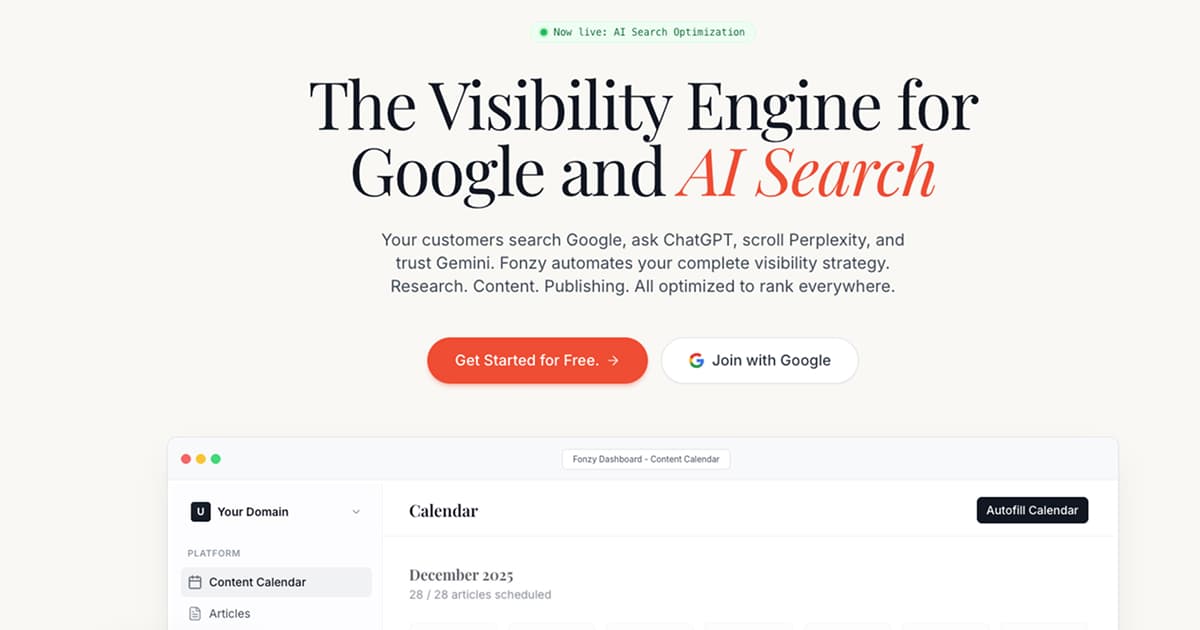
Ready to get a clear, undeniable view of your AI SEO performance? Try Fonzy's AI SEO platform to connect your actions to your revenue from day one. Start your trial and see your ROI.
Continue Reading
→ AI Content Automation for Small Business Growth
→ Choosing AI SEO Platforms for SMEs Compared
→ Fonzy.ai vs Building Your Own AI Content Stack Complexity vs Simplicity
→ Full SEO Content Automation vs AI Writing Assistants
→ Maximize AI SEO for Local Business Visibility Fast
→ The ROI of Automated SEO Content Calculating Your True Savings and Growth with Fonzy.ai

Roald
Founder Fonzy. Obsessed with scaling organic traffic. Writing about the intersection of SEO, AI, and product growth.