Client Work vs Agency Marketing Prioritization Frameworks

Client Work vs. Agency Marketing: Prioritization Frameworks That Scale
Ever had that sinking feeling on a Friday afternoon? You’ve spent the entire week extinguishing client fires, hitting deadlines, and delivering exceptional work. Your clients are happy. But your agency’s own blog hasn’t been updated in a month, that case study you’ve been meaning to write is still just a bulleted list, and your lead-gen feels like it's running on fumes.
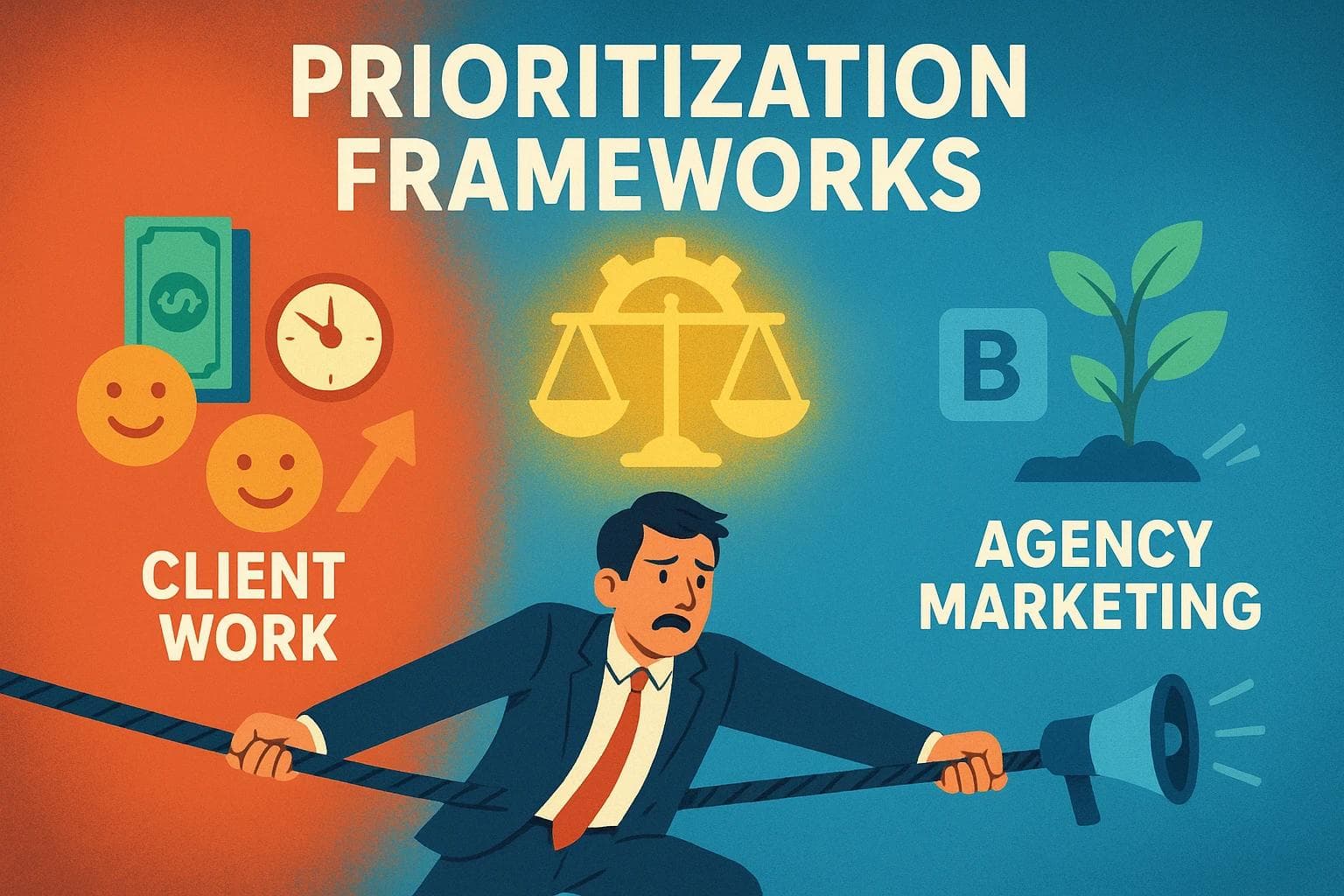
If this sounds familiar, you’re caught in the classic agency trap: the "cobbler's children have no shoes" syndrome. You’re so busy making shoes for others that you’re walking around barefoot. This isn't a sign of a bad agency; it's a sign of a successful agency running into a natural scaling problem. The constant tug-of-war between immediate, billable client work and essential, long-term agency marketing can lead to a feast-or-famine cycle, team burnout, and stunted growth.
The solution isn't to "work harder" or simply hope for a quiet week. The solution is to change how you decide what to work on in the first place.

The Agency's Dual Mandate: Understanding the Tug-of-War
Every task your team undertakes falls into one of two buckets, each with its own powerful gravity.
1. Client Work: This is the engine of your agency. It’s billable, deadline-driven, and directly tied to immediate revenue. The goals are set by the client, and success is measured by their satisfaction and results. It’s tangible, urgent, and pays the bills today.
2. Agency Marketing: This is the compass of your agency. It’s an investment in your future. It includes writing blog posts, recording podcasts, updating your portfolio, and networking. The goals are your own—to generate leads, build authority, and attract better clients. It's strategic, important for tomorrow, but rarely feels as urgent as a client's email marked "URGENT."
The conflict is clear: one is about short-term survival and cash flow, the other is about long-term growth and sustainability. Without a system, the urgent will always defeat the important.
Why "Working Harder" Isn't a Strategy
When you’re juggling dozens of tasks, it's easy to rely on gut feelings. But instinct-based prioritization often falls into predictable, damaging patterns:
- The Loudest Client Gets the Grease: Prioritizing based on which client is most demanding, not which work is most valuable.
- The Path of Least Resistance: Tackling easy, low-impact tasks first to feel productive, while strategic projects gather dust.
- Shiny Object Syndrome: Jumping on a new internal marketing idea (let's start a TikTok!) without evaluating it against existing priorities.
These habits feel productive in the moment, but they keep you locked in a reactive cycle. To scale, you need to shift from a reactive mindset to an objective, data-informed one. You need a framework.
From Chaos to Clarity: 3 Prioritization Frameworks for Your Agency
A prioritization framework is simply a structured system for evaluating tasks to determine their relative importance. Instead of relying on a gut feeling, you use a consistent set of criteria to make objective decisions. Let's adapt three popular frameworks for the unique challenges of agency life.

The RICE Framework: Balancing Impact and Effort
Originally from the world of product management, RICE is excellent for comparing different types of projects (like a client request vs. an internal blog post). It scores tasks based on four factors:
- Reach: How many people will this impact? (e.g., number of users, clients, or monthly blog readers)
- Impact: How much will this impact each person? (Use a scale: 3 for massive, 2 for high, 1 for medium, 0.5 for low)
- Confidence: How confident are you in your estimates? (Use percentages: 100% for high confidence, 80% for medium, 50% for low)
- Effort: How much time will this take from your team? (Estimate in "person-months" or "person-weeks")
The Formula: (Reach × Impact × Confidence) / Effort
Agency Scenario:
- Task A (Client): Create a custom analytics report for your top client.Reach: 1 client (or maybe 5 people on their team)
- Impact: 3 (massive, it's crucial for their quarterly review)
- Confidence: 100%
- Effort: 0.25 weeks (a couple of days)
- RICE Score: (5 × 3 × 1.0) / 0.25 = 60
Task B (Agency): Write a blog post on a trending industry topic.
- Reach: 2,000 blog readers per month
- Impact: 1 (medium, it will be very helpful for some)
- Confidence: 80% (you think it will perform well)
- Effort: 0.25 weeks
- RICE Score: (2000 × 1 × 0.8) / 0.25 = 6,400
Suddenly, the decision isn't about "client vs. agency." The data clearly shows that, all else being equal, the blog post offers exponentially more value across your entire ecosystem. This doesn't mean you ignore the client, but it reframes the conversation around resource allocation.
The Value-Hours Framework: Connecting Time to Tangible Worth
This is a simpler framework, great for quick, daily triage. You evaluate tasks on just two axes:
- Value: How valuable is this task to the business? (Use a simple 1-10 scale)
- Hours: How many hours will it take to complete?
The Formula: Value / Hours
Agency Scenario:
- Task A (Client): Quick social media graphic revision for a retainer client.Value: 3 (Keeps the client happy, but low strategic impact)
- Hours: 1
- Value-Hours Score: 3 / 1 = 3
Task B (Agency): Create a one-page PDF lead magnet from your most popular blog post.
- Value: 9 (High potential to generate leads for months)
- Hours: 4
- Value-Hours Score: 9 / 4 = 2.25
In this case, the quick client task "wins." This framework is perfect for the operations manager level, helping the team knock out high-value, low-effort tasks and ensuring client needs are met efficiently without derailing larger strategic projects.
The Margin Impact Framework: Following the Money
This is a strategic framework best used at the leadership level for quarterly or annual planning. It forces you to prioritize based on a single, crucial question: Will this work increase our agency's profitability?
You categorize tasks by their impact on profit margin:
- Direct Impact: Work for high-margin clients, services with low overhead, or upselling existing accounts.
- Indirect Impact: Agency marketing that attracts high-margin clients, creating systems that reduce project delivery time, or training that allows you to bill at a higher rate.
- No/Low Impact: Work for low-margin legacy clients, internal "vanity" projects, or tasks with no clear connection to revenue.
This framework is less about a numerical score and more about a strategic lens. When you realize your team is spending 60% of its time on low-margin clients, it becomes much easier to prioritize a marketing campaign aimed at attracting a more profitable client profile.
The Future is Automated: How AI is Reshaping Agency Prioritization
The biggest challenge in using these frameworks is gathering the data. Estimating effort, predicting reach, and calculating potential impact can feel like guesswork. This is where the next evolution of agency management is taking shape.
AI-powered tools are emerging that can analyze past project data to predict how long future tasks will take. They can forecast the potential reach and SEO impact of a blog topic before you write a single word. By automating data collection and analysis, AI removes the guesswork from prioritization, allowing agency leaders to make truly data-driven decisions.

Platforms from the Fonzy AI ecosystem are at the forefront of this shift, using artificial intelligence to not just automate content creation but to inform the very strategy that decides what content to create first for maximum impact. This transforms prioritization from a quarterly chore into a continuous, optimized workflow.
Frequently Asked Questions (FAQ)
Q: What's the main difference between client work and agency marketing?
Client work is paid for by an external party to achieve their goals, generating immediate revenue. Agency marketing is an internal investment to achieve your agency's goals (like lead generation), creating future value.
Q: How do we start implementing a framework without overwhelming the team?
Start small. Don't try to implement all three frameworks at once. Pick one—RICE is often a great starting point—and use it to plan just your next week's tasks. Introduce it as an experiment and get team feedback.
Q: What if a client has an "emergency"? How do frameworks handle that?
Frameworks provide a baseline, not rigid rules. An emergency from a high-value client will almost always override a low-score internal task. The key is that this becomes a conscious decision. After the fire is out, you can look at your framework and see exactly what strategic work was sacrificed, helping you plan better for the future.
Q: How much time should we really be spending on our own marketing?
There's no magic number, but many successful agencies aim for 10-20% of their total capacity. The real goal is consistency. Using a framework ensures you're consistently dedicating some capacity to your own growth, even during busy periods.
Your Next Step: From Learning to Doing
Reading about prioritization is one thing; implementing it is what drives change. You don’t need a complex new software or a week-long offsite to get started.
Here’s your challenge: This week, pick one framework and score five tasks from your to-do list.
Choose two client tasks and three internal agency marketing ideas. Run them through the RICE or Value-Hours formula. Don't overthink it. The goal isn't to get a perfect score, but to practice shifting your mindset from "What's on fire?" to "What's most valuable?"
This simple act is the first step toward breaking the feast-or-famine cycle and building a more scalable, profitable, and sustainable agency.
Roald
Founder Fonzy — Obsessed with scaling organic traffic. Writing about the intersection of SEO, AI, and product growth.
Stop writing content.
Start growing traffic.
You just read about the strategy. Now let Fonzy execute it for you. Get 30 SEO-optimized articles published to your site in the next 10 minutes.
No credit card required for demo. Cancel anytime.
How Content Frequency Affects SEO Rankings and What to Prioritize
Explore how balancing content speed and quality impacts SEO and learn when to focus on velocity or perfection.
5 Signs Your Content Strategy is Losing Customers
Discover key signs your content strategy is stuck and quietly losing customers before it impacts your growth.
How to Measure SEO ROI with Business Metrics
Learn simple ways to measure SEO ROI focusing on leads, conversions, cost, and customer value beyond keywords and rankings.