Guide to Structured Data Knowledge Panels and Knowledge Graph

The AI Visibility Trifecta: A Developer's Guide to Structured Data, Knowledge Panels, and the Knowledge Graph
You've probably noticed it. You search for a brand, a person, or a movie, and a detailed information box appears on the right side of the results. It has logos, key facts, social media links—a neat, authoritative summary. Then, more recently, you ask a complex question, and Google provides a comprehensive AI Overview, seemingly pulling facts from thin air.
This isn't magic. It's the visible result of a deep, interconnected system that Google uses to understand the world. And the most exciting part? You have the technical ability to influence it directly.
For a long time, we've been taught to think about SEO in terms of "strings"—the literal keywords people type into a search bar. But AI-powered search thinks in terms of "things"—the real-world entities, concepts, and relationships behind those keywords. To win in this new era, we need to stop just telling Google what our page is about and start explicitly teaching it what our page is.
This is where the AI Visibility Trifecta comes in:
- Structured Data: The language you use to communicate with search engines.
- The Knowledge Graph: The search engine's "brain" or understanding of the world.
- Knowledge Panels: The "face" or visual display of that understanding.
Understanding how these three elements work together is no longer an advanced tactic; it's the technical foundation for future-proofing your online presence.
The Foundation: Demystifying the AI Visibility Trifecta
Before we dive into the code, let's clarify what each component is and how they relate. Many people use these terms interchangeably, but they represent distinct parts of a single data journey.
What is Structured Data?
Structured data is a standardized format of code (like JSON-LD) that you add to your website's HTML. It doesn’t change what users see, but it provides explicit context for search engine crawlers. Think of it as leaving helpful, machine-readable labels on your content. Instead of making Google guess that "Avatar" refers to the James Cameron film, you can use structured data to state it unequivocally.
The vocabulary for this language comes from Schema.org, a collaborative project by Google, Microsoft, Yahoo, and Yandex. It provides a library of "types" (like Organization, Person, or Product) and "properties" (like name, logo, or foundingDate) that you can use to describe your content.
What is the Knowledge Graph?
The Knowledge Graph is Google's massive, internal encyclopedia of entities and the relationships between them. It's the system that understands that Leonardo da Vinci (Person) painted (relationship) the Mona Lisa (Artwork), which is located in (relationship) The Louvre (Organization).
This "brain" is built from countless sources: Wikipedia, government databases, licensed data, and, crucially, the structured data it finds on websites like yours. By providing clear, accurate structured data, you are directly feeding and refining Google's Knowledge Graph.
What are Knowledge Panels?
A Knowledge Panel is the information box that appears in search results when you search for a specific entity that exists in the Knowledge Graph. It’s the visual output of the Knowledge Graph's data. If the Knowledge Graph is the database, the Knowledge Panel is the user interface.
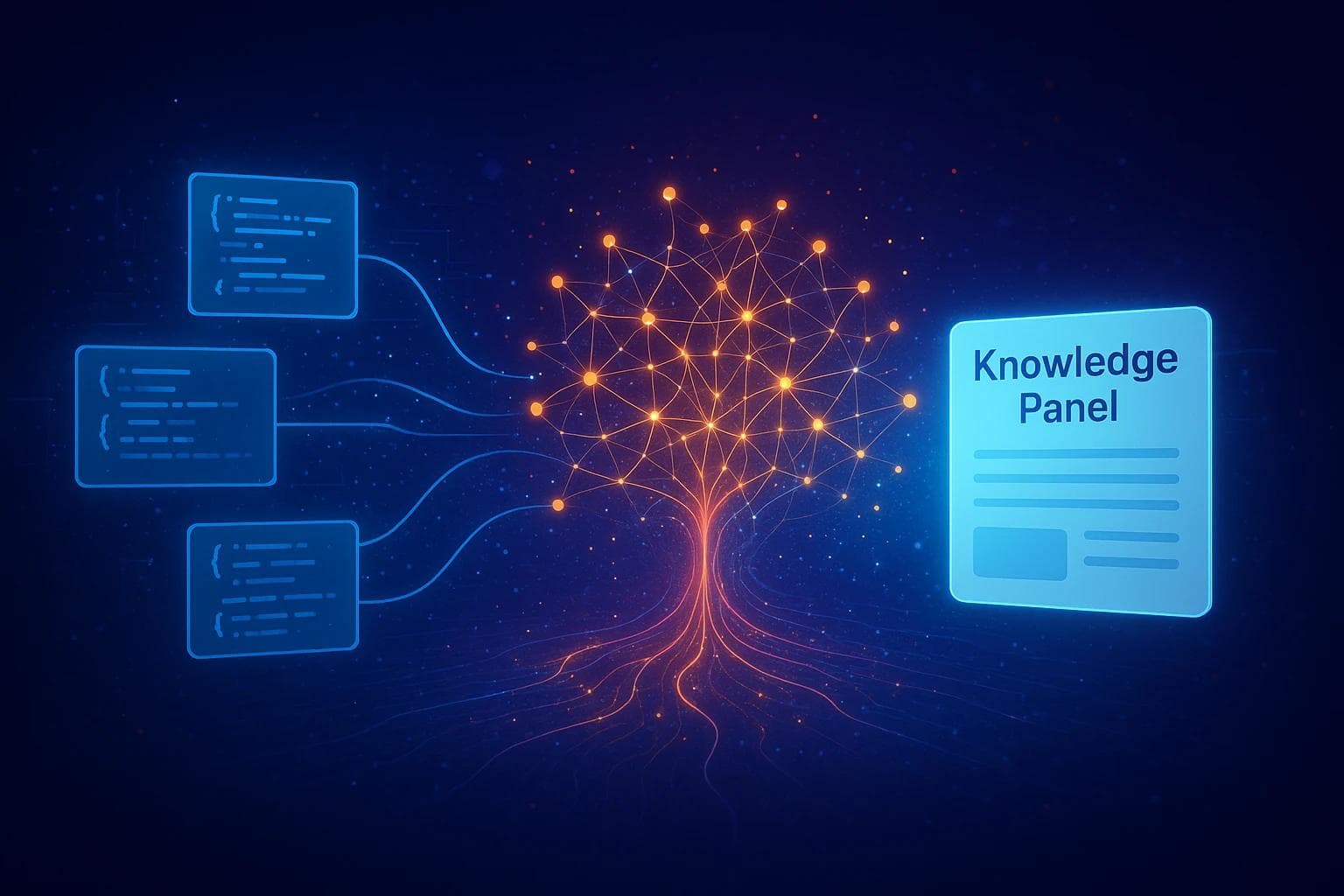
[Image: Diagram illustrating the flow from structured data to Knowledge Graph to Knowledge Panel]
The journey is simple: You add Structured Data to your site, Google uses it (along with other sources) to build its Knowledge Graph, and then it displays that information in a Knowledge Panel and other AI-driven features like AI Overviews.
The Build: Technical Foundations for AI Recognition
Now for the practical part. How do you implement this? We’ll focus on JSON-LD, as it's Google's recommended format and is generally easiest for developers to manage.
Core Schema Types for Essential Visibility
Start with the basics. Every business, brand, or professional should have these fundamental schema types on their key pages.
1. Organization or LocalBusiness
This is your digital business card. It should live on your homepage or about page. It tells Google who you are, where you are, and how to contact you.
JSON-LD Example for an Organization:
{ "@context": "https://schema.org", "@type": "Organization", "name": "Fonzy.ai", "url": "https://www.fonzy.ai", "logo": "https://www.fonzy.ai/logo.png", "sameAs": [ "https://www.linkedin.com/company/fonzy-ai", "https://twitter.com/fonzy_ai" ], "contactPoint": { "@type": "ContactPoint", "telephone": "+1-123-456-7890", "contactType": "customer service" }}2. Article
For every blog post or news piece, use Article schema to define the author, publication date, headline, and featured image. This helps signal expertise and timeliness.
JSON-LD Example for an Article:
{ "@context": "https://schema.org", "@type": "Article", "headline": "The AI Visibility Trifecta: A Developer's Guide", "author": { "@type": "Person", "name": "Alex Johnson", "url": "https://www.fonzy.ai/authors/alex-johnson" }, "datePublished": "2023-10-27", "image": "https://www.fonzy.ai/blog/image.jpg"}3. FAQPage
If a page has a question-and-answer format, use FAQPage schema. This can help you earn rich results directly in the SERP, answering user questions before they even click.
Going Deeper: Advanced Entity-Linking Properties
Once you’ve mastered the basics, you can start building stronger connections using more advanced properties. This is where you truly start influencing the Knowledge Graph.
The sameAs property is your most powerful tool. It unambiguously tells Google that the entity you're describing on your website is the exact same entity as the one represented by another URL.
- Link your
Organizationschema to your official social media profiles, your Crunchbase page, and your Wikipedia entry. - Link your
Personschema (for authors or team members) to their LinkedIn, Twitter, or personal website.
This process, called entity reconciliation, builds a web of trust and authority around your entity, confirming its identity across multiple authoritative sources.
Common Pitfalls and How to Fix Them
Implementing structured data can be tricky. Here are some of the most common errors developers encounter and how to solve them.
Common Mistake: Marking up content that isn't visible on the page. For example, adding 5-star Review schema in the code when there are no reviews visible to the user.
Common Mistake: Using the wrong schema type for the content. For instance, using Product schema on a blog post that merely reviews a product.
- Expert Fix: Be precise. If it’s a review, use the
Reviewtype and nest it within theArticleschema. Use Google's own documentation to find the most specific type that fits your content.
Common Mistake: Incorrectly formatted JSON-LD, often due to a missing comma or bracket.
- Expert Fix: Always validate your code before deploying. Use Google's Rich Results Test to check your markup. It will not only validate the code but also show you which rich results your page is eligible for.
[Image: Screenshot of Google's Rich Results Test showing a validation error and success]
The Mastery: Advanced Strategies for the AI-First Web
With a solid technical foundation, you can move on to more strategic thinking. This is how you prepare not just for today's search, but for tomorrow's.
Technically Signaling E-E-A-T
Google’s concept of Experience, Expertise, Authoritativeness, and Trustworthiness (E-E-A-T) is deeply tied to entities. A well-defined entity is, by its nature, more trustworthy to an algorithm. You can signal E-E-A-T technically by:
- Using
authorschema on articles that links to a detailed author bio page. - On that author page, use
Personschema with thesameAsproperty to link to their credentials (e.g., LinkedIn, publications they've written for). - Using
Organizationschema with theknowsAboutproperty to specify your areas of expertise.
Priming Your Content for AI Overviews
AI Overviews and other generative AI features rely heavily on the Knowledge Graph. When an AI needs a reliable fact, it's more likely to pull from a well-defined, trusted entity than from a random webpage.
By clearly structuring your data, you are essentially pre-packaging your key information in a way that is easy for AI to consume, verify, and cite. An accurate, well-linked Organization schema makes it more likely that an AI Overview will use your official description of your company, not an outdated one from a third-party site.
Frequently Asked Questions (FAQ)
1. What’s the main difference between Structured Data, Knowledge Panels, and the Knowledge Graph?Think of it like this: Structured Data is the recipe you submit. The Knowledge Graph is the cookbook it gets added to. The Knowledge Panel is the finished dish presented to the world. You control the recipe, which influences the cookbook and the final dish.
2. Can structured data guarantee I get a Knowledge Panel?No, it cannot. A Knowledge Panel is granted based on Google's assessment of an entity's notability and the confidence it has in its data. However, accurate and comprehensive structured data is one of the strongest signals you can provide to build that confidence and significantly increase your chances.
3. How long does it take to see results after implementing structured data?It varies. Google needs to recrawl your page to see the changes. Simple rich snippets (like for an FAQ) can appear in days. Changes to the Knowledge Graph or the awarding of a Knowledge Panel are longer-term processes that can take weeks or months as Google verifies your entity across multiple sources.
4. Do I need a Wikipedia page to get a Knowledge Panel?It helps, but it is not a requirement. Wikipedia is a highly trusted source for the Knowledge Graph, but a strong digital presence with consistent information across your website, Google Business Profile, and other authoritative sites can be sufficient.
Your Next Steps to AI Visibility
Moving from "strings to things" is a fundamental shift in how we approach SEO and content. It’s about building a robust, interconnected digital identity that machines can understand as clearly as humans. By mastering the technical foundations of structured data, you aren't just optimizing for search—you're preparing for a future where your data directly fuels AI.
Start by auditing your core pages. Are you clearly defining who you are with Organization or Person schema? Are you marking up your content with Article and FAQPage?
[Image: A checklist graphic summarizing the key action steps from the article]
Once you have the foundation in place, you can move on to a full technical SEO optimization checklist to ensure every part of your site is primed for discovery. For businesses looking to automate this entire process, exploring AI-powered SEO and content tools can help you scale your entity-building efforts and achieve visibility faster.
Roald
Founder Fonzy — Obsessed with scaling organic traffic. Writing about the intersection of SEO, AI, and product growth.
Stop writing content.
Start growing traffic.
You just read about the strategy. Now let Fonzy execute it for you. Get 30 SEO-optimized articles published to your site in the next 10 minutes.
No credit card required for demo. Cancel anytime.
Topic-First Content Strategy for AI-Driven Search
Discover why focusing on topics over keywords drives SEO success in AI-powered search environments.
How to Audit SEO for Automation Opportunities
Discover a simple non-technical checklist to identify SEO tasks you can automate and save time for strategic work.
5 Signs Your Content Workflow Is Blocking Growth
Discover common content workflow problems slowing your growth and how automation can help improve efficiency and results.