The True Cost of Producing SEO Content In-House: Are Hidden Expenses Draining Your Profit?
You just landed a new client. They’re excited, you’re excited, and they’ve signed on for four new SEO-optimized blog posts a month. On your spreadsheet, it looks like a clean win. You calculate the writer's fee, add a healthy markup, and log it as a profitable service.
But a few months later, something feels off. Your team seems stretched, deadlines are getting tight, and despite the "profitable" new work, your agency's margins are shrinking. What’s going on?
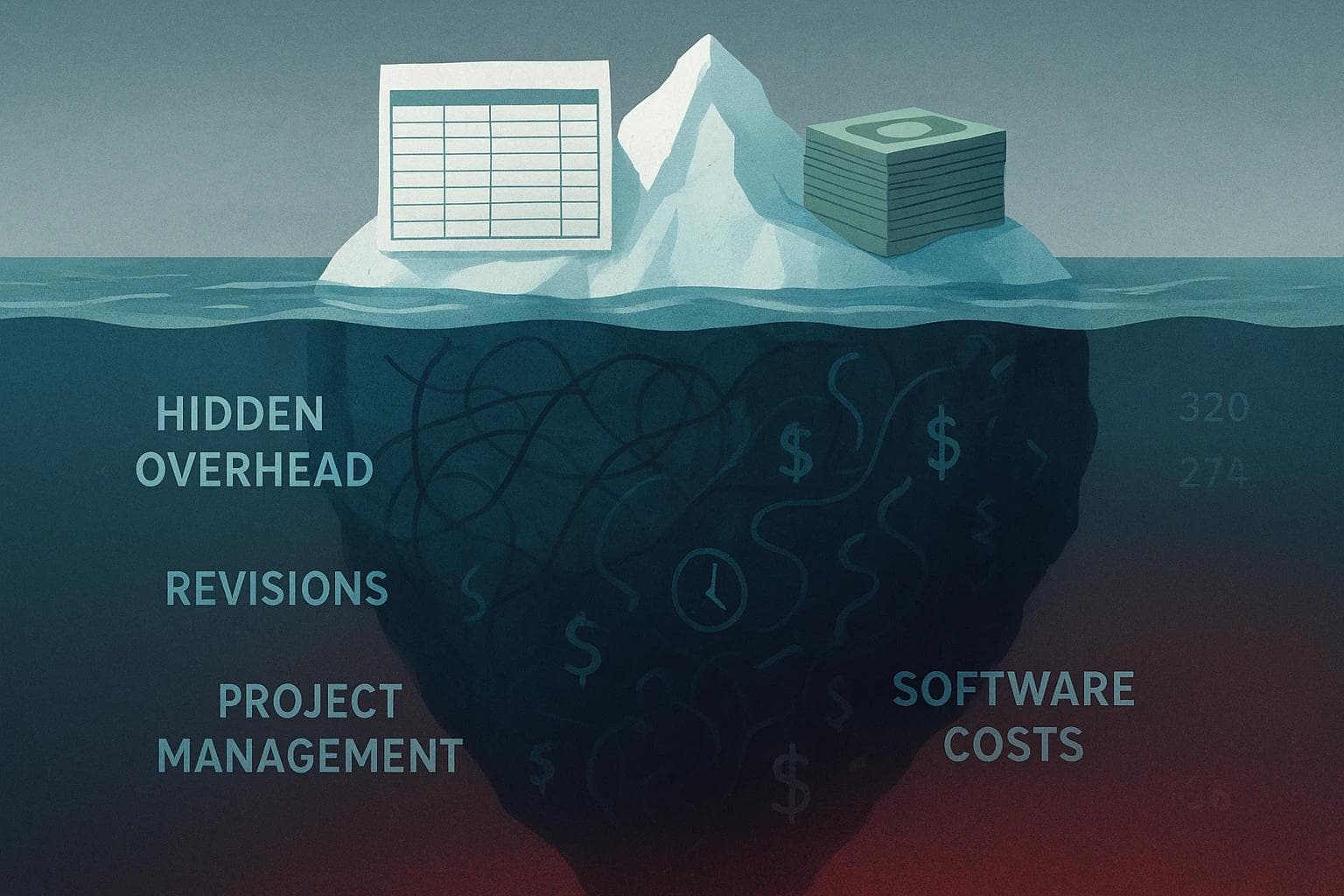
You’re likely falling victim to the invisible drain of in-house content production. The price you see on the surface—the cost of writing—is just the tip of the iceberg. The true cost is buried in a complex web of research hours, endless revision cycles, project management overhead, and a dozen other "stealth expenses" that quietly eat away at your profitability. This guide is here to turn on the lights. We'll break down every line item and uncover the real investment required to produce high-quality SEO content, helping you understand why your old workflow might be costing you more than you think.

The Anatomy of a Single Blog Post: More Than Just Words
Let’s dissect the lifecycle of one "simple" 1,500-word blog post. To make it tangible, we’ll use a conservative blended hourly rate of $50/hour for your in-house team members (a mix of strategists, writers, and editors).
Phase 1: Research & Strategy (2-4 hours)
Before a single word is written, the heavy lifting begins. This isn’t just about picking a keyword; it’s about laying a foundation for success.
- Keyword Research: Identifying primary and secondary keywords with the right intent and achievable difficulty. (1 hour)
- Competitive Analysis: Analyzing the top-ranking articles to understand their structure, depth, and unique angles. (1 hour)
- Topic Ideation & Outlining: Structuring the article, defining H2s and H3s, and outlining the core arguments to guide the writer. (1 hour)
Estimated Cost: 3 hours x $50/hour = $150
Phase 2: Creation (4-6 hours)
This is the stage most people think of as "content production," but it involves more than just drafting.
- First Draft Writing: Crafting the initial 1,500-word article based on the outline and research. (4 hours)
- Asset Sourcing/Creation: Finding or creating relevant images, charts, or infographics to support the text and improve engagement. (0.5 hours)
- Internal Fact-Checking: Verifying all stats, claims, and sources cited in the article. (0.5 hours)
Estimated Cost: 5 hours x $50/hour = $250
Phase 3: Refinement & Optimization (3-5 hours)
A first draft is never a final draft. This is where quality is forged and SEO value is locked in.
- Internal Editing & Proofreading: A second pair of eyes reviews for clarity, flow, grammar, and style. (1.5 hours)
- On-Page SEO Optimization: Weaving in keywords, optimizing meta titles and descriptions, adding internal links, and checking image alt-text. (1 hour)
- Client Feedback & Revisions: The inevitable back-and-forth. Managing client feedback and implementing one or two rounds of revisions. (1.5 hours)
Estimated Cost: 4 hours x $50/hour = $200
Phase 4: Publishing & Promotion (1-2 hours)
The work isn't done once the document is approved.
- CMS Upload & Formatting: Properly formatting the article in WordPress, Webflow, or another CMS, ensuring it looks perfect. (0.5 hours)
- Final Review: One last check on the live staging link before hitting "publish." (0.5 hours)
- Initial Distribution: Sharing the new post on social media channels or in a client newsletter. (0.5 hours)
Estimated Cost: 1.5 hours x $50/hour = $75
Total Direct Cost Per Article: At a glance, the visible work for one blog post takes roughly 13.5 hours, costing $675 in staff time alone. This number is often far higher than agencies budget for, and it doesn't even include the most expensive factors.
The Stealth Killers: Uncovering Your Content's Hidden Overhead
The $675 figure is where most calculations stop. But the true cost is inflated by hidden overheads—the operational friction of just getting things done.
- Project Management: Time spent in Asana, Trello, or Slack assigning tasks, checking statuses, and nudging team members. (Adds 10-15% to total time)
- Internal Communication: The weekly content meetings, the "quick syncs," the email chains to clarify a brief. (Adds 10-15%)
- Software Stack: The monthly cost of your SEO tools (Ahrefs, Semrush), plagiarism checkers, grammar tools (Grammarly), and project management software, amortized per article. (Can be $20-$50 per article)
- Recruitment & Training: The cost of finding, hiring, and training skilled content professionals is a significant, often overlooked, business expense.
When you factor in just project management and communication overhead (25%), that $675 article suddenly costs $843. Now, imagine that cost multiplied across all your clients, every single month.
The Scaling Trap: Why 4x the Content Can Mean 8x the Headache
This is where the model truly breaks. What works (even if inefficiently) for 5 articles a month completely collapses at 20 or 50. The costs don't scale linearly; they explode.
- Complexity Multiplies: Managing four clients' content calendars is exponentially more complex than managing one. Communication lines get crossed, brand voices get muddled, and the potential for error skyrockets.
- Management Overload: A single manager can't oversee 50 articles a month effectively. You need to hire more project managers, which adds to your overhead and further erodes your margin on each piece of content.
- Quality Suffers: As volume increases, your best editors become bottlenecks. To keep up, you either rush the editing process, letting quality slide, or you delay publishing, frustrating clients.
An agency producing 20 articles per month isn't just spending 4x the cost of an agency producing 5. Due to the compounded overhead and inefficiency, their "true cost per article" is often significantly higher, leading to razor-thin—or even negative—margins.

Reclaiming Your Margins: The Shift to Smarter Workflows
If this picture feels painfully familiar, don't worry. This isn't a dead end; it's a turning point. Recognizing the scaling trap is the first step toward escaping it. The solution isn't to work harder or hire more people—it's to fundamentally change the workflow.
This is where technology, specifically automation and AI, becomes a strategic imperative. By automating the most time-consuming, repetitive parts of the content lifecycle, you can reclaim hundreds of hours and protect your profitability. This is where solutions like a dedicated fonzy ai platform come into play, not just as a tool, but as a new operating system for content.
Imagine a workflow where:
- Research & Strategy is cut from hours to minutes as AI analyzes competitors and generates data-driven outlines instantly.
- First Drafts are generated in seconds, giving your talented writers a high-quality foundation to refine, saving up to 80% of their drafting time.
- Optimization is automated, with tools suggesting internal links, optimizing metadata, and ensuring every piece meets SEO best practices without manual checklists.
- Publishing is scheduled and handled automatically, eliminating the manual grind of uploading and formatting content.

This isn't about replacing your team; it's about empowering them. By removing the manual bottlenecks, you free up your strategists, writers, and editors to focus on what they do best: applying human creativity, strategic insight, and nuanced brand understanding—the very things that clients value most.
Your Next Step: How to Conduct a "True Cost" Audit
Knowledge is power. The first step to fixing this problem is to quantify it for your own agency. Over the next week, conduct a simple audit:
- Track the Time: For one or two content pieces, have your team meticulously track their time for every phase listed above (research, writing, editing, revisions, publishing, etc.).
- Include Overhead: Add a 25% buffer to the total time to account for project management and communication.
- Calculate Your Cost: Multiply the total hours by your team's blended hourly rate.
- Add Software Costs: Divide the monthly cost of your content-related software by the number of articles you produce and add it to the cost per piece.
- Compare to Your Price: Finally, compare your "true cost" to what you charge the client. The result might surprise you—and it will be the most compelling business case you've ever seen for modernizing your workflow.
Frequently Asked Questions About In-House Content Costs
What constitutes a realistic budget for in-house SEO content?
Based on our breakdown, a single, high-quality 1,500-word article can easily cost $700-$1,000 in true staff time and overhead. A monthly budget should account for this granular cost multiplied by the desired volume. Anything significantly lower is likely cutting corners on strategy, quality, or optimization—the very things that drive results.
Beyond salaries, what are the most overlooked costs in content production?
The two biggest hidden costs are project management overhead (the time spent managing the work) and the cost of revision cycles. A single unexpected round of client revisions can instantly wipe out the profit margin on a piece of content.
Can I get a quick breakdown of costs per stage?
- Research & Strategy: ~20% of the total cost.
- Creation (Writing & Assets): ~35% of the total cost.
- Refinement & Optimization: ~30% of the total cost.
- Publishing & Overhead: ~15% of the total cost.
What are the financial risks of "cheap" in-house SEO content?
Cheap content almost always leads to poor results, which means zero ROI for your client and a high risk of churn for your agency. Worse, content that ignores SEO best practices can sometimes lead to Google penalties, damaging a client's online visibility and your agency's reputation. The true cost is lost business and a damaged brand.
From Cost Center to Profit Engine
For too long, agencies have accepted that content production is a low-margin, high-headache service. But it doesn't have to be. By understanding the true, all-in cost of your current process, you can see the urgent need for a new approach.
Embracing automation and AI isn't just about saving money; it's about building a scalable, profitable, and future-proof content engine. It allows you to deliver better results for your clients, improve morale for your team, and finally turn your content services into the powerful profit center they were always meant to be.

Roald
Founder Fonzy — Obsessed with scaling organic traffic. Writing about the intersection of SEO, AI, and product growth.
Stop writing content.
Start growing traffic.
You just read about the strategy. Now let Fonzy execute it for you. Get 30 SEO-optimized articles published to your site in the next 10 minutes.
No credit card required for demo. Cancel anytime.

How Content Frequency Affects SEO Rankings and What to Prioritize
Explore how balancing content speed and quality impacts SEO and learn when to focus on velocity or perfection.

5 Signs Your Content Strategy is Losing Customers
Discover key signs your content strategy is stuck and quietly losing customers before it impacts your growth.

How to Measure SEO ROI with Business Metrics
Learn simple ways to measure SEO ROI focusing on leads, conversions, cost, and customer value beyond keywords and rankings.