 Ready to grow?
The rise of AI-powered search engines has fundamentally changed how users find information online. ChatGPT, Google AI Overviews, Perplexity, and Claude are now answering millions of queries daily—often without users ever clicking through to a website. For content creators and marketers, this shift raises a critical question: how do you know if your content is being cited by these answer engines?
Traditional SEO tools like Google Search Console and rank trackers weren't designed for this new landscape. They can't tell you whether ChatGPT mentioned your brand, if Perplexity cited your article, or how often Google's AI Overview pulls from your content. This is where AEO (Answer Engine Optimization) tracking becomes essential.
In this comprehensive AEO tracker guide, we'll explore how to monitor your performance across AI search platforms, which tools can help you track citations, and what metrics matter most for answer engine optimization. Whether you're optimizing content for LLMs or trying to appear in Google's AI-generated answers, understanding AEO tracking is now a critical skill for modern digital marketers.
What Is an AEO Tracker?
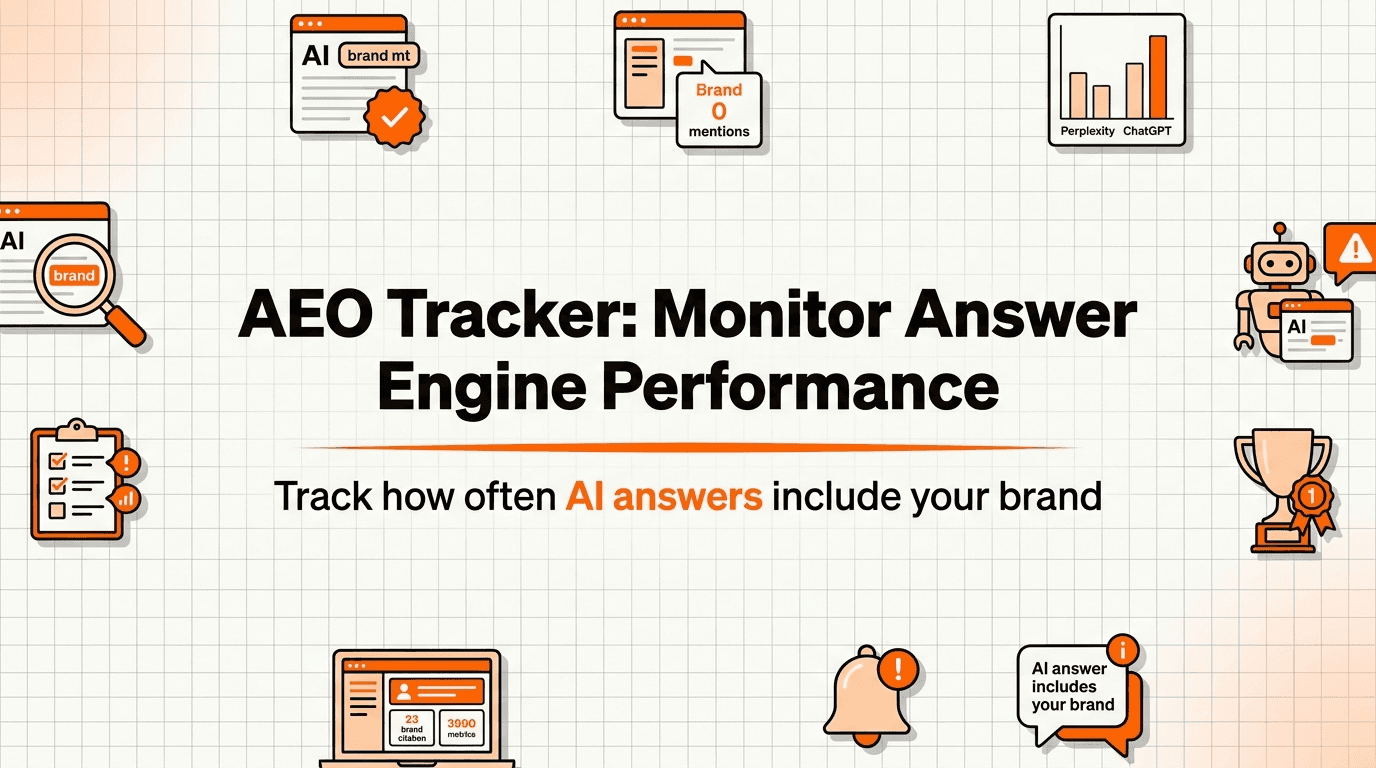
An AEO tracker is a specialized tool or system designed to monitor how frequently your content, brand, or website appears in AI-generated responses from answer engines like ChatGPT, Google AI Overviews, Perplexity, Claude, and other large language model (LLM) platforms.
Unlike traditional SEO rank trackers that monitor your position in search engine results pages (SERPs), AEO trackers focus on citation frequency, source attribution, and visibility within AI-generated answers. These tools help you understand whether answer engines consider your content authoritative and relevant enough to reference when responding to user queries.
The core function of an AEO tracker is to systematically query answer engines with relevant keywords and phrases, then analyze the responses to identify mentions of your brand, citations to your content, or links to your website. This process provides visibility into a new dimension of search performance that traditional analytics platforms simply cannot capture.
For businesses investing in LLM SEO strategies, AEO tracking provides essential feedback on whether optimization efforts are working. Without this visibility, you're essentially flying blind in the age of AI search.
Why Traditional SEO Tracking Tools Miss AI Search Results
Traditional SEO tools were built for a different era—one where search engines displayed a list of blue links and success was measured by keyword rankings and click-through rates. These legacy systems have fundamental limitations when it comes to tracking AI-generated content.
First, answer engines don't provide traditional rankings. When a user asks ChatGPT or Perplexity a question, there's no "position 1" or "position 10"—there's simply an answer that may or may not cite your content. Traditional rank trackers can't capture this citation-based model.
Second, most SEO tools rely on APIs and data feeds from search engines like Google and Bing. Answer engines like ChatGPT don't provide public APIs for tracking citations, and even when they do provide sources, there's no structured data feed that traditional tools can access.
Third, AI responses are non-deterministic, meaning the same query can produce different answers at different times. This variability makes traditional tracking methodologies—which assume consistent, repeatable results—less effective. An AEO tracker needs to account for this variability through multiple queries and statistical sampling.
Finally, traditional tools focus on click-based metrics that become less relevant when users get complete answers without clicking through to websites. AEO requires new metrics like citation frequency, source diversity, and answer relevance—none of which traditional SEO platforms were designed to measure.
Top AEO Tracker Tools to Monitor Answer Engine Performance
The AEO tracking landscape is still emerging, but several tools and platforms have developed capabilities specifically for monitoring answer engine performance. Here are the most effective solutions currently available:
ZipTie specializes in tracking brand mentions across ChatGPT, Perplexity, and other AI platforms. The tool automatically queries these engines with your target keywords and identifies when your brand or content appears in responses. ZipTie offers citation tracking, competitor comparison, and trend analysis over time.
Profound tracks AI search visibility specifically for Google AI Overviews. It monitors when your content appears in AI-generated summaries and provides insights into which queries trigger citations. The platform is particularly useful for understanding how Google's AI interprets and references your content.
BrightEdge has expanded its enterprise SEO platform to include AI search tracking capabilities. Their DataMind feature analyzes AI-generated answers and identifies citation opportunities. This is best suited for larger organizations with substantial content libraries.
Fonzy.ai provides comprehensive GEO services that include AEO tracking as part of a broader optimization strategy. The platform helps you not just monitor citations but optimize your content to increase visibility in AI search results.
For those with technical resources, building custom tracking systems using API access (where available) and web scraping techniques is also an option. This requires significant development effort but provides maximum flexibility and control over what you track and how you analyze the data.
How to Track Your Content in ChatGPT Responses
ChatGPT presents unique tracking challenges since it doesn't consistently provide source citations and its knowledge cutoff means it may not have access to your most recent content. However, with the introduction of ChatGPT Search and browsing capabilities, tracking your content in ChatGPT responses has become increasingly important.
Start by identifying queries where ChatGPT is likely to search the web rather than rely solely on its training data. These typically involve current events, recent data, or topics where the user explicitly asks for up-to-date information. Create a list of target queries relevant to your business and content.
Manually or through automation, submit these queries to ChatGPT and analyze the responses for mentions of your brand, citations to your content, or links to your website. When ChatGPT uses its browsing feature, it will provide source attributions that you can track.
Document the frequency of citations over time. Since ChatGPT responses can vary, run each query multiple times to establish a baseline citation rate. Track whether your content appears in the initial response, follow-up clarifications, or not at all.
Pay attention to the context in which your content is cited. Is it presented as a primary source or a supporting reference? Is your brand mentioned favorably or simply as one of many options? The qualitative aspects of citations matter as much as the quantitative frequency.
For systematic tracking, consider using automation tools that can submit queries via OpenAI's API and parse responses for your brand mentions. This allows you to scale your tracking efforts beyond what's feasible manually.
Monitoring Your Brand in Google AI Overviews
Google AI Overviews (formerly known as SGE or Search Generative Experience) appear at the top of search results for many queries, providing AI-generated summaries with cited sources. Understanding how to optimize for Google AI Overviews and track your performance is critical for maintaining search visibility.
Start by identifying which of your target keywords trigger AI Overviews. Google doesn't display AI-generated answers for every query—they're most common for informational searches, how-to queries, and questions seeking definitions or explanations. Create a list of keywords where AI Overviews appear.
For each of these keywords, manually review the AI Overview to see if your content is cited. Google typically includes 3-6 source links within AI Overviews. Document whether your site appears as a source and in what position. First-position citations generally receive more visibility and credibility.
Track AI Overview appearance rates over time. Unlike traditional snippets, AI Overviews can be dynamic—they may appear for a query today but not tomorrow, depending on Google's assessment of when an AI-generated answer adds value. Consistent tracking reveals patterns in when your content is selected as a source.
Use Google Search Console to identify queries driving impressions and clicks. While GSC doesn't specifically label AI Overview citations, you can infer their impact by analyzing impression and click-through rate changes for queries where you know AI Overviews appear.
Consider location-based variations. AI Overviews may display different sources for the same query depending on the user's location. If you serve multiple geographic markets, track AI Overview citations across different locations to get a complete picture of your visibility.
Tracking Citation Rates Across Perplexity and Claude
Perplexity and Claude represent two different approaches to AI search, and each requires tailored tracking methodologies. Perplexity is explicitly designed as an answer engine with transparent source citations, while Claude (through its Artifacts and research capabilities) can also reference external sources.
Perplexity is perhaps the most trackable answer engine because it consistently provides numbered citations with direct links to sources. For each query, Perplexity typically cites 3-10 sources, making it relatively straightforward to identify when your content appears.
To track Perplexity citations, create a list of queries relevant to your content and industry. Submit these queries to Perplexity and document which sources are cited. Pay attention to your citation position—sources cited earlier in the response typically influence the answer more significantly.
Perplexity offers both standard and Pro search modes, and results can differ between them. Pro searches tend to be more thorough and may cite a broader range of sources. Track your performance in both modes if your audience uses Perplexity Pro.
Claude tracking is more complex because Claude doesn't operate as a dedicated search engine. However, Claude can access the web and provide sources when users ask for current information or research on specific topics. The key is identifying queries where Claude is likely to search rather than rely solely on training data.
For both platforms, calculate your citation rate as a percentage: (number of times cited / total queries tracked) × 100. This metric provides a standardized way to compare performance across different answer engines and track improvements over time.
Key Metrics to Track for Answer Engine Optimization
Effective AEO tracking requires measuring the right metrics. Unlike traditional SEO where rankings and traffic dominate, answer engine optimization demands a different approach to measurement. Here are the essential metrics every AEO tracker should monitor:
Citation Frequency measures how often your content appears as a source across answer engines. Calculate this as both an absolute number (citations per day/week/month) and as a citation rate (percentage of tracked queries that cite your content). This is your primary AEO performance indicator.
Source Position tracks where your content appears when multiple sources are cited. Being the first or second source typically indicates greater authority and relevance. Monitor your average source position over time to gauge whether your authority in answer engines is improving.
Query Coverage measures the percentage of your target queries for which your content gets cited. If you're tracking 100 relevant queries and appear in 25 of them, your query coverage is 25%. Increasing this metric indicates broader topical authority.
Share of Voice compares your citation frequency to competitors. If answer engines cite your content 40% of the time and competitors combined receive 60%, your share of voice is 40%. This contextualizes your performance within your competitive landscape.
Answer Influence assesses how prominently your content influences the AI-generated answer. Are key facts or recommendations from your content featured in the response? This qualitative metric requires manual review but provides insight into whether you're truly influencing the conversation.
Citation Diversity tracks how many different pieces of your content get cited. Having a single page cited repeatedly is good, but having multiple pages cited indicates broader authority across your domain. This metric helps identify whether you need to create more content on specific topics.
Brand Mention Rate specifically tracks how often your brand name appears in responses, even without a formal citation. This indicates brand awareness within AI systems and can be valuable even when no clickable link is provided.
How to Set Up Your AEO Tracking Dashboard
Creating an effective AEO tracking dashboard requires combining data from multiple sources and presenting it in a way that reveals trends and actionable insights. Here's a step-by-step approach to building your dashboard:
Start by selecting your dashboard platform. Options include Google Data Studio (Looker Studio), Tableau, Power BI, or even a well-organized Google Sheet. The key is choosing something that allows you to update data regularly and visualize trends over time.
Define your query sets by organizing target keywords into categories based on your business objectives. Create separate tracking groups for brand queries, product/service queries, educational content queries, and competitor comparison queries. This segmentation allows you to analyze performance by topic and intent.
Establish a tracking schedule that balances comprehensiveness with resource constraints. Daily tracking provides the most granular data but requires significant effort. Weekly tracking is often sufficient for most businesses, while monthly tracking works for stable markets with less frequent content updates.
Create visual components for your dashboard including citation frequency trends over time (line charts), share of voice by competitor (pie or bar charts), source position distribution (histogram), and query coverage by category (heat map or table). Visual representation makes patterns immediately apparent.
Include a detailed citation log that records each instance where your content is cited, including the query, answer engine, date, source position, and a snippet of how your content was referenced. This log becomes invaluable for identifying what content performs well and why.
Add competitive benchmarking sections that compare your performance against key competitors. Track not just whether you're cited, but when competitors are cited instead of you, and which types of queries favor different sources.
Set up automated alerts for significant changes. If your citation rate drops below a certain threshold or if a competitor suddenly dominates previously favorable queries, you need to know immediately so you can investigate and respond.
AEO Tracking vs Traditional Rank Tracking: What's Different
Understanding the fundamental differences between AEO tracking and traditional rank tracking helps set appropriate expectations and measurement strategies. These two approaches serve related but distinct purposes in modern search marketing.
Traditional rank tracking is deterministic and position-based. Your website either ranks #1, #5, or #50 for a given keyword, and this position is consistent (within normal fluctuation ranges) across tracking attempts. AEO tracking is probabilistic and citation-based. Your content might be cited in 60% of queries, not cited in 30%, and cited in a different context in the remaining 10%.
Traditional tracking focuses on visibility and click potential—higher rankings theoretically drive more traffic. AEO tracking focuses on authority and influence—citations indicate that AI systems consider your content credible and relevant, even if this doesn't directly drive traffic.
Rank tracking operates in a zero-sum environment where one site's gain is another's loss—there can only be one #1 result. AEO tracking allows for shared visibility where multiple sources can be cited in a single response, creating opportunities for co-existence with competitors.
Traditional SEO tools can track thousands of keywords daily through automated APIs. AEO tracking often requires actual query submission to answer engines, making it more resource-intensive and limiting the number of queries you can practically monitor.
Perhaps most importantly, rank tracking has decades of data establishing what "good" performance looks like. AEO tracking is still establishing benchmarks, and what constitutes strong performance varies significantly by industry, query type, and answer engine.
Both tracking approaches remain important. Traditional rank tracking tells you how you perform in traditional search, while AEO tracking reveals your performance in AI-mediated search. Comprehensive search marketing requires monitoring both channels.
How Often Should You Monitor AI Search Citations?
The optimal frequency for AEO tracking depends on several factors including your industry's volatility, your content update frequency, available resources, and how aggressively you're optimizing for answer engines.
For most businesses, weekly tracking provides a good balance between actionable insight and reasonable resource investment. Weekly monitoring reveals trends without overwhelming you with data and allows you to correlate changes in citation rates with specific optimization efforts or content updates.
Daily tracking makes sense if you operate in highly competitive, rapidly changing industries like news, finance, or technology. It's also appropriate during active optimization campaigns when you want to quickly assess whether changes are improving performance. However, daily tracking requires significant resources and may show volatility that obscures longer-term trends.
Monthly tracking is sufficient for stable industries with infrequent content updates. If your content and competitive landscape don't change rapidly, monthly snapshots can reveal trends without requiring weekly effort. This approach works well for local businesses, specialized B2B services, or content focused on evergreen topics.
Consider event-driven tracking that increases frequency around significant moments. Track more frequently after publishing major content pieces, making substantial site updates, or when competitors launch new initiatives. Return to normal frequency once you've assessed the impact.
Whatever frequency you choose, consistency matters more than intensity. Regular tracking at longer intervals provides more valuable trend data than sporadic intensive tracking followed by long gaps.
What to Do When Your Content Stops Appearing in AI Results
Losing visibility in answer engine results can be concerning, especially if you've previously enjoyed strong citation rates. However, declining AEO performance is often recoverable with the right diagnostic and optimization approach.
First, determine whether the decline is real or measurement-related. AI responses can be variable, so what appears as declining performance might simply be normal fluctuation. Review your tracking data across multiple time periods and ensure your sample size is sufficient to identify true trends versus random variation.
Analyze which content stopped appearing and look for patterns. Did you lose citations across all topic areas or just specific ones? Are certain types of content (how-to guides, statistical resources, opinion pieces) affected more than others? This diagnostic tells you whether the issue is site-wide or topic-specific.
Investigate what changed. Did competitors publish more authoritative content on these topics? Did answer engines update their algorithms or source selection criteria? Have there been changes to your site structure, content formatting, or technical implementation that might affect how AI systems access and interpret your content?
Review the content that's no longer being cited and assess freshness. Answer engines favor current, up-to-date information. If your content is outdated or contradicts more recent sources, AI systems will naturally prefer newer alternatives. Update statistics, refresh examples, and add recent developments to restore relevance.
Examine how competitors' content differs from yours. Are they providing more comprehensive coverage, better structured information, or stronger supporting evidence? Competitive content analysis reveals optimization opportunities and helps you understand what answer engines are currently favoring.
Consider technical factors that might affect AI accessibility. Ensure your content isn't blocked by robots.txt, that page load speeds are fast, and that content is properly structured with clear headings and semantic markup. Technical issues can prevent answer engines from properly accessing or understanding your content.
Implement targeted improvements based on your diagnosis. This might include refreshing outdated content, improving content depth and structure, enhancing E-E-A-T signals, or creating new content that fills gaps in your coverage. Monitor the impact of these changes through your AEO tracking system.
Frequently Asked Questions
What is the best AEO tracker tool?
The best AEO tracker depends on your specific needs and budget. ZipTie offers strong ChatGPT and Perplexity tracking, while Profound specializes in Google AI Overviews. For comprehensive solutions that include both tracking and optimization, Fonzy.ai provides integrated GEO services that help you monitor and improve answer engine performance. Enterprise users may prefer BrightEdge for its broader feature set and integration with existing SEO workflows.
Can I track my rankings in ChatGPT?
ChatGPT doesn't have traditional rankings like search engines, but you can track whether your content is cited when ChatGPT uses its browsing capability. This requires submitting queries that trigger web searches and analyzing whether your content appears as a source. Since responses vary, you need to track citation frequency rather than fixed positions. Specialized AEO tracking tools can automate this process and provide citation rate statistics over time.
How much does AEO tracking cost?
AEO tracking costs vary widely based on the tool and scale of tracking. Basic monitoring tools start around $50-$100 per month for limited query tracking. Mid-tier platforms typically cost $200-$500 monthly and offer more comprehensive tracking across multiple answer engines. Enterprise solutions can exceed $1,000 per month but provide extensive features, integrations, and higher query volumes. Some agencies include AEO tracking as part of broader optimization services.
Is AEO tracking different from SEO tracking?
Yes, AEO tracking differs significantly from traditional SEO tracking. SEO tracking monitors your position in search engine results pages and focuses on rankings, traffic, and click-through rates. AEO tracking monitors whether AI systems cite your content in generated responses and focuses on citation frequency, source attribution, and authority signals. AEO is probabilistic rather than position-based, and success metrics center on influence and credibility rather than clicks and traffic.
How do I know if my content appears in AI search results?
To determine if your content appears in AI search results, manually submit relevant queries to answer engines like ChatGPT, Perplexity, Google AI Overviews, and Claude. Look for citations, source links, or mentions of your brand in the responses. For systematic monitoring, use AEO tracking tools that automate this process across multiple platforms and queries. You can also analyze referral traffic in Google Analytics to see if AI platforms are sending visitors to your site.
What metrics should I track for answer engine optimization?
Essential AEO metrics include citation frequency (how often you're cited), source position (where you appear among cited sources), query coverage (percentage of target queries that cite you), share of voice (your citations compared to competitors), citation diversity (number of different pages cited), and brand mention rate (brand references even without citations). Together, these metrics provide a comprehensive view of your authority and visibility in answer engine results.
As AI-powered answer engines continue to reshape how people find information online, AEO tracking has evolved from an experimental practice to an essential component of search marketing. The tools and techniques outlined in this guide provide a foundation for monitoring your performance across ChatGPT, Google AI Overviews, Perplexity, Claude, and other emerging platforms.
Success in this new landscape requires shifting from position-based thinking to citation-based measurement, from traffic metrics to authority indicators, and from static rankings to probabilistic visibility. By implementing systematic AEO tracking, you gain the visibility needed to optimize effectively, understand what content resonates with AI systems, and maintain relevance as search continues to evolve.
The answer engine revolution is still in its early stages, and those who establish strong tracking and optimization practices now will have significant advantages as this channel matures. Start with the fundamentals—identify your target queries, set up basic tracking, and monitor your citation rates—then expand your efforts as you learn what works for your specific content and industry.