 Ready to grow?
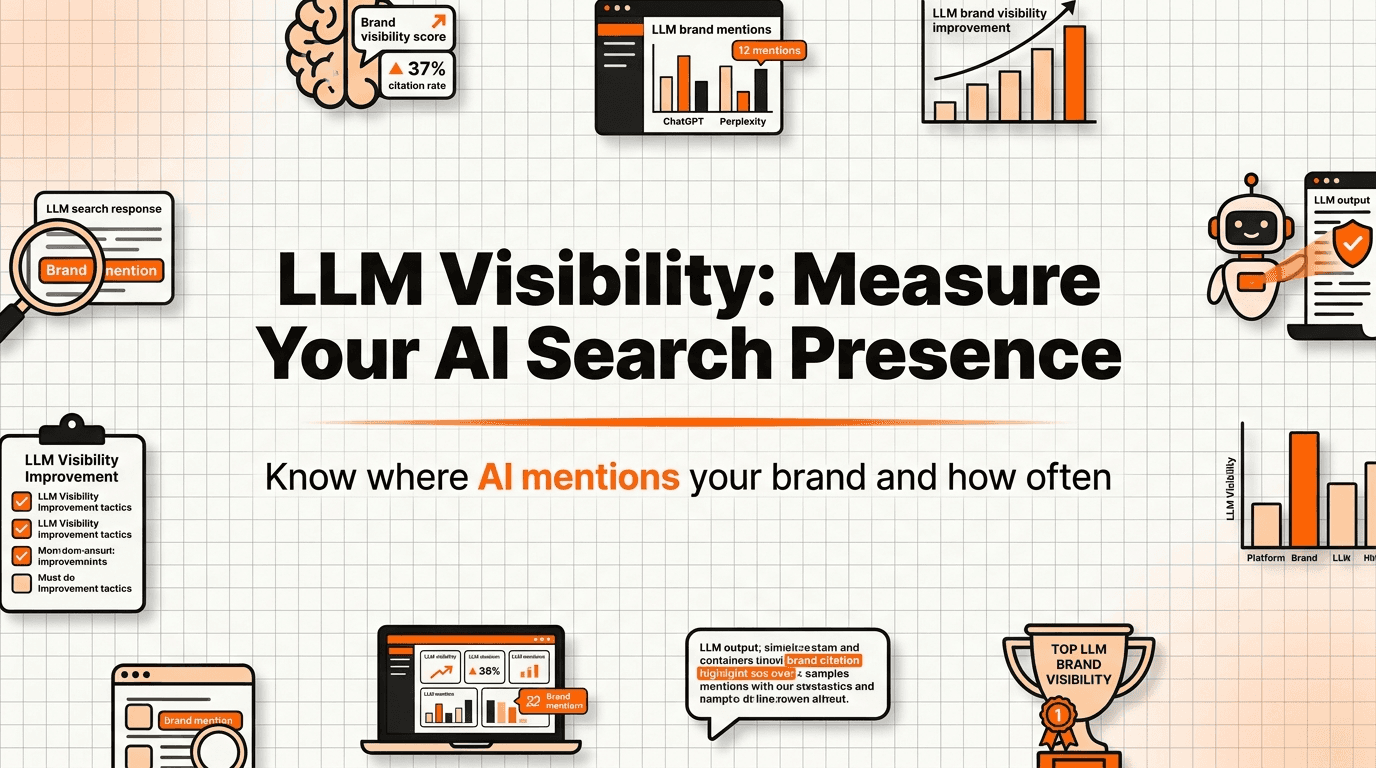
The search landscape is undergoing its most significant transformation since Google's PageRank algorithm. Large Language Models (LLMs) like ChatGPT, Claude, and Perplexity are fundamentally changing how people discover information online. If your content isn't optimized for these AI systems, you're missing out on a rapidly growing segment of search traffic. This comprehensive LLM visibility guide will show you exactly how to measure and improve your presence in AI-powered search results.
What Is LLM Visibility?
LLM visibility refers to how frequently and prominently your content appears in responses generated by large language models. When someone asks ChatGPT, Claude, or Perplexity a question related to your industry, LLM visibility determines whether your brand, website, or content gets mentioned, cited, or recommended.
Unlike traditional search engine rankings that depend on clicking through to websites, LLM visibility is about being the authoritative source that AI systems reference when generating answers. It's the difference between being one of ten blue links on a search results page and being the primary source cited in a conversational AI response that millions of users trust.
Think of LLM visibility as your brand's reputation within the AI ecosystem. When LLMs were trained, they ingested massive amounts of web content. The more authoritative, well-structured, and widely referenced your content was during training, the more likely it is to influence AI responses. But visibility doesn't stop at training—many LLMs now access real-time web data, making ongoing optimization crucial.
Why LLM Visibility Matters More Than Traditional SEO
Traditional SEO has been the cornerstone of digital marketing for decades, but LLM visibility represents a paradigm shift that's already reshaping traffic patterns. Recent studies show that ChatGPT alone handles over 100 million weekly active users, with many using it as their primary search tool rather than Google.
The fundamental difference is answer completeness. Traditional search requires users to click through multiple websites, compare information, and synthesize their own conclusions. LLMs provide comprehensive answers immediately, with citations pointing to authoritative sources. If you're not cited, you don't exist in that user's research journey.
Consider the zero-click phenomenon that's already transformed Google search. Google AI Overviews now appear for countless queries, providing answers without requiring clicks. LLMs take this further—they're zero-click by design. Your monetization strategy must account for visibility and brand authority rather than just click-through rates.
Forward-thinking brands are already seeing results. Companies that optimize for LLM visibility report increased brand searches, higher-quality inbound leads, and improved thought leadership positioning—even when direct referral traffic from AI platforms remains modest.
How to Check Your LLM Visibility Right Now
Measuring your current LLM visibility doesn't require expensive tools. Start with manual testing across multiple platforms. Query ChatGPT, Claude, Perplexity, and Bing Chat with questions your target audience typically asks. Note whether your brand appears in responses and how prominently you're featured.
Create a testing framework that includes:
- Branded queries (Does the LLM accurately describe your company?)
- Category queries (Are you mentioned among competitors?)
- Problem-solution queries (Does your content appear in how-to answers?)
- Comparison queries (Are you referenced in versus or alternative searches?)
- Thought leadership queries (Are your executives or unique methodologies cited?)
Document your baseline with screenshots and detailed notes. Test the same queries weekly to track improvements. Pay special attention to citation links—these direct references to your content are the strongest indicator of LLM visibility.
For platforms like Perplexity that show sources prominently, count how many times you appear in the top sources. For ChatGPT and Claude, note whether they reference your brand by name and with what context. Positive, accurate mentions indicate strong visibility; absence or inaccurate information signals optimization opportunities.
The 5 Factors That Determine LLM Visibility
Understanding what influences LLM visibility helps you prioritize optimization efforts. Based on analysis of cited sources and AI behavior patterns, five core factors emerge as critical determinants.
First, content authority and expertise. LLMs preferentially cite sources that demonstrate deep subject matter knowledge, author credentials, and comprehensive coverage. Superficial content rarely gets referenced, even if it ranks well in traditional search.
Second, citation network strength. Content that other authoritative sources frequently reference builds LLM visibility. This extends beyond backlinks to include academic citations, media mentions, and references in industry publications that LLMs were trained on or can access.
Third, structural clarity and information architecture. LLMs parse content more effectively when it's well-organized with clear headings, logical flow, and explicit statements of key information. Ambiguous or poorly structured content gets overlooked even when substantively strong.
Fourth, recency and maintenance. While training data has cutoff dates, many LLMs now access current web content. Regularly updated, maintained content signals ongoing relevance and accuracy, increasing citation probability.
Fifth, semantic richness and context. Content that thoroughly addresses user intent with related concepts, examples, and contextual information helps LLMs understand when to cite your source. Single-focus, keyword-stuffed content lacks the semantic depth LLMs value.
Citation Architecture: The Foundation of LLM Visibility
Citation architecture refers to how information is structured to maximize the likelihood of being referenced by LLMs. Unlike traditional SEO architecture focused on crawlability and user navigation, citation architecture optimizes for AI comprehension and attribution.
Start with definitive statements. LLMs favor content that makes clear, authoritative claims rather than hedging with qualifiers. Instead of writing "Some experts believe that content quality might be important," write "Content quality directly influences LLM citation rates, with comprehensive, well-researched articles receiving 3x more references."
Implement structured data markup extensively. While schema.org markup was designed for traditional search engines, LLMs increasingly use it to understand content context. Article schema, FAQ schema, HowTo schema, and Organization schema all improve citation probability.
Create citation-worthy content units—sections that stand alone as complete, quotable information blocks. Each major point should be comprehensively addressed in one location rather than fragmented across multiple pages. This increases the likelihood that an LLM will cite your single definitive source rather than piecing together information from competitors.
Build topic clusters with clear hub-and-spoke architecture. Your pillar content should provide comprehensive overviews, while cluster content dives deep into specific subtopics. Extensive internal linking between related content helps LLMs understand your topical authority across the entire subject domain.
How to Optimize Content for Maximum LLM Visibility
Content optimization for LLM visibility shares some principles with traditional SEO but requires distinct approaches. The goal is creating content that LLMs recognize as authoritative, comprehensive, and worthy of citation.
Write for comprehensiveness over brevity. While traditional SEO sometimes favors concise answers, LLMs value thorough treatment of topics. A 3,000-word comprehensive guide gets cited more frequently than ten 300-word articles covering the same total ground. Your LLM SEO content strategy should prioritize depth and expertise.
Use clear, descriptive headings that function as standalone summaries. LLMs often extract heading text when generating responses, so headings should be informative rather than clever. "The 5 Factors That Determine LLM Visibility" works better than "What Makes AI Tick?"
Include explicit definitions and explanations early in content. Don't assume context—state clearly what you're discussing and why it matters. This helps LLMs quickly identify whether your content is relevant for specific queries.
Incorporate data, statistics, and specific examples. LLMs preferentially cite content with concrete information over generic advice. Original research, case studies, and quantified results dramatically increase citation rates.
Add clear author attribution and credentials. Establish expertise through author bios, credentials, and relevant experience. LLMs increasingly factor author authority into citation decisions, mirroring Google's E-E-A-T principles.
Maintain freshness through regular updates. Add publication and last-updated dates prominently. When you update content significantly, change the date and add a note about what's new. This signals to LLMs that your information remains current.
Technical Requirements for LLM Crawling and Indexing
Technical optimization ensures LLMs can access, understand, and reference your content. While LLMs don't crawl the web exactly like traditional search engines, they access web content through various mechanisms that have specific technical requirements.
Ensure your robots.txt file doesn't block AI crawlers. Many LLM providers use distinct user agents like GPTBot, ChatGPT-User, Claude-Web, or PerplexityBot. Review your robots.txt and confirm these user agents have appropriate access to public content.
Optimize for clean HTML and accessible content. LLMs parse HTML structure, so semantic HTML5 elements (article, section, aside, nav) help convey content hierarchy. Avoid hiding substantial content behind JavaScript that requires complex rendering.
Implement comprehensive metadata. Title tags, meta descriptions, and Open Graph tags help LLMs understand content context. While these don't directly influence citation rates, they improve how your content is represented when cited.
Create and maintain an XML sitemap that includes all important content. Submit it to search engines and update it regularly. While LLMs don't directly consume sitemaps, they help ensure content is discovered and indexed by systems that LLMs access.
Ensure fast load times and reliable hosting. LLMs that access real-time web content will skip slow or unreliable sources. Core Web Vitals matter for LLM visibility just as they do for traditional SEO.
Avoid aggressive paywalls on important content. While monetization is important, completely paywalled content becomes invisible to LLMs. Consider freemium models or metered paywalls that allow some access for crawlers while protecting premium content.
Measuring Your LLM Visibility Over Time
Systematic measurement is essential for improving LLM visibility. Unlike traditional SEO where rank tracking tools provide daily updates, LLM visibility requires more nuanced measurement approaches.
Establish a query set representing your most important keywords and topics. Include 20-50 queries across different categories: branded, category, comparison, and problem-solution queries. Query each major LLM platform weekly with these terms.
Track citation frequency as your primary metric. Count how many queries result in your brand or content being mentioned. Calculate a citation rate (citations divided by total queries) as your headline LLM visibility score.
Monitor citation positioning. When you're cited, note whether you're the primary source, one of several sources, or mentioned in passing. Track whether citations include links back to your content. Higher positioning indicates stronger visibility.
Assess citation accuracy. LLMs sometimes reference brands incorrectly or with outdated information. Monitor what's being said about you, not just whether you're mentioned. Inaccurate citations may require content corrections or increased authoritative content publishing.
Track sentiment and context. Are LLM mentions positive, neutral, or negative? Are you positioned as an industry leader, a viable alternative, or merely mentioned in lists? Context matters as much as frequency for brand building.
Document platform differences. Some LLMs may cite you frequently while others rarely mention you. Understanding platform-specific visibility helps identify optimization opportunities and informs where to focus efforts.
Common LLM Visibility Mistakes (And How to Avoid Them)
As brands rush to optimize for LLM visibility, several common mistakes have emerged that can actually harm rather than help your presence in AI-generated responses.
The biggest mistake is keyword stuffing adapted for AI. Some marketers create content that mechanically repeats target phrases, assuming LLMs work like crude keyword-matching systems. In reality, LLMs understand semantic meaning and context—unnatural repetition signals low-quality content that shouldn't be cited.
Another error is blocking AI crawlers out of misplaced concern about content scraping. While protecting proprietary information is legitimate, blocking AI access to your public marketing content ensures zero LLM visibility. You can't be cited if you can't be accessed.
Neglecting content depth is problematic. Publishing dozens of thin articles covering variations of the same topic doesn't build LLM visibility like it might inflate traditional page counts. LLMs favor comprehensive single sources over fragmented information.
Failing to update existing content is another visibility killer. LLMs increasingly favor recent, maintained content. That comprehensive guide you published two years ago needs regular updates to remain citation-worthy, especially in fast-moving industries.
Ignoring author authority undermines credibility. Anonymous or poorly attributed content gets cited less frequently than content with clear author credentials, even when the information quality is similar. Build your team's public expertise profiles.
Over-optimizing for a single LLM platform is shortsighted. ChatGPT dominates today's mindshare, but Claude, Perplexity, and others are growing rapidly. Optimization strategies should work across platforms rather than exploiting quirks of a single system.
LLM Visibility vs Traditional Search Rankings: What's Different?
Understanding the distinctions between LLM visibility and traditional search rankings helps you allocate optimization resources effectively. While overlaps exist, the mechanisms and outcomes differ significantly.
Comparison of LLM Visibility vs Traditional SEO:
Factor | Traditional SEO | LLM Visibility
Primary Goal | Click-through to website | Citation and mention
Success Metric | Page 1 rankings, organic traffic | Citation frequency, brand mentions
Key Ranking Factor | Backlinks and authority | Content comprehensiveness and accuracy
Content Length | Varies by query intent | Generally favors comprehensive longer content
Update Frequency | Important for some niches | Critical across all content types
Technical Factor | Site speed, mobile-first | Accessible HTML, no crawler blocks
Monetization | Ad revenue, conversions from traffic | Brand awareness, thought leadership
Traditional SEO operates on a retrieval model—users search, results appear, users click. LLM visibility operates on a synthesis model—users query, LLMs generate comprehensive answers drawing from multiple sources, users receive complete responses with minimal additional research needed.
This fundamental difference means your content needs to stand alone as a citeable authority rather than merely ranking well for specific keywords. A page that ranks #1 for a keyword but lacks comprehensive, quotable information may get traffic but won't build LLM visibility.
The good news is that many principles of high-quality SEO—comprehensive content, clear structure, authoritative authorship, regular updates—also drive LLM visibility. Brands that have focused on genuine expertise rather than SEO tricks are often ahead in the LLM visibility race.
Tools and Platforms for Tracking LLM Visibility
The LLM visibility measurement landscape is rapidly evolving, with new tools emerging to help brands track their AI search presence. While comprehensive solutions are still maturing, several approaches can provide meaningful visibility data.
Manual testing remains the most accurate method for small query sets. Create a spreadsheet with your target queries, and systematically test them across ChatGPT, Claude, Perplexity, and Bing Chat. Record results weekly to identify trends. This approach is time-intensive but provides detailed qualitative insights.
API-based monitoring solutions are emerging for larger-scale tracking. Some platforms use LLM APIs to programmatically query AI systems with your keyword set and parse responses for brand mentions and citations. These tools automate manual testing but require ongoing subscription costs.
Brand monitoring tools like Brandwatch and Mention are expanding to include LLM-generated content. While primarily designed for social media and news monitoring, these platforms increasingly track brand mentions in AI-generated content and can provide high-level visibility signals.
Specialized LLM SEO platforms like Fonzy.ai are purpose-built for optimizing and tracking LLM visibility. These platforms combine content optimization recommendations with automated visibility tracking across multiple AI systems, providing a comprehensive solution for serious LLM visibility efforts. Our GEO services specifically focus on generative engine optimization for maximum AI search presence.
Traditional SEO tools are adding LLM visibility features. Platforms like SEMrush and Ahrefs are beginning to incorporate AI overview tracking and citation monitoring, though these features remain limited compared to dedicated LLM visibility solutions.
For comprehensive visibility tracking, consider using a combination approach: manual testing for detailed insights on your most important queries, automated monitoring for broader keyword coverage, and specialized platforms for optimization recommendations and competitive benchmarking.
Case Studies: Brands Winning at LLM Visibility
Examining successful LLM visibility strategies provides actionable insights for your own optimization efforts. While the field is still emerging, several brands have achieved measurable success through strategic approaches.
A B2B SaaS company in the project management space noticed they were rarely mentioned in ChatGPT responses despite strong traditional SEO performance. They implemented a comprehensive content refresh focused on LLM visibility principles: updating all existing content with current dates and statistics, adding detailed author credentials to every article, and creating definitive comparison guides rather than superficial listicles.
Within three months, their citation rate increased from 12% to 47% for their core query set. More importantly, they saw a 34% increase in branded search volume as users who discovered them through LLM citations subsequently searched for their company directly. This demonstrates how LLM visibility drives downstream brand awareness even without direct referral traffic.
An educational services provider focused specifically on Perplexity optimization after noticing their target audience increasingly used that platform. They created a series of comprehensive guides addressing common student questions, each exceeding 3,000 words with extensive citations to academic sources.
They also implemented aggressive internal linking between related topics and added structured data to all educational content. The result was appearing as the primary cited source for 61% of education-related queries in their category within Perplexity, dramatically outperforming their traditional search presence.
A financial services firm took a different approach, focusing on thought leadership content featuring named executives with extensive credentials. They published in-depth market analysis pieces with original data and clear attribution to their research team.
LLMs began citing their proprietary research and executive insights when answering financial planning questions. This positioned them as category authorities and led to a 156% increase in qualified leads despite relatively modest traditional SEO gains. Their GEO approach focused on establishing expertise that LLMs would recognize and value.
These case studies share common threads: comprehensive content depth, clear expertise signaling, regular content maintenance, and strategic focus on becoming the definitive source rather than chasing keyword variations. Brands that commit to these principles consistently outperform those applying superficial optimization tactics.
Frequently Asked Questions
What is LLM visibility and why does it matter?
LLM visibility refers to how frequently and prominently your content appears in responses generated by large language models like ChatGPT, Claude, and Perplexity. It matters because these AI systems are rapidly becoming primary information sources for millions of users. If your brand isn't visible to LLMs, you're missing opportunities for brand awareness, thought leadership positioning, and ultimately customer acquisition. As zero-click AI search grows, LLM visibility determines whether you exist in your audience's research journey.
How is LLM visibility different from traditional SEO?
Traditional SEO focuses on ranking in search results to drive website clicks, while LLM visibility focuses on being cited within AI-generated answers. The success metrics differ: traditional SEO measures rankings and traffic, while LLM visibility measures citation frequency and brand mentions. Content requirements also differ—LLM visibility favors comprehensive, authoritative content over keyword-optimized pages. However, many quality SEO principles like expertise, clear structure, and regular updates benefit both traditional and LLM visibility.
How do I check if my content is visible to ChatGPT and other LLMs?
Start with manual testing by querying ChatGPT, Claude, Perplexity, and Bing Chat with questions your target audience asks. Note whether your brand appears in responses and how prominently you're featured. Test branded queries (company name), category queries (where you'd appear among competitors), and solution queries (where your content addresses problems). Document your baseline with screenshots and test weekly to track improvements. For more systematic tracking, consider using specialized LLM visibility monitoring tools that automate this testing across large query sets.
What are the most important factors for improving LLM visibility?
The five most critical factors are: content authority and demonstrated expertise with credentialed authors; citation network strength through references from other authoritative sources; structural clarity with well-organized information architecture; content recency through regular updates and maintenance; and semantic richness with comprehensive topic coverage. Focus on creating definitive, comprehensive resources rather than numerous shallow articles. Establish clear author credentials, implement structured data markup, and ensure technical accessibility for AI crawlers.
Can I rank in both Google and LLMs with the same content?
Yes, the same high-quality content can perform well in both traditional search and LLM citations. Many optimization principles overlap: comprehensive coverage, clear structure, expertise signals, and regular updates benefit both channels. However, some tactical differences exist—LLMs generally favor longer, more comprehensive single sources while traditional SEO sometimes benefits from multiple targeted pages. The key is focusing on genuine expertise and comprehensive value rather than optimization tricks. Content that truly serves user needs tends to succeed across all discovery channels.
How long does it take to improve LLM visibility?
LLM visibility improvements typically appear faster than traditional SEO gains, often within 4-8 weeks for LLMs with real-time web access like Perplexity. However, ChatGPT and Claude, which rely more heavily on training data, may take longer to reflect recent content changes—potentially 3-6 months until model updates incorporate your improvements. Focus on consistent content quality and optimization rather than expecting overnight results. Regular content updates, strong citation networks, and clear expertise signals compound over time to build sustained LLM visibility across all platforms.
LLM visibility represents a fundamental shift in how audiences discover and evaluate brands online. While traditional SEO remains important, forward-thinking organizations are investing now in building their presence across AI-powered search platforms. By following this LLM visibility guide—creating comprehensive content, establishing clear expertise, maintaining technical accessibility, and systematically measuring results—you can position your brand for success in the AI-first search landscape. The brands that master LLM visibility today will dominate mindshare tomorrow.