 Ready to grow?
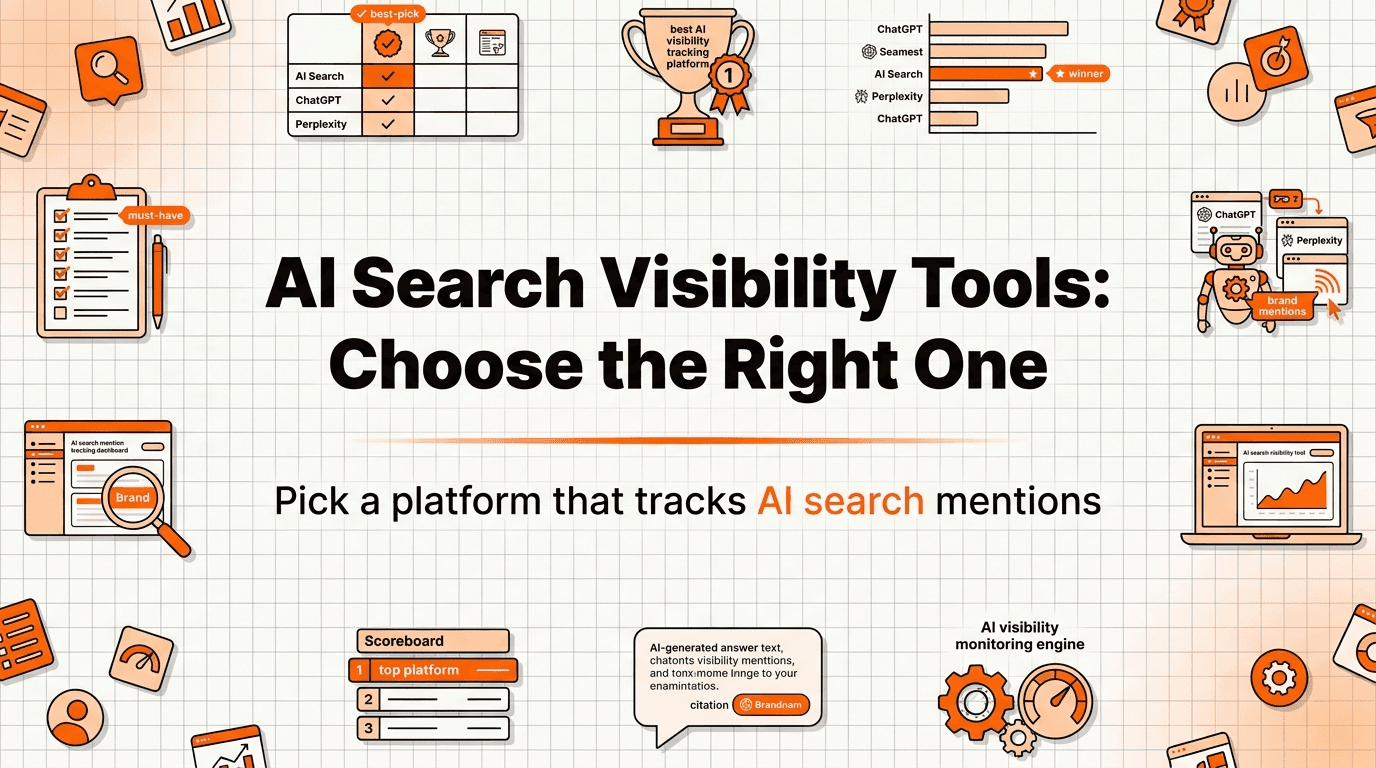
The landscape of search is evolving faster than ever. While you've spent years mastering Google rankings and traditional SEO metrics, a new frontier has emerged: AI search engines and Large Language Models (LLMs) that are fundamentally changing how people discover content. If you're still relying solely on Google Analytics and traditional rank tracking, you're missing a massive piece of the visibility puzzle.
AI search visibility tools represent the next generation of SEO analytics, designed specifically to track how your content performs in ChatGPT, Perplexity AI, Claude, and other LLM-powered platforms. This comprehensive ai search visibility tools guide will walk you through everything you need to know about selecting, implementing, and maximizing these emerging platforms.
Why Traditional SEO Tools Can't Track AI Search Performance
Traditional SEO tools like SEMrush, Ahrefs, and Moz were built for a world where Google dominated search. They excel at tracking keyword rankings, backlinks, and SERP features. However, they fundamentally fail when it comes to AI search for several critical reasons.
First, AI search engines don't operate on traditional ranking systems. When someone asks ChatGPT a question, there's no position one through ten. Instead, LLMs synthesize information from multiple sources and present it as a natural language response. Your content might be cited, paraphrased, or referenced without explicit attribution.
Second, traditional tools can't access the proprietary APIs and data streams that AI search engines use. They can't tell you how often your brand appears in Claude conversations or whether Perplexity cites your articles as authoritative sources. This blindspot is growing larger as more users shift toward AI-powered search experiences.
Third, the metrics themselves are completely different. Traditional SEO focuses on impressions, clicks, and conversions. AI search visibility requires tracking citation frequency, source attribution, context accuracy, and sentiment of mentions. These are fundamentally new KPIs that legacy tools weren't designed to measure.
Finally, optimization strategies differ dramatically. As we discuss in our LLM SEO optimization guide, ranking in AI search requires structured data, clear entity relationships, and authoritative signals that go beyond traditional keyword targeting.
What Are AI Search Visibility Tools?
AI search visibility tools are specialized platforms designed to monitor, measure, and analyze how your content and brand appear across LLM-powered search experiences. Unlike traditional rank trackers that show your position in Google results, these tools track citation frequency, source attribution, and contextual mentions across platforms like ChatGPT, Perplexity AI, Claude, Gemini, and emerging AI search engines.
These platforms work by systematically querying AI models with relevant questions and prompts, then analyzing the responses to identify when and how your content is referenced. They track patterns over time, helping you understand which topics generate citations, how your visibility trends, and where you stand relative to competitors.
Most AI search visibility tools offer several core capabilities:
- Citation tracking across multiple LLM platforms
- Brand mention monitoring and sentiment analysis
- Competitive intelligence showing how often competitors are cited
- Topic and query analysis revealing which prompts trigger citations
- Historical trending data to measure visibility changes over time
- Alert systems that notify you of significant visibility changes
The sophistication of these tools varies significantly. Some offer basic citation counting, while advanced platforms provide deep semantic analysis, context evaluation, and actionable optimization recommendations specific to AI search algorithms.
Top AI Search Visibility Tools Compared (2024)
The AI search visibility market is rapidly evolving, with new platforms emerging regularly. Here's a detailed comparison of the leading tools currently available:
Fonzy.ai
Fonzy.ai stands out as a comprehensive AI SEO automation platform that combines AI search visibility tracking with content optimization and automated publishing. Unlike standalone tracking tools, Fonzy helps you both monitor and improve your AI search performance through intelligent content recommendations.
The platform tracks citations across ChatGPT, Perplexity, Claude, and other major LLMs while providing actionable insights about which content formats and topics generate the most visibility. Its automation capabilities help scale content production specifically optimized for AI search algorithms.
BrightEdge
BrightEdge has evolved its enterprise SEO platform to include generative AI tracking capabilities. Their Generative Parser technology monitors how content appears in AI-generated answers across multiple platforms. Best suited for large enterprises with substantial budgets, BrightEdge offers robust data but comes with enterprise-level pricing.
Authoritas
Authoritas provides AI Overview and LLM visibility tracking integrated into their broader SEO platform. They focus heavily on tracking how brands appear in Google's AI Overviews (as we detail in our Google AI Overviews guide), making it particularly valuable for brands concerned about Google's evolving search experience.
Zyphr
Zyphr specializes exclusively in LLM visibility tracking, monitoring how content performs across ChatGPT, Perplexity, Claude, and other AI platforms. Their focused approach provides detailed citation analytics and competitive intelligence without the broader SEO features of all-in-one platforms.
GeoRanker
GeoRanker combines traditional local SEO tracking with AI search visibility monitoring. Particularly valuable for businesses with physical locations or those targeting geo-specific queries (similar to what we discuss in our geo services guide), the platform shows how AI models respond to location-based queries.
When evaluating these platforms, consider factors like platform coverage (which AI models they track), data freshness (how frequently they update), query customization (whether you can monitor specific prompts), competitive analysis features, and integration capabilities with your existing marketing stack.
How to Track Your Content Citations in ChatGPT
Tracking citations in ChatGPT presents unique challenges because the platform doesn't always provide explicit source attribution. However, with the right approach and tools, you can monitor your content's influence effectively.
The most reliable method involves systematic query testing. Create a list of relevant questions and prompts that your target audience might ask ChatGPT. These should cover your core topics, products, and areas of expertise. Run these queries regularly and analyze the responses for any mention of your brand, content, or concepts unique to your materials.
For ChatGPT specifically, pay attention to browsing citations when users enable web browsing capabilities. In these instances, ChatGPT may explicitly cite web sources, including your content. Track the frequency and context of these citations across different query types.
Document the following metrics for each query:
- Whether your brand or content is mentioned at all
- The prominence of the mention (early vs. late in the response)
- Whether attribution is explicit or the information is paraphrased
- The sentiment and context of the mention
- Which competitors are mentioned alongside your brand
Automated AI search visibility tools streamline this process significantly by running hundreds of queries systematically and tracking changes over time. They can alert you when your citation frequency drops or when new content begins generating visibility.
Additionally, monitor indirect signals. If your website traffic analytics show referrals with unusual patterns or direct traffic spikes that correlate with specific topics, this may indicate ChatGPT users following through to verify information or learn more.
Monitoring Your Brand Mentions in Perplexity AI
Perplexity AI presents a different tracking opportunity because it explicitly cites sources with clickable references. This transparency makes it somewhat easier to track citations, but also raises the stakes—appearing as a cited source in Perplexity can drive significant referral traffic.
Begin by identifying the query categories most relevant to your business. Perplexity users tend to ask more research-oriented questions compared to ChatGPT, so focus on informational and analytical queries rather than purely transactional ones.
Create a monitoring schedule that checks these queries weekly at minimum. Perplexity's results can vary based on recent content updates and trending information, so regular monitoring helps you understand volatility and identify optimization opportunities quickly.
When your content appears as a Perplexity citation, analyze the query context carefully. What specific angle or information from your content triggered the citation? Did Perplexity use your content as a primary source or as supplementary information? Understanding these patterns helps you create more content that earns citations.
Track your citation rank as well. Perplexity typically provides 3-5 primary sources per query. Being cited first or second significantly impacts click-through rates compared to being the fifth source. If you're consistently appearing but in lower positions, this indicates an opportunity to strengthen your content authority on those topics.
Also monitor for citation drops. If you previously appeared for certain queries but no longer do, investigate whether competitor content has superseded yours, whether the query interpretation has shifted, or whether your content has become outdated.
Measuring Visibility in Claude and Other LLMs
Claude, developed by Anthropic, and other emerging LLMs each have unique characteristics that affect tracking strategies. Claude tends to provide more nuanced, context-aware responses with careful qualifications, while models like Google's Gemini integrate more directly with search data.
For Claude specifically, focus on technical and analytical queries where the model excels. Claude users often ask complex questions requiring multi-step reasoning, making it particularly valuable for B2B brands, technical products, and professional services.
When tracking across multiple LLMs simultaneously, standardize your query set to enable meaningful comparisons. Use identical prompts across ChatGPT, Claude, Perplexity, and other platforms, then analyze how responses differ. You may find that certain content performs exceptionally well in one model but poorly in others, revealing optimization opportunities.
Consider these platform-specific factors:
- Training data cutoffs: Each model has different knowledge cutoff dates, affecting which content can be referenced
- Real-time web access: Some models browse the web for current information while others rely solely on training data
- Source citation practices: Models differ dramatically in how they attribute information
- User demographics: Different LLMs attract different user bases with varying information needs
For comprehensive tracking, invest in tools that monitor multiple platforms simultaneously rather than trying to manually track each one. The time savings and data consistency make this approach far more scalable.
Key Metrics to Track for AI Search Performance
AI search requires a fundamentally different metrics framework than traditional SEO. While position tracking and click-through rates matter for Google, AI search demands new KPIs that reflect how LLMs reference and present information.
Citation Frequency
This measures how often your content or brand is mentioned across a defined set of relevant queries. Track both raw citation counts and citation rate (percentage of relevant queries that mention you). Increasing citation frequency indicates growing topical authority in AI models.
Source Attribution Rate
Of the citations you receive, how many include explicit source attribution versus paraphrased information? Higher attribution rates typically correlate with stronger brand recognition and can drive referral traffic.
Prominence Score
Where in AI-generated responses does your content appear? Mentions in the opening paragraph carry more weight than those buried at the end. Track average mention position across queries to gauge how central your content is to AI responses.
Share of Voice
What percentage of citations go to your brand versus competitors in your query set? This competitive metric helps benchmark your relative AI search visibility and identify gaps where competitors dominate.
Sentiment and Context Quality
Being mentioned isn't enough—you need positive, accurate mentions in relevant contexts. Track the sentiment of your mentions (positive, neutral, negative) and verify that AI models represent your brand and content accurately.
Query Coverage
How many of your target query categories generate citations? Broad query coverage indicates comprehensive topical authority, while narrow coverage suggests opportunities to expand content into additional areas.
Velocity of Change
Track how quickly your visibility metrics change over time. Rapid increases might indicate successful optimization or trending topics, while sudden drops warrant immediate investigation.
Establish baseline measurements for all these metrics before implementing optimization changes. This allows you to measure the true impact of your AI search strategies and justify continued investment.
How to Set Up AI Search Tracking in 15 Minutes
Getting started with AI search tracking doesn't require weeks of setup. Follow this streamlined process to begin monitoring your visibility within 15 minutes:
Step 1: Choose your tracking platform. Select an AI search visibility tool that covers your priority platforms. If you're just starting, focus on one comprehensive tool rather than multiple specialized ones.
Step 2: Define your core query set (5 minutes). Identify 10-20 questions your target audience commonly asks. Include brand-related queries (mentions of your company name), category queries (general questions about your industry), and competitor comparison queries. Keep this initial set manageable—you can expand later.
Step 3: Configure tracking parameters (3 minutes). Input your queries into your chosen tool and select which AI platforms to monitor. Set your tracking frequency (daily for volatile topics, weekly for more stable content).
Step 4: Add competitor tracking (3 minutes). Include 3-5 main competitors in your monitoring. This provides essential context for interpreting your own performance.
Step 5: Set up alerts (2 minutes). Configure notifications for significant changes—citation drops above 20%, new competitor mentions in your key queries, or sudden visibility spikes that indicate opportunity.
Step 6: Establish your baseline (2 minutes). Let the tool run its initial tracking sweep. This first data set becomes your baseline for measuring future improvements.
That's it. You now have functional AI search tracking running. Schedule a weekly 15-minute review to check your dashboard, note significant changes, and adjust your query set based on what you learn.
As you become more sophisticated, expand your query set, add more granular tracking for high-value topics, and integrate AI search data with your content planning process.
AI Search Visibility vs Traditional SERP Tracking
Understanding the fundamental differences between AI search visibility and traditional SERP tracking helps you allocate resources appropriately and set realistic expectations.
Traditional SERP tracking is deterministic and positional. For any given keyword, you have a specific ranking position. Position one receives approximately 28% of clicks, position two gets 15%, and so on. The relationship between ranking and traffic is well-established and predictable.
AI search visibility is probabilistic and contextual. There are no fixed positions. Your content might be cited in 70% of relevant queries or 30%, but each occurrence is unique. The same query asked slightly differently might produce completely different results.
SERP tracking focuses on keywords and specific search queries. AI search tracking must consider semantic intent and topic clusters. LLMs don't just match keywords—they understand concepts and relationships, so your tracking must reflect this sophistication.
Traditional SEO has clear success metrics: ranking improvements, traffic increases, conversion rate optimization. AI search success is more nuanced. A citation without attribution might build brand awareness without driving immediate traffic, yet still deliver value.
The optimization cycles also differ. Traditional SEO changes can show results within days or weeks. AI search optimization often requires longer to impact model outputs, as LLMs may not immediately recognize updated content or new authority signals.
Most importantly, these aren't competing priorities—they're complementary. Strong traditional SEO performance often correlates with better AI search visibility, as both reward authoritative, well-structured, comprehensive content. Maintain both tracking systems and look for synergies rather than choosing one over the other.
Building Your AI Search Visibility Dashboard
An effective AI search visibility dashboard consolidates your key metrics into a single view that enables quick decision-making. Here's how to structure your dashboard for maximum utility.
Top Section: Overall Performance
Display your primary KPIs prominently: total citations this period, citation frequency trend (up or down), share of voice percentage, and citation growth rate. These high-level metrics provide immediate context about your overall AI search performance.
Platform Breakdown
Show citation performance by platform (ChatGPT, Perplexity, Claude, etc.). This reveals which platforms drive your strongest visibility and where opportunities for improvement exist.
Topic Performance
Group queries by topic category and display citation rates for each. This identifies your strongest content areas and reveals gaps where you lack visibility.
Competitive Intelligence
Include a competitive comparison showing your citation share versus key competitors. Visualize this as a share of voice chart that makes relative performance immediately clear.
Trending Queries
Highlight queries where your visibility changed significantly this period. Both gains and losses deserve attention—gains to understand what's working, losses to address problems quickly.
Alert Section
Reserve space for active alerts and notifications requiring immediate attention. This ensures urgent issues don't get buried in data.
Keep your dashboard focused on actionable metrics rather than vanity numbers. Every element should either inform a decision or trigger an investigation. Remove any metric that doesn't meet this criterion.
Update your dashboard weekly at minimum, daily if you're actively optimizing or working in fast-moving industries. Schedule regular review sessions to analyze trends and plan optimization efforts based on what the data reveals.
Common Mistakes When Tracking AI Citations
As AI search tracking evolves, several common mistakes consistently trip up marketers. Avoid these pitfalls to maximize the value of your tracking efforts.
Tracking Too Few Queries
Monitoring just 5-10 queries provides insufficient data to understand your true AI search visibility. Start with at least 20-30 queries across multiple topic areas, then expand as you identify patterns and opportunities.
Ignoring Query Variation
LLMs respond differently to slight query variations. Don't just track one version of a question—test multiple phrasings of the same information need to understand how robust your visibility is across semantic variations.
Expecting Immediate Results
AI models don't update instantly when you publish new content. Allow weeks or even months for optimization efforts to impact model outputs, especially for training-data-dependent models without real-time web access.
Focusing Only on Branded Queries
Tracking brand mentions is important, but generic category queries often represent larger opportunity. Balance your query set between branded, category, and competitive queries.
Neglecting Context Quality
A citation in the wrong context or with incorrect information can damage your brand. Always review the actual citations, not just counts, to ensure accuracy and appropriate context.
Treating All Platforms Identically
Different AI platforms serve different audiences and excel at different query types. Don't assume optimization strategies that work for ChatGPT will automatically translate to Perplexity or Claude.
Forgetting Competitive Context
Your citation count means little without competitive context. A 20% citation rate might be excellent if competitors average 10%, or concerning if they're at 40%.
Over-Optimizing for Current Models
AI models evolve rapidly. Optimization tactics that work today might become irrelevant with the next model update. Focus on fundamental quality signals—authority, comprehensiveness, accuracy—that transcend specific model versions.
The Future of AI Search Analytics
AI search visibility tracking is still in its early stages, but the trajectory is clear. Several emerging trends will shape the next generation of AI search analytics platforms.
Real-time monitoring will become standard as APIs mature and platforms provide official access to citation data. Currently, most tracking relies on sampling and periodic queries, but this will evolve toward continuous monitoring with immediate alerts.
Predictive analytics will help forecast visibility changes before they occur. By analyzing content patterns, competitive movements, and model behavior, advanced tools will predict which content is likely to gain or lose visibility and recommend preemptive optimization.
Attribution accuracy will improve as AI platforms face pressure to properly credit sources. This transparency benefits content creators and makes tracking more straightforward, while also raising the stakes for maintaining visibility.
Integration with content workflows will tighten. Rather than treating AI search tracking as separate from content creation, platforms will increasingly embed visibility insights directly into content management systems, providing real-time optimization suggestions as you write.
Standardization of metrics will emerge as the industry matures. Currently, different platforms define key metrics differently, making comparisons challenging. Expect industry standards to develop, similar to how traditional SEO coalesced around common KPIs.
Multi-modal tracking will expand beyond text. As AI models increasingly incorporate images, video, and audio, visibility tracking will need to measure how your visual content and multimedia assets appear in AI responses.
The most successful organizations will treat AI search visibility as a strategic priority now, building expertise and data history while the field is still emerging. Those who wait until AI search tracking is mainstream will face steeper learning curves and entrenched competitors.
Frequently Asked Questions
Can you track rankings in ChatGPT like Google rankings?
No, ChatGPT and other LLMs don't use traditional ranking systems. Instead of position one through ten, LLMs generate contextual responses that may mention multiple sources without explicit ranking. You track citation frequency and prominence rather than numerical positions. Think of it as measuring share of voice rather than rank position.
What's the best tool for monitoring AI search visibility?
The best tool depends on your specific needs and budget. Fonzy.ai offers comprehensive AI search tracking integrated with content optimization and automation, making it ideal for organizations wanting an all-in-one solution. For enterprise needs, BrightEdge provides robust data but at enterprise pricing. Specialized tools like Zyphr focus exclusively on LLM visibility tracking. Evaluate based on which AI platforms you need to monitor, your budget, and whether you want standalone tracking or integrated optimization capabilities.
How much do AI search visibility tools cost?
Pricing varies significantly based on features and scale. Entry-level monitoring tools start around $99-299 per month for basic citation tracking across limited queries. Mid-tier platforms with competitive intelligence and multiple platform coverage typically range from $500-1,500 monthly. Enterprise solutions with comprehensive tracking, predictive analytics, and API access can exceed $5,000 per month. Most platforms offer tiered pricing based on the number of queries tracked and platforms monitored.
Do I still need Google Analytics if I use AI search tools?
Absolutely. AI search visibility tools and traditional web analytics serve complementary but different purposes. Google Analytics tracks what happens on your website—visitor behavior, conversions, and engagement. AI search tools track what happens before visitors reach your site—how you're mentioned in AI responses. You need both to understand the complete customer journey. When someone discovers you through an AI citation and then visits your site, Google Analytics captures that conversion while AI tools explain the discovery mechanism.
How often should I check my AI search visibility?
For most organizations, weekly reviews are sufficient unless you're in a rapidly changing industry or actively running AI optimization campaigns. Daily monitoring makes sense when launching new content initiatives or responding to visibility drops. Monthly reviews are too infrequent—AI search dynamics change quickly enough that monthly data misses important trends. Set up automated alerts for significant changes so you can respond immediately to major shifts while maintaining your regular review schedule for strategic analysis.
Can AI search visibility tools track competitor mentions?
Yes, most quality AI search visibility tools include competitive tracking features. You can monitor how often competitors are cited for the same queries you track, compare your citation rates to theirs, and identify queries where competitors dominate. This competitive intelligence reveals opportunities where you can improve content to capture share of voice. Some advanced tools also track which specific competitors appear together with your brand in AI responses, helping you understand direct competitive relationships as perceived by AI models.
Choosing the right AI search visibility tools requires understanding your specific needs, budget constraints, and strategic priorities. Whether you're just beginning to track AI citations or looking to upgrade from basic monitoring to comprehensive analytics, the key is starting now rather than waiting for the market to mature further. The data and expertise you build today will compound as AI search becomes increasingly central to how audiences discover content and brands.