 Ready to grow?
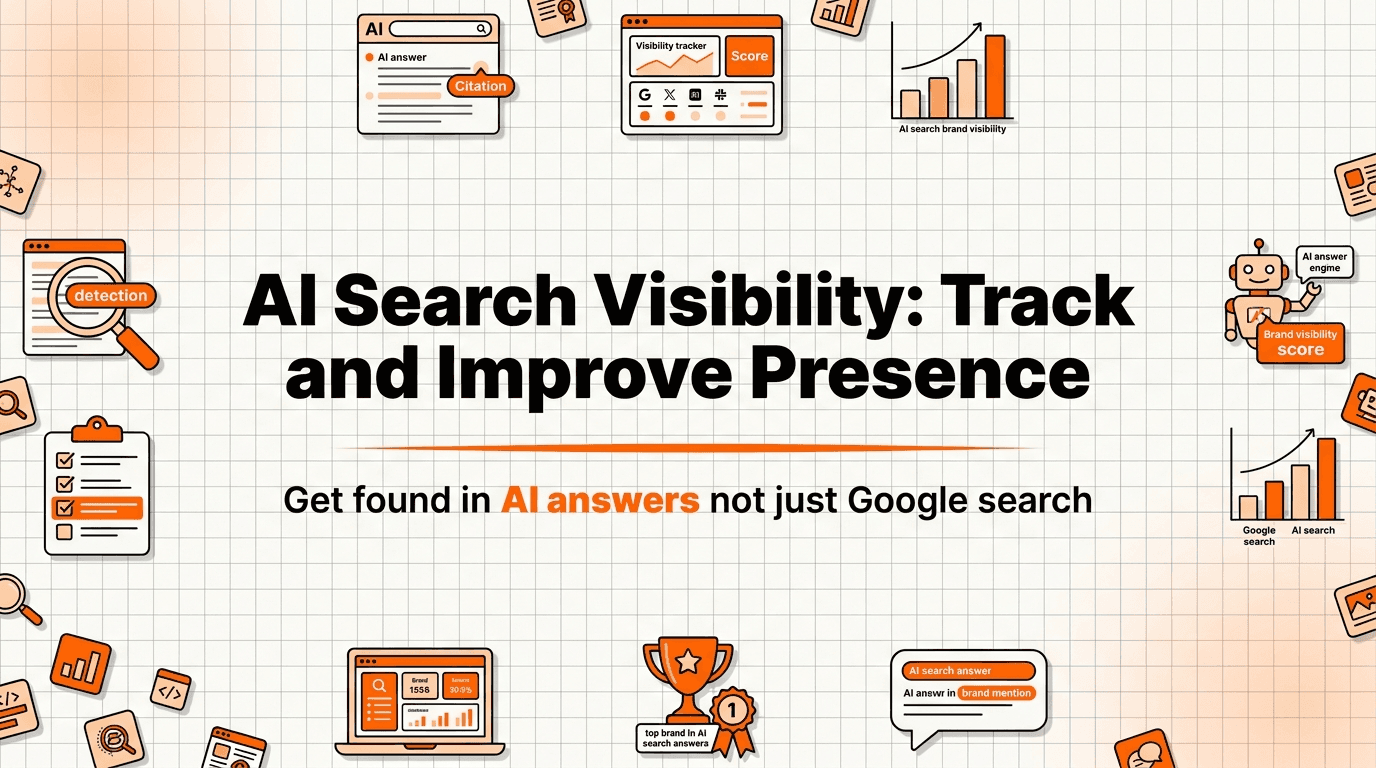
The search landscape is undergoing its most dramatic transformation since Google first indexed the web. While marketers obsess over keyword rankings and backlink profiles, a seismic shift is quietly reshaping how people find information online. AI-powered search engines like ChatGPT, Perplexity, Claude, and Google's AI Overviews are fundamentally changing the rules of visibility.
This comprehensive ai search visibility guide will show you exactly how to track, measure, and improve your presence across AI search platforms—before your competitors figure it out.
What Is AI Search Visibility (And Why Traditional SEO Is Dying)
AI search visibility refers to how frequently and prominently your content appears in responses generated by AI-powered search engines and chatbots. Unlike traditional search engine results pages (SERPs) where users see ten blue links, AI search engines synthesize information from multiple sources and present a single, conversational answer.
When someone asks ChatGPT about the best project management software or queries Perplexity about SEO strategies, these AI systems pull from their training data and real-time web sources to construct responses. Your AI search visibility determines whether your brand, content, or expertise gets cited in those answers.
Traditional SEO isn't quite dead, but it's evolving rapidly. The zero-click search trend was just the beginning. With Google AI Overviews now appearing for countless queries, users increasingly get their answers without clicking through to any website. The game has shifted from ranking high to being the source that AI systems trust and cite.
Research shows that over 40% of younger users now prefer asking ChatGPT or Perplexity instead of using Google for informational queries. This behavioral shift represents an existential challenge for businesses that have built their traffic strategies entirely around traditional search rankings.
The 4 AI Search Engines You Need to Optimize For
Not all AI search platforms are created equal. Each has different data sources, retrieval mechanisms, and user demographics. Here are the four platforms that should be on your radar:
ChatGPT Search
OpenAI's ChatGPT now includes real-time web browsing capabilities for Plus subscribers and all users on certain queries. With over 100 million weekly active users, ChatGPT has become a primary research tool for professionals, students, and consumers. Its search function pulls from current web content and provides cited sources, making it crucial for visibility.
Perplexity AI
Purpose-built as an AI answer engine, Perplexity combines large language models with real-time search to deliver sourced, conversational answers. It prominently displays citations and allows users to dive deeper into source material. Perplexity has positioned itself as a Google alternative and is growing rapidly among tech-savvy users.
Google AI Overviews
Google's AI-generated summaries now appear at the top of search results for countless queries. These overviews synthesize information from multiple sources and often reduce the need for users to click through to websites. Understanding how to appear in these overviews is essential for maintaining search visibility in the AI era.
Microsoft Copilot
Integrated into Bing, Edge, and Microsoft 365 products, Copilot reaches hundreds of millions of users, particularly in enterprise environments. Its tight integration with productivity tools makes it especially relevant for B2B companies and service providers.
How AI Search Visibility Differs From Traditional SEO
The fundamental principles that governed traditional SEO for two decades are being rewritten. Understanding these differences is critical for developing an effective AI search visibility strategy.
Traditional SEO vs. AI Search Visibility:
Traditional SEO focuses on ranking for specific keywords. You optimize pages around target phrases, build backlinks, and compete for positions on the SERP. Success is measured by rankings and click-through rates.
AI search visibility focuses on being cited as a source. Instead of ranking #1 for a keyword, your goal is to become the authoritative source that AI models reference when answering questions in your domain. Success is measured by citation frequency and the quality of context in which you're mentioned.
Traditional SEO relies heavily on backlinks as trust signals. The more high-quality sites link to you, the more authority you accumulate in Google's eyes.
AI search visibility prioritizes content structure, clarity, and factual accuracy. While backlinks still matter, AI systems evaluate content based on how well-structured your information is, how clearly you explain concepts, and whether your facts can be corroborated across multiple sources. Proper schema markup and structured data become even more important.
Traditional SEO optimizes for keyword queries. You research what people type into search boxes and create content targeting those exact phrases.
AI search visibility optimizes for conversational questions and intent. People interact with AI differently—they ask complete questions, engage in multi-turn conversations, and express nuanced intent. Your content needs to address the full spectrum of related questions, not just individual keywords. This is where LLM SEO optimization becomes essential.
Traditional SEO measures success through traffic and rankings. You track position changes, organic sessions, and conversion rates from search traffic.
AI search visibility measures success through citation metrics and brand mentions. You track how often your content is referenced, the context of those mentions, and whether you're positioned as an authority. Traffic may actually decrease while your influence increases.
How to Measure Your AI Search Visibility Right Now
Measuring AI search visibility requires new tools and methodologies. Since there's no AI equivalent of Google Search Console yet, you'll need to employ a combination of manual checks and emerging platforms.
Manual Citation Tracking
Start by directly querying AI search engines with questions related to your industry, products, or expertise. Create a spreadsheet with 20-30 relevant queries that your target audience might ask. Run these queries weekly across ChatGPT, Perplexity, Google AI Overviews, and Copilot. Document whether your brand or content is mentioned, how it's positioned, and what competitors appear.
This manual process is time-consuming but invaluable for establishing baseline visibility. You'll quickly identify which platforms cite you most frequently and which topics you own versus areas where competitors dominate.
Source Attribution Analysis
When AI platforms cite sources, analyze the pattern. Which of your pages get cited most often? For which types of queries? Are you cited as a primary source or a supporting reference? Understanding these patterns helps you identify what's working and replicate it across other content.
Traffic Source Segmentation
Review your Google Analytics referral traffic. Look for visits coming from chat.openai.com, perplexity.ai, and other AI platforms. While AI search often doesn't result in clicks, when it does, those visitors tend to be highly qualified since they've already engaged with your content through the AI response.
Brand Mention Monitoring
Set up monitoring for brand mentions across social media and forums where users share AI-generated responses. Many users screenshot and share helpful ChatGPT or Perplexity answers. These organic shares indicate strong AI search visibility and provide qualitative insight into how your brand is being positioned.
7 Tactics to Improve Your AI Search Visibility
Improving your presence in AI search results requires a strategic approach that goes beyond traditional SEO tactics. Here are seven proven methods to increase your AI search visibility.
1. Create Comprehensive, Fact-Dense Content
AI models prefer content that thoroughly addresses topics with specific, verifiable facts. Thin content that dances around a subject without providing concrete information gets ignored. Focus on depth over breadth—a single 3,000-word comprehensive guide typically performs better than three 1,000-word surface-level articles.
Include specific data points, statistics, examples, and case studies. When you make claims, support them with evidence. AI systems are trained to prioritize content that demonstrates expertise through specificity rather than vague generalizations.
2. Structure Content for AI Parsing
AI systems extract information more effectively from well-structured content. Use clear hierarchical headings (H2s, H3s), short paragraphs, bullet points, and numbered lists. Each section should address a specific sub-topic completely before moving to the next.
Implement schema markup to help AI systems understand your content's context and relationships. Use FAQ schema for question-and-answer content, Article schema for blog posts, and appropriate structured data for products, services, events, and local businesses. For location-based services, proper implementation of geo-targeted content strategies becomes critical.
3. Optimize for Question-Based Queries
People interact with AI conversationally, asking complete questions rather than typing keyword fragments. Research the questions your audience asks using tools like AnswerThePublic, Reddit, Quora, and industry forums. Structure content to directly answer these questions with clear, quotable responses.
Create dedicated FAQ sections that address related questions comprehensively. Begin answers with clear, direct statements before elaborating. AI systems often extract these initial sentences as citations.
4. Build Topical Authority Through Content Clusters
Rather than creating isolated articles on random topics, develop content clusters around core themes where you want to be recognized as an authority. Create a comprehensive pillar page on a broad topic, then develop supporting content that addresses specific sub-topics in depth.
This approach signals to AI systems that you're a comprehensive resource on the subject, increasing the likelihood they'll cite you when answering related questions. Internal linking between cluster content strengthens this topical authority signal.
5. Establish and Showcase Expertise
AI systems evaluate content credibility partly through author credentials and expertise signals. Create detailed author bios that establish relevant credentials, experience, and qualifications. Link to author profiles on LinkedIn and other professional platforms.
Include author bylines on all content. Publish original research, case studies, and data-driven insights that demonstrate first-hand knowledge. Guest post on authoritative sites in your industry to build your professional footprint across the web.
6. Maintain Content Freshness and Accuracy
AI systems prioritize recent, up-to-date information. Regularly audit and update your existing content to ensure facts, statistics, and recommendations remain current. Add publication and update dates to articles, and actually update them when information changes.
Outdated information damages your credibility in AI citations. If your 2022 article about social media algorithms hasn't been updated, AI systems will prefer citing a competitor's 2024 version instead.
7. Earn Citations from High-Authority Sources
While backlinks matter less for AI search than traditional SEO, being cited or mentioned by authoritative sources still carries weight. AI systems learn to trust sources that other trusted sources reference.
Pursue digital PR opportunities, contribute expert quotes to journalists, publish in industry publications, and collaborate with respected voices in your field. Each mention reinforces your authority in the broader web context that AI models analyze.
Common AI Search Visibility Mistakes (And How to Avoid Them)
As businesses scramble to adapt to AI search, several common mistakes are emerging. Avoiding these pitfalls will save you time and resources.
Mistake 1: Keyword Stuffing for AI
Some marketers assume they can game AI systems the same way they once manipulated search engines—by stuffing content with target phrases. AI language models are far more sophisticated at detecting unnatural language patterns. They penalize content that reads awkwardly or unnaturally, even if it's technically keyword-rich.
Instead, write naturally for humans. AI systems are trained on high-quality human writing and prefer content that reads smoothly and conversationally.
Mistake 2: Ignoring Source Attribution
Failing to cite sources in your own content can hurt AI search visibility. AI systems evaluate credibility partly through how well you support claims with evidence and references. Content that makes unsupported assertions appears less trustworthy than content that cites reputable sources.
Link to authoritative sources when making factual claims. This practice also encourages reciprocal citation and positions you within a network of credible information sources.
Mistake 3: Creating AI-Generated Content Without Human Expertise
The irony isn't lost: using AI to create content optimized for AI search. While AI writing tools can assist with content creation, purely AI-generated content that lacks human expertise, original insights, or unique perspectives rarely achieves strong AI search visibility.
AI systems are trained to recognize and prefer content that demonstrates genuine expertise and original thinking. Use AI as a tool to enhance your content creation process, but ensure every piece includes unique insights, original research, or expert perspectives that only you can provide.
Mistake 4: Neglecting Technical Foundations
Some marketers focus entirely on content while ignoring technical factors that affect how AI systems access and understand their sites. Slow page speeds, poor mobile optimization, broken links, and missing structured data all hinder AI search visibility.
Ensure your site is technically sound with fast loading times, clean code, proper schema markup, and an XML sitemap. Make it easy for AI crawlers to access and parse your content.
AI Search Visibility Tools and Platforms
The AI search visibility space is rapidly evolving, with new tools emerging to help marketers track and optimize their presence. Here are the current leaders and what they offer.
Fonzy.ai
Fonzy.ai provides AI SEO automation specifically designed for optimizing content for AI search engines. The platform analyzes how AI systems interpret your content and provides actionable recommendations for improving visibility across ChatGPT, Perplexity, and other AI platforms. It automates much of the manual tracking work required to monitor AI citations.
Perplexity Analytics
For publishers and content creators, Perplexity offers analytics that show when your content appears in search results. While still limited compared to traditional analytics platforms, it provides valuable insights into which articles generate citations and visibility.
Citation Tracking Spreadsheets
For those on a budget, a well-organized spreadsheet can effectively track AI search visibility. Create columns for query, date, platform, citation status, position, and competitor mentions. Run weekly checks and log results. While manual, this approach provides complete control over what you track and how you analyze trends.
Schema Markup Tools
Tools like Google's Structured Data Markup Helper, Schema.org's validator, and various WordPress plugins help implement the structured data that AI systems use to understand content context. Proper schema markup is foundational for AI search visibility.
The Future of AI Search Visibility: What's Coming in 2025-2026
The AI search landscape will continue evolving rapidly over the next two years. Understanding emerging trends helps you prepare and adapt your strategy proactively.
Multimodal Search Integration
AI search engines are rapidly expanding beyond text to include images, videos, audio, and other media formats. Google's Gemini and OpenAI's GPT-4V already process visual information. By 2025, optimizing images, videos, and other media for AI discoverability will be as important as optimizing text content.
This means comprehensive alt text, video transcripts, detailed image descriptions, and properly tagged media files will become crucial ranking factors for AI visibility.
Personalized AI Search Results
AI search engines will increasingly personalize results based on user preferences, search history, and context. The same query from two different users may generate different responses citing different sources based on their profiles and past interactions.
This personalization makes broad AI search visibility more challenging but also more valuable. Building consistent authority across diverse user segments will require comprehensive topical coverage and multiple content formats addressing the same subjects from different angles.
Real-Time Information Prioritization
As AI search engines improve their real-time web access, recency will become an even more critical factor. Content that's regularly updated, news-focused sites, and brands that consistently publish fresh insights will gain advantages over static resources.
This trend favors publishers who can maintain content freshness at scale and businesses that share timely industry insights rather than evergreen content alone.
Voice and Conversational Interfaces
Voice-based AI search through smart speakers, mobile assistants, and automotive systems will expand dramatically. Optimizing for voice search requires even more natural, conversational content that directly answers spoken questions.
Content formatted as clear, quotable answers to common questions will perform best in voice search scenarios where AI systems need to provide concise spoken responses.
Paid AI Search Placements
Just as Google evolved from purely organic results to incorporating paid advertisements, AI search platforms will inevitably introduce monetization through sponsored content, promoted sources, or paid placements in AI-generated responses.
Early adopters who understand how to balance organic AI search visibility with strategic paid placements will gain significant competitive advantages as these advertising formats mature.
Frequently Asked Questions
What is AI search visibility?
AI search visibility refers to how often and prominently your content, brand, or expertise appears in responses generated by AI-powered search engines like ChatGPT, Perplexity, Google AI Overviews, and Microsoft Copilot. Unlike traditional search engine rankings, AI search visibility focuses on whether AI systems cite your content as a source when answering user questions. High AI search visibility means your content is frequently referenced, quoted, and recommended by these AI platforms.
How do you check if your content appears in AI search results?
You can check AI search visibility by directly querying AI platforms with questions related to your content or industry. Create a list of relevant queries your audience might ask, then search for those questions on ChatGPT, Perplexity, Google, and Copilot. Note whether your content is cited, how it's positioned, and what context surrounds the mention. Additionally, you can use emerging AI SEO tools like Fonzy.ai to automate this tracking process and monitor citation frequency over time.
Does traditional SEO still matter for AI search visibility?
Yes, but with important differences. Traditional SEO fundamentals like quality content, site structure, mobile optimization, and page speed remain relevant because they affect how AI systems access and evaluate your content. However, the emphasis shifts from ranking for specific keywords to establishing topical authority, providing comprehensive information, and creating content that AI systems consider credible and citation-worthy. Backlinks matter less than content quality and structure, while expertise signals and factual accuracy become more critical.
Which AI search engines should I optimize for?
The four primary AI search platforms to optimize for are ChatGPT Search, Perplexity AI, Google AI Overviews, and Microsoft Copilot. ChatGPT reaches over 100 million weekly users and is rapidly becoming a research tool. Perplexity is purpose-built as an AI answer engine with growing adoption among tech-savvy users. Google AI Overviews appear prominently in traditional Google search results. Microsoft Copilot is integrated into Bing, Edge, and Microsoft 365, reaching enterprise users. Your priority should depend on where your target audience searches for information.
How long does it take to improve AI search visibility?
Improving AI search visibility typically takes 2-4 months of consistent effort, though results vary based on your starting point, competition level, and content quality. Unlike traditional SEO where ranking changes can occur within weeks, AI systems need time to discover, evaluate, and begin citing your content. Creating comprehensive, authoritative content in your niche, properly structuring it for AI parsing, and maintaining content freshness all contribute to faster results. Established brands with existing authority may see improvements sooner, while newer sites require more time to build credibility across AI platforms.
AI search visibility represents the future of online discoverability. While traditional SEO isn't disappearing overnight, the shift toward AI-powered search is accelerating faster than most marketers realize. The brands and businesses that invest now in understanding and optimizing for AI search engines will establish competitive advantages that become increasingly difficult to overcome as this transition accelerates. Start tracking your AI search visibility today, implement the strategies outlined in this guide, and position yourself as an authority that AI systems trust and cite regularly.