 Ready to grow?
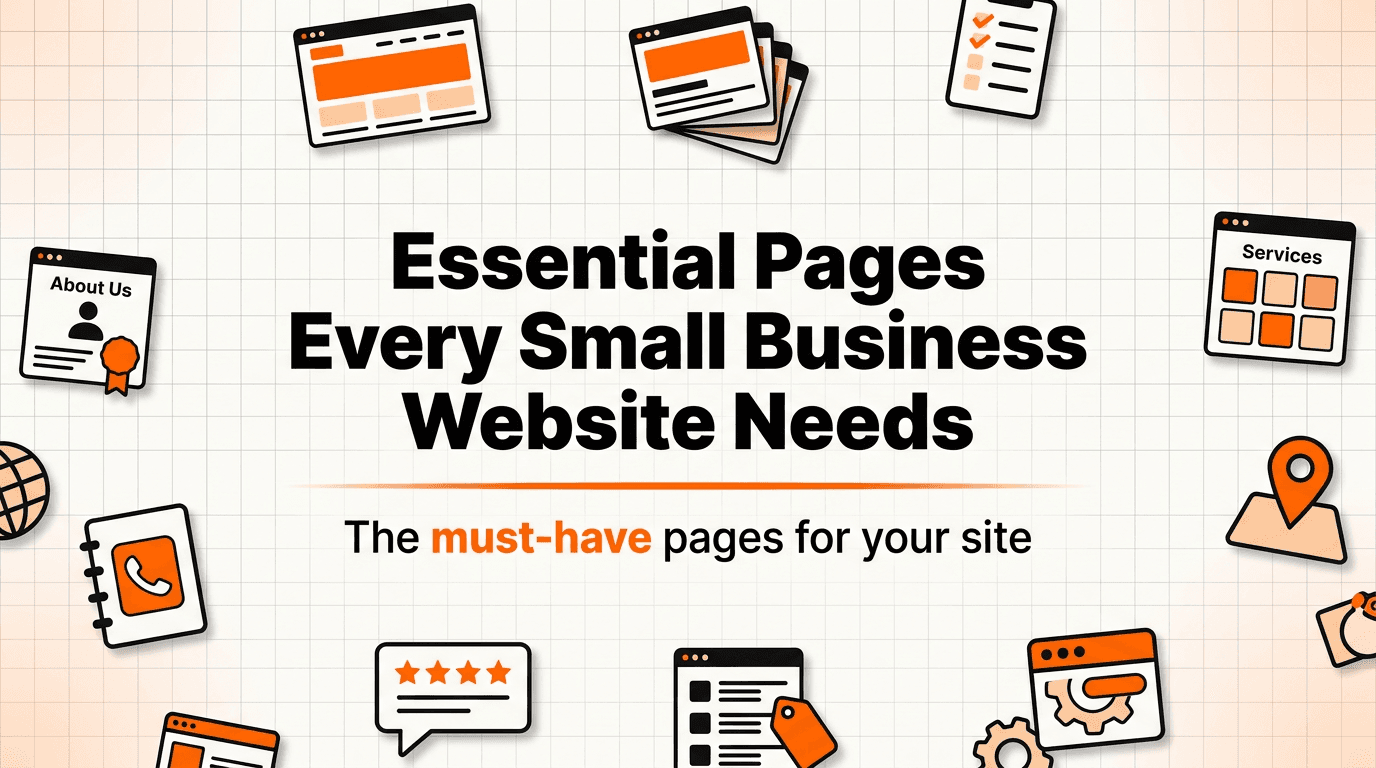
Short answer: Most small businesses need five pages, each doing one job: a homepage (what you do, for whom), a services or products page (what you sell and rough prices), an about page (a real person to trust), a contact page (a real phone number and address), and one page that earns search traffic, like a blog or guide.
That is the whole starter site. Not fifty pages. Not a redesign. Five pages, each pulling its weight.
Picture a house cleaner with a one-page website: a logo, a nice photo, and a form that just says "Get in touch." It looks fine. It also gets almost no work, because a visitor cannot tell what a clean costs, cannot find a phone number, and cannot see who is showing up at their door. We will follow that cleaner through this post and fix one page at a time.
How many pages does a small business website actually need?
Five. The U.S. Small Business Administration lists five essential pages every small business site needs: a homepage, an about page, a products or services page, a contact page, and a testimonials page, with a few more to add over time. Our list swaps the testimonials page for one that earns search traffic, and we will get to why. The point stands: a handful of pages, each with a clear job, beats a sprawling site nobody finishes building.
Doing this work for owner-run businesses, the pattern is always the same. The owner thinks the problem is that the site looks dated, so they want a bigger, prettier rebuild. The real problem is usually that three of the five jobs are missing. The homepage never says what they do in plain words, the prices are hidden, and the phone number lives only in a form. Fix those three and the site starts working, even if it still looks a little plain.
A web builder pricing out simple sites for local businesses put the starter set plainly on the Warrior Forum: "An example site would have maybe a home page with a picture slider and their contact details address etc, an about us page, a contact us page with a contact form." People who build these sites for a living keep landing on the same short list, because it is the list that answers the questions a customer actually has.
If you want the pure numbers answer to the count question, we go deeper on how many pages a website should have and where the extra ones come from. For most owners, though, "which five, and what each is for" matters more than the total. Here is each page, in the order a customer meets it.
Page one: a homepage that says what you do in one line
A stranger lands on your homepage and gives it a few seconds. In that time they need to answer one question: "Am I in the right place?" The house cleaner's homepage should say, near the top, "House cleaning for homes in Leeds. Weekly, fortnightly, or one-off deep cleans." That is it. What you do, who it is for, and where.
The mistake is opening with "Welcome to our website" or a fuzzy slogan. That wastes the seconds you have. Say the plain thing first, then let the page breathe.
The homepage also does a job for Google. It is usually the page search engines treat as the front door of your business, so the words on it tell search engines and AI assistants what you are and where you work. "House cleaner in Leeds" belongs in the heading, not buried three scrolls down. Your homepage does not need to be clever. It needs to be clear, and clear is what gets rewarded.
Page two: a services or products page that shows prices
Here is the page most small sites are missing, and it is the one that turns lookers into leads. The house cleaner adds a Services page: "Standard clean, from $120. Deep clean, from $200. Move-out clean, from $280." Suddenly a visitor knows whether they can afford it, and the ones who can start booking.
Owners resist putting prices up. They worry a competitor will undercut them, or that every job is different. You do not need an exact figure. A "starting from" price does the work: it filters out the people who were never going to hire you and reassures the ones who will. A price range answers the quiet question every customer has before they call.
This page earns its keep with Google too. "House cleaning prices Leeds" and "deep clean cost" are things people type and ask AI assistants every day. A page that names your services and rough costs is a page that can show up for those searches. If you sell services, it is worth building this out properly; we cover the details in our guide to a services page that ranks and converts. If you sell products, the same rule holds: show what it is, show what it costs, make it easy to buy.
Page three: an about page with a real face, not a logo
People hire people. Your about page is where a stranger decides whether you feel like a safe pair of hands. The house cleaner's about page needs a real photo of her (or her small team), one honest paragraph on how long she has been cleaning homes, and what she is fussy about. Not a stock image of a sparkling kitchen. Her actual face.
This is not soft advice. Stanford's long-running web credibility research found that "design and look" was the single biggest thing people used to judge whether a site could be trusted, named by about 46% of respondents, with roughly three in four judging credibility on how a site presents itself rather than on any formal credential. First impressions of the page are first impressions of you. The SBA gives the same tip in plainer words: show photos of the team in action rather than a picture of your building.
An about page does light work for search too, especially for your business name and local trust signals. Mostly, though, it is the page that turns "some cleaning company" into "Sarah, who has cleaned homes on my street for six years." That shift is what makes someone pick up the phone. If you want help writing one that does not read like a resume, we walk through it in how to write an about page that builds trust.
Page four: a contact page with a real phone number
This is the page that was quietly costing the house cleaner every lead. Her old site had a form labeled "Get in touch" and nothing else. No number. No service area. No hours. A visitor ready to book had no way to act, so they left and called the next cleaner on the list.
The numbers on this are blunt. A KoMarketing web usability report found that 44% of people said missing contact information or a phone number was a reason they left a business website. More than half named thorough contact information as the content most often missing from company sites, and 64% said they wanted to see it, making it the single most requested thing on a business website. People are not being difficult. They just want to know they can reach a real business.
So the contact page gets the real details: a phone number you answer, an email, the area you serve, and your hours. If you take walk-ins, add the address and a map. The house cleaner adds her mobile number and "Serving Leeds and surrounding areas, calls answered 8am to 6pm," and the quote requests start arriving. A BrightLocal consumer survey found that after reading good reviews, one in five people go on to contact the business and another one in five book an appointment. The contact page is where all of that lands. Make it easy, or the interest evaporates.
Page five: one page that earns search traffic
The first four pages convince people who already found you. The fifth page helps new people find you at all. This is a blog post or a helpful guide that answers a real question your customers ask before they ever think about hiring.
For the house cleaner, that page is "How often should you get your house professionally cleaned?" or "What is included in a deep clean?" People search those questions constantly, and none of the four core pages answer them. A guide does, and it pulls in visitors who did not know your business existed yet. It also gives AI assistants and search engines something to quote when someone asks for advice, which is increasingly how people find local businesses.
This matters more than most owners think. A BrightLocal survey found that 54% of consumers visit a business's website after reading reviews, yet only about 40% of small businesses even have a dedicated website, despite most of them saying they invest in getting found online. A single genuinely useful page can be the thing that shows up when a neighbor searches, then routes them to your services and contact pages. You do not need to post weekly. One strong guide, kept accurate, does real work. Our take on whether it pays off is in whether blogging actually helps your SEO.
What about testimonials, FAQ, and a portfolio?
These are the pages to add once the first five are earning their keep, not before. A testimonials page (which the SBA counts among its essentials) gathers your reviews in one place with real names attached. An FAQ page answers the questions you keep getting by phone, which saves you time and helps you show up when people ask those exact questions online. A portfolio or gallery suits anyone whose work is visual: a painter, a gardener, a baker.
Add them when you have something real to fill them with. An empty testimonials page or a three-line FAQ looks worse than no page at all. Build the five that answer a customer's core questions first, then grow from there.
How the five pages link together
The last job is making the pages point at each other so a visitor can move without thinking. Your homepage links out to services and to contact. Your services page ends with a clear next step to the contact page. Your blog post links to the relevant service. Your about page reassures, then sends people to book. It is a small loop: find you, understand you, trust you, reach you.
If a full five-page site feels like too much this month, start with the two that stop the bleeding: a services page with prices and a real contact page. That is the fix that changed the house cleaner's site from a dead end into a source of quote requests. If a single page really is all you can manage right now, make that one page do the five jobs in sections, and read our guide to making a one-page website work for search so it still gets found.
Frequently asked questions
Do I really only need five pages?
Five is the starter set that covers what a customer needs to decide and what search engines need to understand you. The SBA lists five essentials, and most service businesses do fine with them for a long time. Add testimonials, FAQ, or a portfolio later, when you have real content to fill them.
Should I put prices on my website?
Yes, at least a "starting from" figure. Owners worry about tipping off competitors, but a price range mostly filters out people who were never going to buy and reassures the ones who will. Hidden prices send ready buyers to a competitor who shows theirs.
Is a contact form enough, or do I need a phone number?
You need both, but the phone number is not optional. A KoMarketing usability report found 44% of people leave a site that has no visible contact information or phone number. A form alone signals that you would rather not be called, which costs you the customers who prefer to talk before they book.
Do I need a blog if I run a small local business?
You need at least one page that answers a question people search for before hiring, which a blog post handles well. It does not have to be a running blog. One accurate, genuinely useful guide can pull in visitors your homepage never would and give AI assistants something to cite.
Start with the house cleaner's fix: a services page that shows prices and a contact page with a real number. Those two pages turn a site from a polite dead end into a place that books work. That is what Fonzy is built to get right, making sure each page says the plain thing a customer needs and the clear thing Google and AI search need, so the five pages you already have start earning their keep.
Sources
- U.S. Small Business Administration: the five essential pages a small business website needs
- KoMarketing B2B Web Usability Report: 44% leave a site with no contact info, 64% want it visible
- Stanford web credibility research (Fogg et al.): about 46% judge a site's credibility on its design and look
- BrightLocal Local Consumer Review Survey: 54% check a business website after reading reviews
- BrightLocal SMB Marketing Report: only 40% of small businesses have a dedicated website