 Ready to grow?
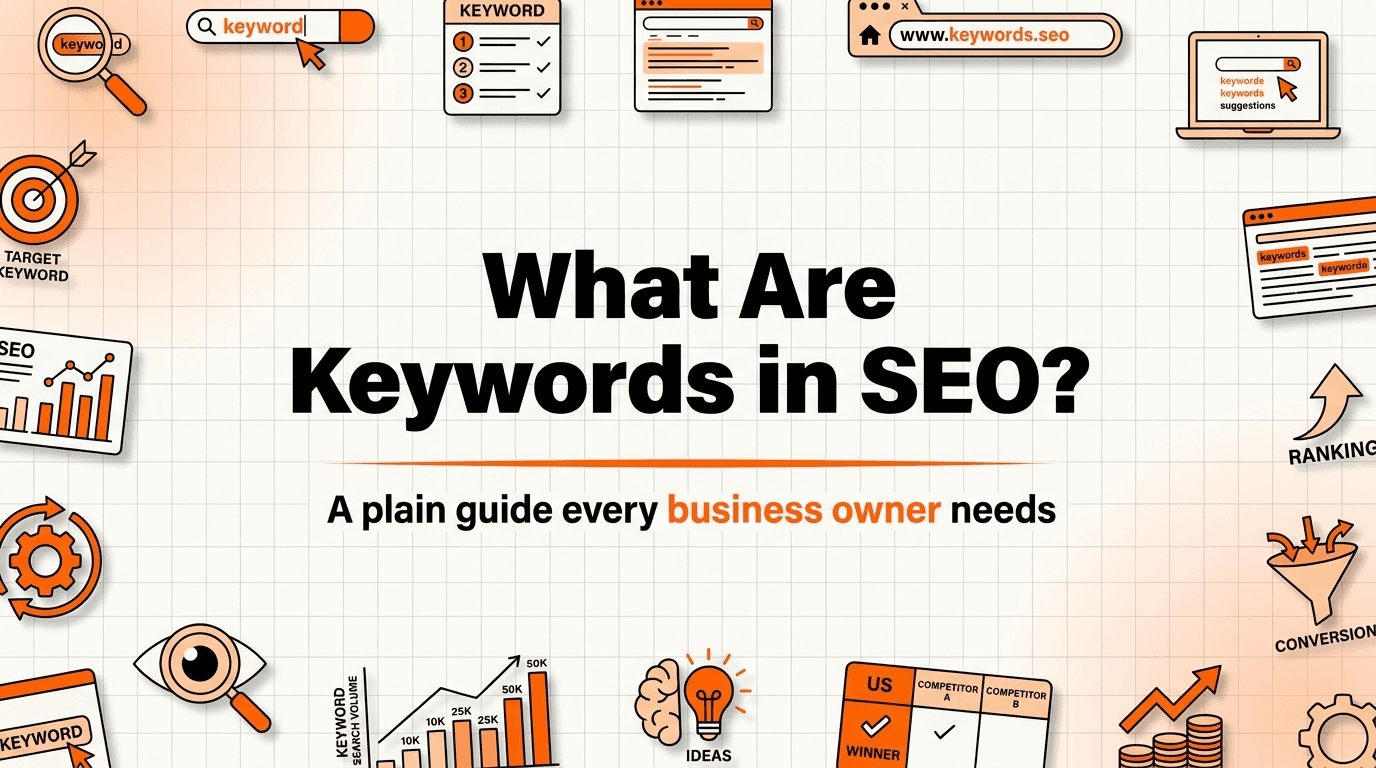
A keyword is the exact word or phrase a customer types into Google when they are looking for what you sell. That is the whole concept. It is not a setting you switch on, not a piece of code, not something you buy. It is your customer's own words.
Meet Bella. She runs a mobile dog-grooming business out of a converted van. When a dog owner three towns over wants their nervous spaniel groomed at home, they open Google and type "mobile dog grooming near me." That phrase is a keyword. Bella's job is simple to describe and easy to get wrong: use the same words her customers use, on the pages of her website, so Google can match her van to the person searching for it.
That is the one idea in this article. Keywords are your customers' words. Your task is to find them and use them. Everything below is how.
So what exactly is a keyword?
Type "dog groomer near me" into Google and you have just typed a keyword. So has every other person who searched that phrase today. A keyword is nothing more than the search itself, the literal text a person enters when they want something.
For Bella, the keywords that matter are the phrases real owners type when they need her:
- "mobile dog grooming near me"
- "dog groomer that comes to your house"
- "how to calm a nervous dog at the groomer"
Notice these are not clever or technical. They are how a worried dog owner actually talks. That is the point. Google's whole job is to connect those words to the business that answers them best. If Bella's website uses the same plain phrases her customers do, Google has an easy match to make. If her site says "premium canine aesthetic services," it does not, because nobody types that.
Here is a number that makes the case. According to Google, about 15% of the searches it sees every single day are brand new, queries it has never seen before. John Mueller of Google revisited that figure at a 2025 Search Central Live event and noted it has held steady even as AI search grew. People invent new ways to ask for things constantly. You cannot guess every phrase. You can only write in normal language and cover the questions real people ask.
Why does the same word mean different things?
The literal phrase is only half the story. What the person actually wants is the other half, and it matters more.
Take two searches. Someone types "dog grooming prices." Someone else types "how to brush a doodle at home." Both contain dog grooming words. They want completely opposite things. The first person is close to booking and wants to know what it costs. The second person wants to learn a skill and do it themselves, today, for free. If Bella sends both of them to her booking page, she wins one and loses one.
This is called search intent: the want behind the words. A good rule is to read the phrase and ask, "What is this person trying to do?" Buy soon. Learn something. Compare options. Find a phone number. Match your page to that want, not just to the keyword.
So Bella builds a "mobile grooming prices" page for the ready-to-buy searcher, and a short "how to brush a doodle between grooms" article for the learner. The learner is not a wasted visitor. They remember the groomer who taught them something useful, and they call when the matting gets out of hand.
Head terms or long-tail: which should you chase?
Keywords come in two rough sizes, and the smaller-traffic one is usually the better bet.
A "head term" is short and broad: "dog grooming." A "long-tail" keyword is longer and specific: "mobile dog grooming for anxious dogs in Brighton." Head terms get searched far more, but everyone is fighting for them, and the searcher could want anything. Long-tail terms get searched less, but the person knows exactly what they want, which is often to buy.
Most of what people type is already long-tail. In Backlinko's study of 306 million keywords, 91.8% of all keywords were long-tail, meaning three or more words. Real searches are specific, not clipped two-word terms. The same study found the median keyword gets only about 10 searches a month. That sounds tiny until you realize there are millions of those phrases, each one a person with a clear need, and almost no competition for them.
For Bella, "dog grooming" is a war she cannot win against national chains. "Mobile dog groomer for senior dogs near Hove" is a war that barely has another soldier in it, and the person searching it is ready to book. You do not need to master this distinction today. If you want the deep version later, there is a full guide on long-tail keywords worth reading. For now, the takeaway is short: specific phrases are easier to win and bring readier buyers.
How do you find the words your customers actually use?
You already have most of them. They are sitting in your inbox, your call log, and your reviews. You do not need a paid tool to start. Here are four free ways, all doable in an afternoon.
Start with Google autocomplete. Type your service into the search bar and watch the dropdown fill in. When Bella types "mobile dog grooming," Google suggests "mobile dog grooming near me," "mobile dog grooming prices," "mobile dog grooming for aggressive dogs." Those suggestions are real searches other people made. That is a free list of your customers' words, handed to you by Google.
Next, look at the "People also ask" boxes. Run a search and Google shows a stack of related questions real people ask: "How much is mobile dog grooming?" "Do mobile groomers do nails?" Each one is a question you can answer on a page.
Then read your own inbox. The questions customers email and call you with are keywords in disguise. If five people this month asked whether you handle matted coats, "matted dog grooming" belongs on your site. You are not guessing what customers want. They already told you.
Finally, mine your reviews and your competitors' reviews. The exact words people use to praise or complain are the words they search with. A review that says "so gentle with my anxious rescue" tells Bella that "gentle groomer for anxious dogs" is language her customers use. Borrow it.
This matters more now that people ask search engines full questions out loud. Roughly 14.1% of searches are phrased as a question, according to that same Backlinko study, and that share climbs as people talk to ChatGPT, Google's AI answers, and voice assistants. Nobody asks Siri "dog groomer Brighton." They ask, "Where can I find a mobile dog groomer who's good with nervous dogs?" Writing in your customers' real questions wins on both Google and AI search, because both are trying to answer a human asking a human-shaped question.
Where do you put keywords once you have them?
Pick one keyword family per page, then place those words where they carry weight. Not everywhere. In a handful of spots that tell Google and the reader what the page is about.
For Bella's prices page, built around "mobile dog grooming prices," the places that count are:
- The page title, the text that shows in the browser tab and the Google result: "Mobile Dog Grooming Prices in Brighton."
- The main heading on the page, the H1, the big line at the top.
- The subheadings that break up the page.
- The first paragraph, where you confirm the reader landed in the right place.
- Image alt text, the short description attached to a photo so Google knows what it shows: "mobile dog grooming van interior."
- The body copy, naturally, wherever it fits the sentence.
One keyword family per page keeps things clean. The prices page is about prices. The anxious-dog page is about anxious dogs. Each page gives Google one clear job and one clear match.
Will repeating the keyword more help you rank?
No. It does the opposite, and the company that runs the search engine says so plainly.
Cramming a phrase into a page over and over is called keyword stuffing, and it reads like a robot wrote it. "Bella's mobile dog grooming offers the best mobile dog grooming, so book mobile dog grooming today for all your mobile dog grooming needs." A real customer closes that tab. Google's own SEO Starter Guide tells site owners to create content primarily for people, not search engines, and it explicitly warns against awkwardly repeating words. The firm that decides your ranking is telling you the winning move is to sound like a person.
So write the page for the dog owner first. Say "mobile dog grooming" where it reads naturally, then move on. If you read a sentence aloud and it sounds like a normal human said it, you are fine. If it sounds like a machine hitting a quota, cut the repeats. Google rewards the page a person would actually want to read, because that is the page it wants to put in front of the searcher.
Frequently asked questions
How many keywords should one page target?
One keyword family, which is your main phrase plus the close variations of it. Bella's prices page can target "mobile dog grooming prices," "mobile dog grooming cost," and "how much is mobile dog grooming" together, because they are the same want worded three ways. Trying to win five unrelated phrases on one page confuses both Google and the reader.
Do I need a paid keyword tool to get started?
No. Google autocomplete, the "People also ask" boxes, your own inbox, and your reviews give you a strong list for free, and they reflect how real customers talk. Paid tools add search-volume numbers and scale once you grow, but a complete beginner can find dozens of real keywords today with no tool and no budget.
What is the difference between a keyword and search intent?
The keyword is the literal phrase someone types. Search intent is the want behind it, what they are actually trying to do. "Dog grooming prices" and "how to brush a doodle" share grooming words but carry opposite intents, one ready to buy and one wanting to learn, so they need different pages.
Are keywords still worth bothering with for AI search?
Yes, more than ever, just phrased as real questions. People ask ChatGPT and voice assistants full sentences like "who's a good mobile groomer for nervous dogs near me," and the pages that answer those plain questions are the ones AI tools pull from. Writing in your customers' natural words covers both Google and AI search at once.
Bella never learned SEO. She learned to listen to how dog owners ask for help, then put those exact words on her pages, in the title, the heading, and the first line. That is the entire skill: your customers' words, used where they count. If you would rather have that done for you, on the pages that bring you bookings, that is the quiet work Fonzy handles in the background, and a good next read is how to get more customers.